Fox grape
Vitis labrusca · Accepted scientific name
Scientific literature: Very Sparse (3 studies) · ★☆☆☆☆
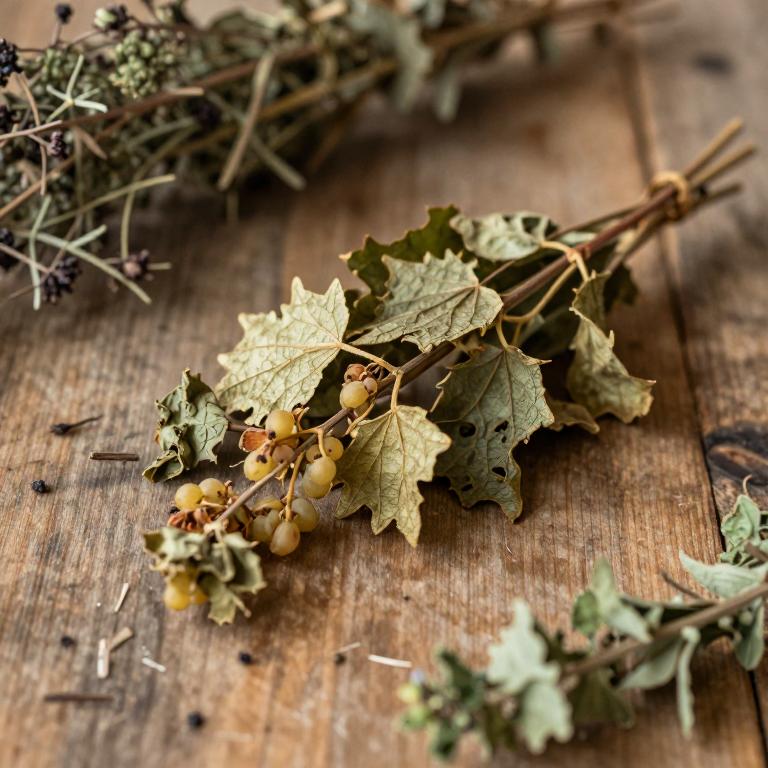
Fox grape, scientifically known as Vitis labrusca, is a native North American woody vine celebrated for its distinct, musky flavor. Beyond its culinary uses, this plant offers medicinal potential through its antioxidant-rich skins and seeds, which are traditionally studied for their anti-inflammatory properties and ability to support cardiovascular health.
Names and Synonyms
Common Names
- fox grape
- northern fox grape
- skunk grape
- Concord grape
Scientific Names
Accepted name
Vitis labruscaSynonyms
- Vitis labrusca f. alba
- Vitis vinifera var. labrusca
- Vitis occidentalis
- Vitis labrusca var. rosea
- Vitis labrusca var. macrophylla
- Vitis ferruginea
- Vitis bracteata
- Vitis catawba
- Vitis rufa
- Vitis canina
- Vitis blanda
- Vitis cana
- Vitis labrusca var. catawba
- Vitis labrusca var. dissecta
- Vitis labrusca var. eisingburgensis
- Vitis luteola
- Vitis labrusca var. subedentata
- Vitis labrusca var. alba
- Vitis taurina
- Vitis labrusca var. labruscoides
- Vitis ciliata
Regional and Traditional Names
Spanish:
- Vitis rugosa
- Vitis obliqua
- Vitis vulgaris
- Vitis palmata
- Vitis vinifera var. labrusca
- Vitis latifolia
- Vitis occidentalis
- Vitis luteola
- Vitis taurina
- Vitis blanda
- Vid americana
- Vitis canina
- Vitis labruscana
- Parra brava
- Vitis labruscoides
- Uva chinche
- labrusca
- parra brava
- parrón
- vid silvestre
German:
- Fuchsrebe
- Fuchs-Rebe
- Erdbeer-Rebe
- Fuchsrebe
- Isabellarebe
- Tessiner Rebe
French:
- vigne américaine
- vigne framboisier
- vigne lambruche
- vigne cotonneuse
- vigne isabelle
- Vigne americaine
Sources: Wikidata, Catalogue of Life
Taxonomical Classification
This plant belongs to the kingdom Plantae and is classified under the phylum Streptophyta and class Equisetopsida. Within the subclass Magnoliidae, it is placed in the order Vitales and the family Vitaceae. Finally, its taxonomic identity is defined by the genus Vitis, specifically the species Vitis labrusca.
| Rank | Classification |
|---|---|
| Kingdom | Plantae |
| Phylum | Streptophyta |
| Class | Equisetopsida |
| Subclass | Magnoliidae |
| Order | Vitales |
| Family | Vitaceae |
| Genus | Vitis |
Sources: The World Checklist of Vascular Plants (WCVP)
Distribution
This plant exhibits a diverse geographical distribution across several regions of the European continent. In Middle Europe, it can be found growing in the territories of Austria, Germany, and Hungary. Its presence also extends into Southwestern Europe, where it inhabits parts of France. Additionally, the species is documented within the island region of Corse. These locations highlight the plant's ability to thrive in both central and southwestern climates.
| Region | Area |
|---|---|
| Middle Europe | Austria |
| Middle Europe | Germany |
| Middle Europe | Hungary |
| Southwestern Europe | Corse |
| Southwestern Europe | France |
| Southwestern Europe | Portugal |
| Southwestern Europe | Sardegna |
| Southwestern Europe | Spain |
| Southeastern Europe | Albania |
| Southeastern Europe | Greece |
Sources: The World Checklist of Vascular Plants (WCVP)
Botanical Identification
Ecology
The ecology of Vitis labrusca is characterized by its preference for forest environments, where it functions as a vigorous woody climber. Within these forest ecosystems, the plant typically colonizes the understory and edges, utilizing its tendrils to ascend trees and shrubs to reach higher light intensities. This climbing habit allows it to compete effectively for solar energy within the complex vertical structure of the woodland. The species thrives in well-drained soils and often occupies moist, temperate habitats where the canopy provides a balance of dappled sunlight and protection from extreme environmental fluctuations. By integrating into the forest strata, Vitis labrusca plays a role in the structural complexity of its habitat, contributing to the availability of resources for various forest fauna.
- Habitat :
- forest
Life history
The life history of Vitis labrusca is characterized by its status as a perennial organism, allowing it to persist through multiple growing seasons and establish long-term presence in its ecosystem. Regarding its structural growth habit, the plant functions as a phanerophyte, utilizing woody stems to elevate its photosynthetic organs above the ground level, which is essential for its climbing and sprawling nature. Additionally, its growth architecture can be classified as a nanophanerophyte, reflecting the specific scale and height at which its persistent woody branches and foliage are maintained throughout its developmental stages.
- Life form :
- nanophanerophyte
- Life form :
- phanerophyte
- Lifecycle :
- perennial
Morphology
The morphology of Vitis labrusca is characterized by a woody structure that develops into a robust liana. As an obligatory climber, it utilizes its climbing mechanisms to ascend various supports rather than remaining self-supporting. While its growth form is categorized as a shrub due to its structural density, it functions primarily as a vine within its ecosystem. The plant is strictly terrestrial in its habitat, showing no aquatic or semiaquatic tendencies, and it maintains an independent biological existence, functioning as a non-parasitic organism without the need for an epiphyte or parasitic relationship.
- Aquatic :
- terrestrial
- Climber :
- liana
- Climber :
- obligatory
- Epiphyte :
- terrestrial
- Growth form :
- shrub
- Parasite :
- independent
- Woodiness :
- woody
Physiology
The physiology of Vitis labrusca is characterized by a C3 photosynthetic pathway, which governs its carbon fixation processes and metabolic efficiency under typical environmental conditions. The leaf morphology plays a critical role in its gas exchange and light interception capabilities, with individual leaves exhibiting significant dimensional variability. Specifically, the leaf length typically ranges from a minimum of 5 cm to a maximum of 20 cm, while the leaf width spans from a minimum of 5 cm to a maximum of 20 cm. These dimensions facilitate the plant's ability to manage transpiration and photosynthetic output relative to its surface area.
- Leaf length max:
- 20 cm
- Leaf length min:
- 5 cm
- Leaf width max:
- 20 cm
- Leaf width min:
- 5 cm
- Photosynthetic pathway :
- C3
Reproduction
The reproduction of Vitis labrusca is characterized by a specific seasonal flowering window and distinct seed morphology. The flowering process typically commences in May and concludes in June, marking the primary reproductive period for the species. Following successful pollination, the plant produces seeds with specific physical dimensions and weights. The seed mass varies, with a minimum recorded value of 0.03009 g, a maximum of 0.054654 g, and a calculated mean mass of approximately 0.047001 g. In terms of physical dimensions, the seeds can reach a maximum length of 6 mm and a maximum width of 5 mm, providing the necessary biological foundation for the next generation of the plant.
- Flowering time :
- May
- Flowering time :
- Jun
- Seed length max:
- 6 mm
- Seed mass max:
- 0.054654 g
- Seed mass mean:
- 0.047001 g
- Seed mass min:
- 0.03009 g
- Seed width max:
- 5 mm
Sources: Global Inventory of Floras and Traits (GIFT)
Chemicals
Vitis labrusca has 1 reported phytochemicals identified across 0 scientific publications and several other databases. The most consistently reported chemicals include Flavonoids.
| Chemical | Supporting sources | Consensus |
|---|---|---|
| Flavonoids | 1 supporting sources | ★☆☆☆☆ |
Flavonoids
- Journal of cardiovascular pharmacology
Activities
Vitis labrusca has 1 reported activities identified across 0 scientific publications and several other databases. The most consistently reported activities include Antioxidant.
| Activity | Supporting sources | Consensus |
|---|---|---|
| Antioxidant | 1 supporting sources | ★☆☆☆☆ |
Antioxidant
- Journal of cardiovascular pharmacology
Conditions
Vitis labrusca has 1 reported investigations on conditions identified across 0 scientific publications and several other databases. The most consistently reported conditions include vasodilation.
| Condition | Supporting sources | Consensus |
|---|---|---|
| Vasodilation | 1 supporting sources | ★☆☆☆☆ |
Vasodilation
- Journal of cardiovascular pharmacology
Preparations
Vitis labrusca has 2 reported preparations identified across 0 scientific publications and several other databases. The most consistently reported preparations include concord grape, crude extracts.
| Preparation | Supporting sources | Consensus |
|---|---|---|
| Concord grape | 1 supporting sources | ★☆☆☆☆ |
| Crude extracts | 1 supporting sources | ★☆☆☆☆ |
Concord grape
- Journal of cardiovascular pharmacology
Crude extracts
- Pharmacological research