Christmas mistletoe
Viscum · Accepted scientific name
Scientific literature: Very Sparse (9 studies) · ★☆☆☆☆
Christmas mistletoe, scientifically known as Viscum, is a fascinating parasitic plant that thrives in the canopy of host trees. Beyond its festive symbolism, it holds significant ethnobotanical value. Traditionally used in various medicinal practices, it is studied for its unique bioactive compounds and potential therapeutic applications in modern pharmacology.
- Family
- Santalaceae
- Native range
- Europe
- Parts used
- Not available
- Common names
- Christmas Mistletoe · Mistletoe
- Scientific synonyms
- Aspidixia · Stelin
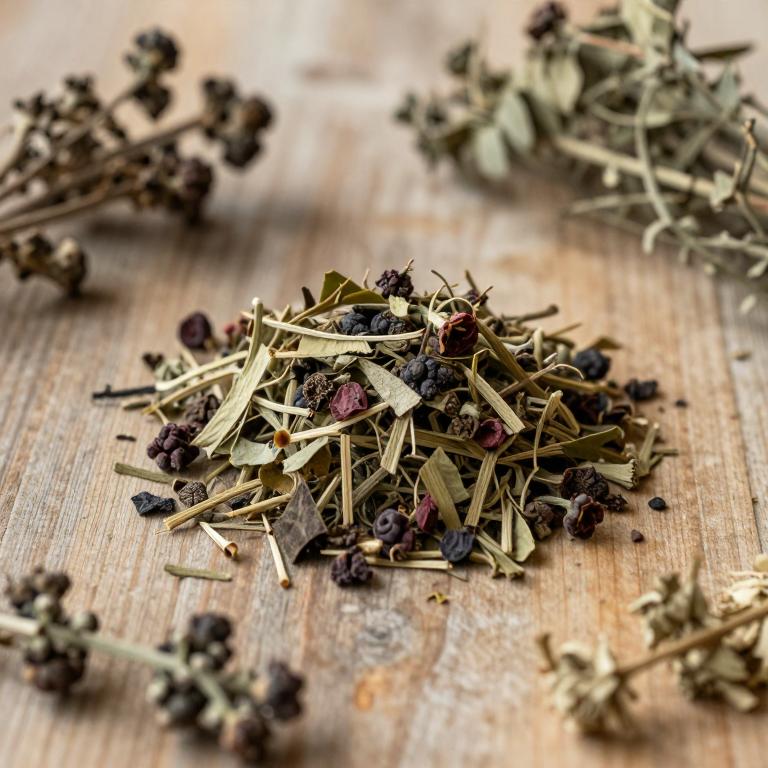
Names and Synonyms
Common Names
- Christmas mistletoe
- mistletoe
Scientific Names
Accepted name
ViscumSynonyms
- Aspidixia
- Stelin
Regional and Traditional Names
Spanish:
- Muérdagos del Viejo Mundo
German:
- Misteln
- Mistelzweig
- Mistel
- Misteln
Sources: Wikidata, Catalogue of Life
Taxonomical Classification
This plant belongs to the kingdom Plantae and the phylum Streptophyta, falling under the class Equisetopsida and subclass Magnoliidae. Within the order Santalales, it is classified under the family Santalaceae. It is specifically identified by the genus Viscum.
| Rank | Classification |
|---|---|
| Kingdom | Plantae |
| Phylum | Streptophyta |
| Class | Equisetopsida |
| Subclass | Magnoliidae |
| Order | Santalales |
| Family | Santalaceae |
| Genus | Viscum |
Sources: The World Checklist of Vascular Plants (WCVP)
Distribution
This plant is widely distributed across several key regions within Northern Europe. In the western parts of the continent, it can be found throughout Great Britain and Ireland. Moving further north, its presence extends into the Scandinavian Peninsula. Specifically, it inhabits the territories of Norway and Sweden. Additionally, the plant is also documented to grow within Denmark.
| Region | Area |
|---|---|
| Northern Europe | Denmark |
| Northern Europe | Great Britain |
| Northern Europe | Ireland |
| Northern Europe | Norway |
| Northern Europe | Sweden |
| Middle Europe | Austria |
| Middle Europe | Belgium |
| Middle Europe | Czechia-Slovakia |
| Middle Europe | Germany |
| Middle Europe | Hungary |
Sources: The World Checklist of Vascular Plants (WCVP)
Chemicals
Viscum has 1 reported phytochemicals identified across 0 scientific publications and several other databases. The most consistently reported chemicals include Terpenes.
| Chemical | Supporting sources | Consensus |
|---|---|---|
| Terpenes | 1 supporting sources | ★☆☆☆☆ |
Terpenes
- Combinatorial chemistry & high throughput screening
Activities
Viscum has 3 reported activities identified across 0 scientific publications and several other databases. The most consistently reported activities include Antimicrobial, Antioxidant, Antiproliferative.
| Activity | Supporting sources | Consensus |
|---|---|---|
| Antimicrobial | 1 supporting sources | ★☆☆☆☆ |
| Antioxidant | 1 supporting sources | ★☆☆☆☆ |
| Antiproliferative | 1 supporting sources | ★☆☆☆☆ |
Antimicrobial
- Combinatorial chemistry & high throughput screening
Antioxidant
- Combinatorial chemistry & high throughput screening
Antiproliferative
- Combinatorial chemistry & high throughput screening
Conditions
Viscum has 3 reported investigations on conditions identified across 0 scientific publications and several other databases. The most consistently reported conditions include cancer, antihypertensive, antioxidant.
| Condition | Supporting sources | Consensus |
|---|---|---|
| Cancer | 2 supporting sources | ★☆☆☆☆ |
| Antihypertensive | 1 supporting sources | ★☆☆☆☆ |
| Antioxidant | 1 supporting sources | ★☆☆☆☆ |
Cancer
- Journal of ethnopharmacology
- Molecules (Basel, Switzerland)
Antihypertensive
- Molecules (Basel, Switzerland)
Antioxidant
- Molecules (Basel, Switzerland)
Preparations
Viscum has 1 reported preparations identified across 0 scientific publications and several other databases. The most consistently reported preparations include Mistletoe extracts.
| Preparation | Supporting sources | Consensus |
|---|---|---|
| Mistletoe extracts | 1 supporting sources | ★☆☆☆☆ |
Mistletoe extracts
- Journal of ethnopharmacology