denseflower mullein
Verbascum densiflorum · Accepted scientific name
Scientific literature: Very Sparse (11 studies) · ★☆☆☆☆
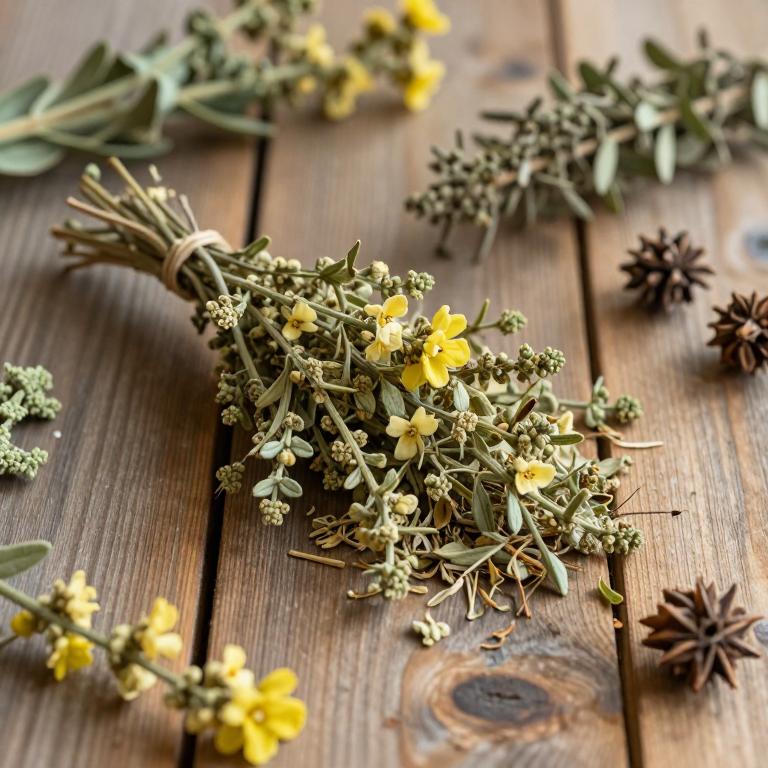
Denseflower mullein, scientifically known as Verbascum densiflorum, is a striking perennial prized for its architectural beauty and medicinal potential. Characterized by its thick, velvety foliage and vibrant flower spikes, this species is often utilized in traditional herbalism to support respiratory health and soothe inflammatory conditions through its bioactive compounds.
Names and Synonyms
Common Names
- denseflower mullein
- Dense-Flowered Mullein
- dense-flower mullein
- mullein
Scientific Names
Accepted name
Verbascum densiflorumSynonyms
- Verbascum thapsiforme var. bicolle
- Verbascum thapsiforme var. laxum
- Verbascum phlomoides var. cuspidatum
- Verbascum phlomoides var. cuspidatum
- Verbascum macrantherum
- Verbascum thapsus var. thapsiforme
- Verbascum thapsiforme var. thapsonigrum
- Verbascum cuspidatum
- Verbascum phlomoides var. thapsiforme
- Verbascum messanense
- Verbascum phlomoides var. gymnostemon
- Verbascum thapsiforme
- Verbascum phlomoides subsp. thapsiforme
- Verbascum velenovskyi
- Verbascum thapsiforme subsp. cuspidatum
- Verbascum floccosum var. gymnostemon
- Verbascum phlomoides subsp. thapsiforme
Regional and Traditional Names
Spanish:
- Verbascum phlomoides var. thapsiforme
- Verbascum phlomoides ssp thapsiforme
- Verbascum stiriacum
- Acebustre
- Verbascum phlomoides var. cuspidatum
- Verbascum phlomoides var cuspidatum
- Verbascum thapsiforme ssp densiflorum
- Verbascum phlomoides var thapsiforme
- Verbascum thapsiforme
- Verbascum phlomoides ssp. thapsiforme
- Verbascum linkianum
- Verbascum cuspidatum
- Verbascum macrantherum
- Verbascum thapsiforme ssp cuspidatum
- Verbascum phlomoides var gymnostemon
- Verbascum velenovskii
German:
- Großblütige Königskerze
- Dichtblütige Königskerze
- faux bouillon blanc
- Großblütige Königskerze
- Grossbluetige Koenigskerze
- Grossbluetiges Wollkraut
French:
- Molène à fleurs denses
- Molene a fleurs denses
- Molène faux bouillon blanc
- Faux bouillon-blanc
- Molène faux Bouillon-blanc
- Verbascum thapsiforme
- Faux bouillon blanc
- Molene a fleurs denses
- bonhomme
- Molène faux bouillon-blanc
- Molène à fleurs denses
Sources: Wikidata, Catalogue of Life
Taxonomical Classification
This plant, known scientifically as Verbascum densiflorum, belongs to the kingdom Plantae and the phylum Streptophyta. Within the class Equisetopsida and subclass Magnoliidae, it is classified under the order Lamiales and the family Scrophulariaceae. Finally, its taxonomic identity is completed by its placement within the genus Verbascum.
| Rank | Classification |
|---|---|
| Kingdom | Plantae |
| Phylum | Streptophyta |
| Class | Equisetopsida |
| Subclass | Magnoliidae |
| Order | Lamiales |
| Family | Scrophulariaceae |
| Genus | Verbascum |
Sources: The World Checklist of Vascular Plants (WCVP)
Distribution
This plant exhibits a diverse geographical range spanning several regions across the European continent. In Northern Europe, its presence is noted in the coastal and inland areas of Denmark and Great Britain. It can also be found growing within the natural landscapes of Ireland and Sweden. Moving toward Middle Europe, the species extends its reach into the mountainous terrains of Austria. Together, these locations define the specific environmental zones where the species thrives.
| Region | Area |
|---|---|
| Northern Europe | Denmark |
| Northern Europe | Great Britain |
| Northern Europe | Ireland |
| Northern Europe | Sweden |
| Middle Europe | Austria |
| Middle Europe | Belgium |
| Middle Europe | Czechia-Slovakia |
| Middle Europe | Germany |
| Middle Europe | Netherlands |
| Middle Europe | Poland |
Sources: The World Checklist of Vascular Plants (WCVP)
Botanical Identification
Ecology
The ecology of Verbascum densiflorum is characterized by its preference for transitional and open environments, specifically thriving within forest edges and meadows. This species occupies a relatively low-altitude ecological niche, maintaining an elevational range that begins at 0 m AMSL and extends up to a maximum of 500 m AMSL. By inhabiting these ecotones, the plant benefits from the specific light availability and soil conditions found at the intersection of woodland and grassland ecosystems.
- Elevational range max:
- 500 m AMSL
- Elevational range min:
- 0 m AMSL
- Habitat :
- forest edges, meadows
Life history
The life history of Verbascum densiflorum is characterized by a biennial lifecycle, meaning it typically completes its biological development over a period of two years. As a hemicryptophyte, its perennating buds are located at or just below the soil surface, protected by the leaf litter or ground cover during unfavorable periods. The plant maintains an evergreen deciduousness, retaining its vegetative structures to facilitate survival across seasonal transitions.
- Deciduousness :
- evergreen
- Life form :
- hemicryptophyte
- Lifecycle :
- biennial
Morphology
The morphology of Verbascum densiflorum is characterized by its growth form as a non-woody herb and forb. It is a terrestrial, self-supporting plant that does not function as a climber, liana, or vine, nor does it exhibit epiphytic or parasitic behaviors, growing instead as an independent organism. In terms of stature, the plant exhibits significant variation in height, with measurements ranging from a minimum of 0.2 m to a maximum of 1.8 m, maintaining a mean plant height of approximately 1.103 m.
- Aquatic :
- terrestrial
- Climber :
- self-supporting
- Epiphyte :
- terrestrial
- Growth form :
- herb
- Growth form :
- forb
- Parasite :
- independent
- Plant height max:
- 1.8 m
- Plant height mean:
- 1.103 m
- Plant height min:
- 0.2 m
- Woodiness :
- non-woody
Physiology
The physiology of Verbascum densiflorum is characterized by a C3 photosynthetic pathway, a standard carbon fixation mechanism for most temperate herbaceous species. The plant exhibits a non-carnivorous nutritional strategy, relying entirely on autotrophic processes for organic matter production rather than the capture of prey. Morphologically, its foliage is defined by a mean leaf size of 152.87292 cm², which contributes to its overall surface area for light interception. This leaf structure is further quantified by a mean Specific Leaf Area (SLA) of 171.42 cm²/g, indicating the relationship between the leaf's biomass and its surface area, which reflects its resource allocation and efficiency in light capture and gas exchange.
- Carnivory :
- non-carnivorous
- Leaf size mean:
- 152.87292 cm²
- Photosynthetic pathway :
- C3
- Specific Leaf Area (SLA) mean:
- 171.42 cm²/g
Reproduction
The reproduction of Verbascum densiflorum is characterized by a monoCarpic life cycle, meaning the plant typically flowers once before dying. The flowering period is concentrated in the warmer months, beginning in July and extending through October. During this time, the plant utilizes biotic pollination syndromes, specifically relying on insects to facilitate the transfer of pollen. The reproductive process is capable of self-fertilization, ensuring seed set even in the absence of diverse pollinators. Following successful fertilization, the plant produces fruit in the form of a dehiscent capsule. The seeds produced within these capsules are quite small, with a minimum mass of 0.0001 g, a maximum mass of 0.0012 g, and a mean seed mass of approximately 0.000466 g. Once the capsule reaches maturity, it undergoes dehiscence to release the seeds, which are dispersed via an anemochorous syndrome, utilizing wind to distribute them across the environment. Notably, asexual reproduction is absent in this species, making sexual reproduction through seed production the primary means of propagation.
- Dehiscence :
- dehiscent
- Dispersal syndrome :
- anemochorous
- Flowering time :
- Jul
- Flowering time :
- Oct
- Fruit type :
- capsule
- Monocarpy :
- monocarp
- Pollination syndrome :
- insect
- Pollination syndrome :
- biotic
- Reproduction asexual :
- absent
- Seed mass max:
- 0.0012 g
- Seed mass mean:
- 0.000466333333333333 g
- Seed mass min:
- 1e-04 g
- Self fertilization :
- present
Sources: Global Inventory of Floras and Traits (GIFT)
Plant Parts
Verbascum densiflorum has 1 reported plant parts identified across 1 scientific publications and several other databases that are studied for medicinal purposes. The most consistently reported plant part include flower.
| Plant part | Supporting sources | Consensus |
|---|---|---|
| Flower | 1 supporting sources | ★☆☆☆☆ |
Flower
- Phytochemical analysis : PCA
Chemicals
Verbascum densiflorum has 5 reported phytochemicals identified across 1 scientific publications and several other databases. The most consistently reported chemicals include Flavonoids, Saponins, Iridoids, Luteolin-7-glucoside, Verbascoside.
| Chemical | Supporting sources | Consensus |
|---|---|---|
| Flavonoids | 2 supporting sources | ★☆☆☆☆ |
| Saponins | 2 supporting sources | ★☆☆☆☆ |
| Iridoids | 1 supporting sources | ★☆☆☆☆ |
| Luteolin-7-glucoside | 1 supporting sources | ★☆☆☆☆ |
| Verbascoside | 1 supporting sources | ★☆☆☆☆ |
Flavonoids
- Polish journal of pharmacology and pharmacy
- Archivum immunologiae et therapiae experimentalis
Saponins
- Polish journal of pharmacology and pharmacy
- Archivum immunologiae et therapiae experimentalis
Iridoids
- Archivum immunologiae et therapiae experimentalis
Luteolin-7-glucoside
- Phytochemical analysis : PCA
Verbascoside
- Phytochemical analysis : PCA
Conditions
Verbascum densiflorum has 3 reported investigations on conditions identified across 1 scientific publications and several other databases. The most consistently reported conditions include asthma, inflammation, respiratory tract diseases.
| Condition | Supporting sources | Consensus |
|---|---|---|
| Asthma | 1 supporting sources | ★☆☆☆☆ |
| Inflammation | 1 supporting sources | ★☆☆☆☆ |
| Respiratory tract diseases | 1 supporting sources | ★☆☆☆☆ |
Asthma
- Phytochemical analysis : PCA
Inflammation
- Phytochemical analysis : PCA
Respiratory tract diseases
- Phytochemical analysis : PCA