Cretan Mullein
Verbascum creticum · Accepted scientific name
Scientific literature: Very Sparse (3 studies) · ★☆☆☆☆
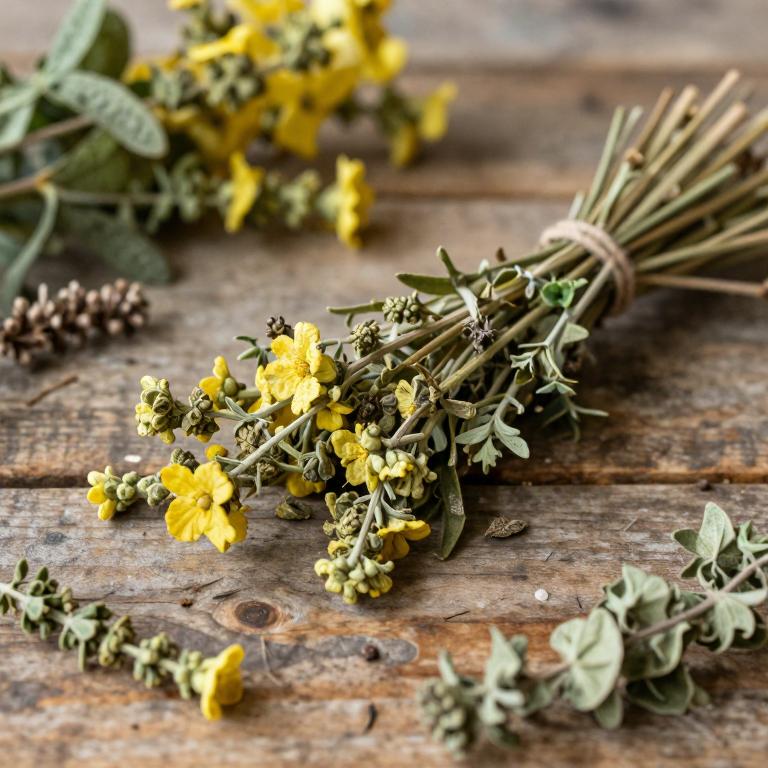
Cretan Mullein, scientifically known as Verbascum creticum, is a resilient perennial herb native to the Mediterranean landscape. Renowned for its velvety foliage and striking yellow blossoms, this plant holds significant ethnobotanical value. It is traditionally utilized in herbal medicine to support respiratory health and soothe various inflammatory conditions.
- Family
- Scrophulariaceae
- Native range
- Europe
- Parts used
- Not available
- Common names
- Cretan Mullein
- Scientific synonyms
- Ditoxia Cretica · Thapsandra Cretica · 7 more
Names and Synonyms
Common Names
- Cretan Mullein
Scientific Names
Accepted name
Verbascum creticumSynonyms
- Ditoxia cretica
- Thapsandra cretica
- Celsia cretica f. pallescens
- Celsia cretica
- Lasiake lyratum
- Celsia australis
- Celsia cretica subsp. balearica
- Celsia lyrata
- Ditoxia lyrata
Sources: Wikidata, Catalogue of Life
Taxonomical Classification
This plant, known as Verbascum creticum, belongs to the kingdom Plantae and the phylum Streptophyta. Within the class Equisetopsida and subclass Magnoliidae, it is classified under the order Lamiales and the family Scrophulariaceae. Finally, it is placed within the genus Verbascum.
| Rank | Classification |
|---|---|
| Kingdom | Plantae |
| Phylum | Streptophyta |
| Class | Equisetopsida |
| Subclass | Magnoliidae |
| Order | Lamiales |
| Family | Scrophulariaceae |
| Genus | Verbascum |
Sources: The World Checklist of Vascular Plants (WCVP)
Distribution
This plant exhibits a specific geographical range that spans across several distinct regions of Europe. In Northern Europe, its presence can be noted in Great Britain. Moving toward Southwestern Europe, it is distributed across the Baleares and Corse. Furthermore, the species is found within the borders of France. Finally, its range extends to the island of Sardegna in the Mediterranean.
| Region | Area |
|---|---|
| Northern Europe | Great Britain |
| Southwestern Europe | Baleares |
| Southwestern Europe | Corse |
| Southwestern Europe | France |
| Southwestern Europe | Sardegna |
| Southwestern Europe | Spain |
| Southeastern Europe | Italy |
| Southeastern Europe | Sicilia |
| Northern Africa | Algeria |
| Northern Africa | Morocco |
Sources: The World Checklist of Vascular Plants (WCVP)
Botanical Identification
Ecology
The ecology of Verbascum creticum is characterized by its preference for lowland environments, where it occupies specific niches within low-altitude landscapes. This species is primarily found at elevations starting from 0 m AMSL, extending up to a maximum elevational range of 300 m AMSL. Its distribution is closely tied to these lower-lying habitats, defining its ecological footprint within its native range.
- Elevational range max:
- 300 m AMSL
- Elevational range min:
- 0 m AMSL
- Habitat :
- Lowland
Life history
The life history of Verbascum creticum is characterized by a biennial lifecycle, typically completing its development over a two-year period. It exhibits a dual life form classification depending on its developmental stage and environmental adaptation, functioning as both a hemicryptophyte and a therophyte. As a hemicryptophyte, its perennating buds are located at the soil surface, protected by leaf litter or soil, while its therophyte nature reflects its ability to survive as an annual through seed production. Additionally, the plant is deciduous, shedding its foliage as part of its seasonal biological cycle.
- Deciduousness :
- deciduous
- Life form :
- hemicryptophyte
- Life form :
- therophyte
- Lifecycle :
- biennial
Morphology
The morphology of Verbascum creticum is characterized by its growth form as a non-woody herb that functions as a self-supporting, independent organism rather than a parasite or climber. As a terrestrial plant, it exhibits a variable stature, with heights ranging from a minimum of 0.4 m to a maximum of 2 m, maintaining an average plant height of approximately 0.7 m.
- Aquatic :
- terrestrial
- Climber :
- self-supporting
- Growth form :
- herb
- Parasite :
- independent
- Plant height max:
- 2 m
- Plant height mean:
- 0.7 m
- Plant height min:
- 0.4 m
- Woodiness :
- non-woody
Physiology
The physiological structure of Verbascum creticum is characterized by a diverse leaf morphology and specific nutritional dependencies. The plant exhibits a complex leaf arrangement that can manifest as alternate, opposite, whorled, or in a basal rosette configuration. The foliage is primarily elliptic in form, with leaf lengths varying significantly between a minimum of 9 cm and a maximum of 20 cm. In terms of lateral expansion, the leaf width fluctuates between a minimum of 3 cm and a maximum of 8 cm, maintaining a mean width of approximately 6.5 cm. Regarding its metabolic processes and soil interactions, the plant does not function as a nitrogen fixer, meaning it relies on the availability of soil nitrates and ammonium rather than symbiotic nitrogen-fixing bacteria to meet its nitrogen requirements.
- Leaf arrangement :
- alternate
- Leaf form :
- elliptic
- Leaf length max:
- 20 cm
- Leaf length min:
- 9 cm
- Leaf width max:
- 8 cm
- Leaf width mean:
- 6.5 cm
- Leaf width min:
- 3 cm
- Nitrogen fixer :
- no
Reproduction
The reproduction of Verbascum creticum is characterized by a sexual process involving bisexual flowers, with asexual reproduction being entirely absent. The flowering period typically commences in April and concludes in May. These flowers are distinguished by a red color and possess a width ranging from 4 to 5 cm. The pollination mechanism is biotic, specifically following an insect pollination syndrome, and the plant does not exhibit self-fertilization. Following successful pollination, the plant produces fruits with a mean length and width of 0.9 cm. Each fruit is highly prolific, containing more than 1000 seeds, with an average seed mass of 9e-05 g. The dispersal of these seeds follows an anemochorous syndrome, relying on wind for distribution.
- Dispersal syndrome :
- anemochorous
- Flower colour :
- red
- Flower width max:
- 5 cm
- Flower width min:
- 4 cm
- Flowering time :
- Apr
- Flowering time :
- May
- Fruit length mean:
- 0.9 cm
- Fruit width mean:
- 0.9 cm
- Pollination syndrome :
- insect
- Pollination syndrome :
- biotic
- Reproduction asexual :
- absent
- Reproduction sexual :
- bisexual
- Seed mass mean:
- 9e-05 g
- Seeds_per_fruit :
- >1000
- Self fertilization :
- absent
Sources: Global Inventory of Floras and Traits (GIFT)
Chemicals
Verbascum creticum has 3 reported phytochemicals identified across 0 scientific publications and several other databases. The most consistently reported chemicals include 1-OCTEN-3-OL, Phenylethanal, cis-3-Hexen-1-ol.
| Chemical | Supporting sources | Consensus |
|---|---|---|
| 1-OCTEN-3-OL | 1 supporting sources | ★☆☆☆☆ |
| Phenylethanal | 1 supporting sources | ★☆☆☆☆ |
| cis-3-Hexen-1-ol | 1 supporting sources | ★☆☆☆☆ |
1-OCTEN-3-OL
- Natural product research
Phenylethanal
- Natural product research
cis-3-Hexen-1-ol
- Natural product research