Lowveld Honeysuckle Tree
Turraea nilotica · Accepted scientific name
Scientific literature: Very Sparse (6 studies) · ★☆☆☆☆
Lowveld Honeysuckle Tree, scientifically known as Turraea nilotica, is a versatile medicinal plant native to African savannas. Renowned for its therapeutic properties, various parts of the tree—including the bark, roots, and leaves—are utilized in traditional medicine to treat ailments ranging from skin infections to digestive issues and inflammation.
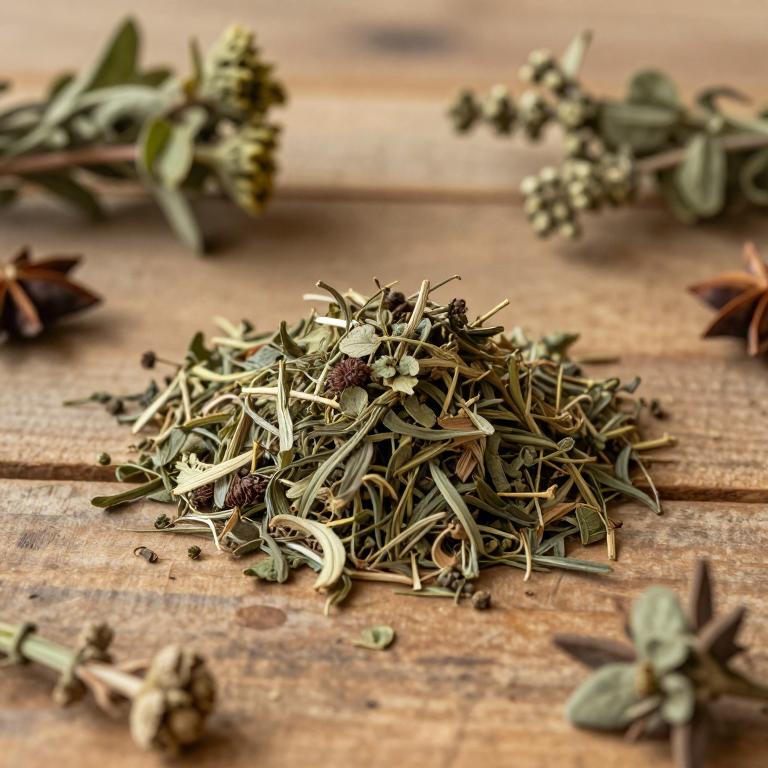
Names and Synonyms
Common Names
- Common Turraea
- Miombo Honeysuckle-Tree
- Small Mahogany
- Turraea
- lowveld honeysuckle-tree
Scientific Names
Accepted name
Turraea niloticaSynonyms
- Turraea tubulifera
- Turraea nilotica var. glabrata
- Turraea randii
Sources: Wikidata, Catalogue of Life
Taxonomical Classification
This plant belongs to the kingdom Plantae and the phylum Streptophyta, falling under the class Equisetopsida and subclass Magnoliidae. Within the order Sapindales, it is classified under the family Meliaceae. Finally, its specific taxonomic identity is established within the genus Turraea.
| Rank | Classification |
|---|---|
| Kingdom | Plantae |
| Phylum | Streptophyta |
| Class | Equisetopsida |
| Subclass | Magnoliidae |
| Order | Sapindales |
| Family | Meliaceae |
| Genus | Turraea |
Sources: The World Checklist of Vascular Plants (WCVP)
Distribution
This plant exhibits a broad geographical range across several regions of the African continent. In West-Central Tropical Africa, its presence is noted within the borders of Burundi. Its distribution extends into Northeast Tropical Africa, where it can be found in Ethiopia, Somalia, and the territories of Sudan and South Sudan. Additionally, the species is documented in East Tropical Africa, specifically within Kenya. These diverse locations highlight the plant's ability to thrive across various tropical African landscapes.
| Region | Area |
|---|---|
| West-Central Tropical Africa | Burundi |
| Northeast Tropical Africa | Ethiopia |
| Northeast Tropical Africa | Somalia |
| Northeast Tropical Africa | Sudan-South Sudan |
| East Tropical Africa | Kenya |
| East Tropical Africa | Tanzania |
| South Tropical Africa | Malawi |
| South Tropical Africa | Mozambique |
| South Tropical Africa | Zambia |
| South Tropical Africa | Zimbabwe |
Sources: The World Checklist of Vascular Plants (WCVP)
Botanical Identification
Ecology
The ecology of Turraea nilotica is characterized by its preference for specific landscape formations, primarily thriving within coastal (Acacia) bushland, though it is also found rarely in dry forest environments. This species occupies a distinct altitudinal niche, distributed across an elevational range that extends from a minimum of 425 m AMSL to a maximum of 1065 m AMSL.
- Elevational range max:
- 1065 m AMSL
- Elevational range min:
- 425 m AMSL
- Habitat :
- coastal (Acacia) bushland; rarely in dry forest
Life history
The life history of Turraea nilotica is characterized by its status as a perennial species, allowing it to maintain a long-term presence within its natural ecosystem. As a perennial plant, it does not follow the rapid cycle of annuals or the intermediate stage of biennials; instead, it establishes a robust, woody structure that enables it to survive through multiple growing seasons. This longevity is supported by its ability to endure varying environmental conditions over many years, contributing to its stability in the landscapes it inhabits. Over its extended lifespan, the plant undergoes various stages of vegetative growth and reproductive cycles, ensuring its continued existence and contribution to the local flora.
- Lifecycle :
- perennial
Morphology
The morphology of Turraea nilotica is characterized by its growth form as a woody tree. It is a self-supporting, independent species that does not function as a climber, parasite, or epiphyte, maintaining a strictly terrestrial existence. The plant's stature varies significantly depending on environmental conditions, with a minimum height of 1.5 m, a maximum height of 6 m, and a mean plant height of approximately 10 m.
- Aquatic :
- terrestrial
- Climber :
- self-supporting
- Epiphyte :
- terrestrial
- Growth form :
- tree
- Parasite :
- independent
- Plant height max:
- 6 m
- Plant height mean:
- 10 m
- Plant height min:
- 1.5 m
- Woodiness :
- woody
Reproduction
Reproduction in Turraeaf nilotica is characterized by the production of seeds that exhibit highly consistent physical properties within the observed parameters. The seeds are remarkably uniform in size, with a recorded seed mass mean of 0.0151 g. This consistency is further evidenced by the fact that the seed mass maximum and minimum values both align at 0.0151 g, indicating a complete lack of variance in mass among the sampled seeds. Such precise uniformity in seed mass suggests a highly standardized reproductive output for the species.
- Seed mass mean:
- 0.0151 g
Sources: Global Inventory of Floras and Traits (GIFT)
Chemicals
Turraea nilotica has 3 reported phytochemicals identified across 0 scientific publications and several other databases. The most consistently reported chemicals include 11-epi-Toonacilin, Azadironolide, triterpenoids.
| Chemical | Supporting sources | Consensus |
|---|---|---|
| 11-epi-Toonacilin | 1 supporting sources | ★☆☆☆☆ |
| Azadironolide | 1 supporting sources | ★☆☆☆☆ |
| triterpenoids | 1 supporting sources | ★☆☆☆☆ |
11-epi-Toonacilin
- Journal of ethnopharmacology
Azadironolide
- Journal of ethnopharmacology
triterpenoids
- Journal of ethnopharmacology
Activities
Turraea nilotica has 2 reported activities identified across 0 scientific publications and several other databases. The most consistently reported activities include Antiplasmodial, Cytotoxic.
| Activity | Supporting sources | Consensus |
|---|---|---|
| Antiplasmodial | 1 supporting sources | ★☆☆☆☆ |
| Cytotoxic | 1 supporting sources | ★☆☆☆☆ |
Antiplasmodial
- Journal of ethnopharmacology
Cytotoxic
- Journal of ethnopharmacology
Conditions
Turraea nilotica has 1 reported investigations on conditions identified across 0 scientific publications and several other databases. The most consistently reported conditions include malaria.
| Condition | Supporting sources | Consensus |
|---|---|---|
| Malaria | 1 supporting sources | ★☆☆☆☆ |
Malaria
- Journal of ethnopharmacology