small ballmoss
Tillandsia recurvata · Accepted scientific name
Scientific literature: Very Sparse (4 studies) · ★☆☆☆☆
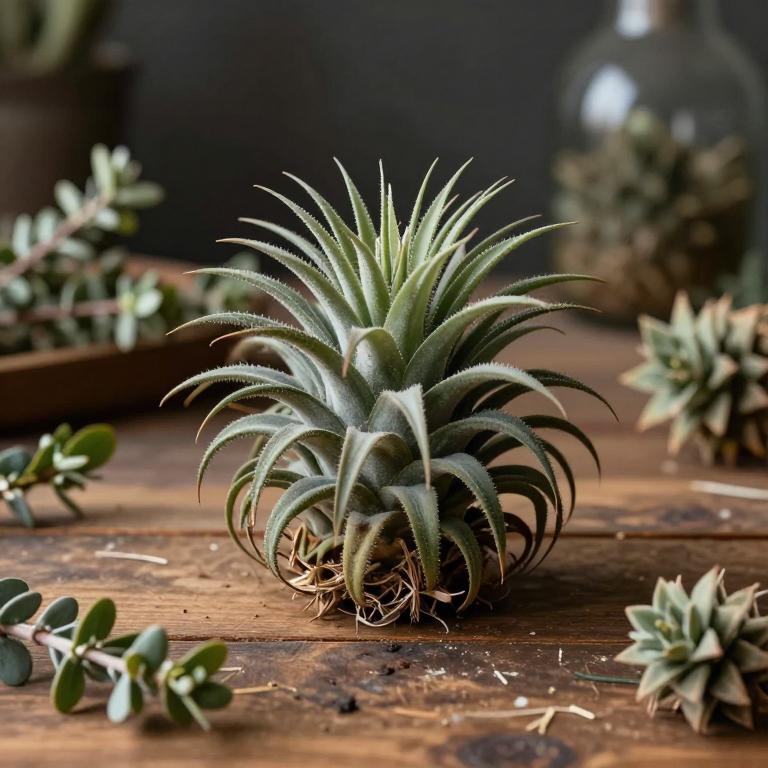
Small ballmoss, scientifically known as Tillandsia recurvata, is a unique, resilient air plant found throughout the Americas. Belonging to the Bromeliaceae family, it thrives without soil, drawing moisture and nutrients from the air. This fascinating epiphyte is valued for its compact, spherical form and its specialized ecological role.
Names and Synonyms
Common Names
- Ballmoss
- Old Man's Beard
- ball-moss
- bunch-moss
- small ballmoss
Scientific Names
Accepted name
Tillandsia recurvataSynonyms
- Diaphoranthema uniflora
- Diaphoranthema recurvata
- Tillandsia recurvata f. argentea
- Tillandsia recurvata f. brevifolia
- Tillandsia recurvata f. caespitosa
- Tillandsia recurvata var. ciliata
- Tillandsia recurvata var. contorta
- Tillandsia recurvata f. contorta
- Tillandsia recurvata f. elongata
- Tillandsia recurvata f. major
- Tillandsia recurvata f. minor
- Tillandsia recurvata f. minuta
- Tillandsia recurvata var. minuta
- Tillandsia pauciflora
- Tillandsia monostachya
- Tillandsia uniflora
- Renealmia recurvata
Regional and Traditional Names
Spanish:
- Tillandsia uniflora
- Tillandsia recurvata forma caespitosa
- Tillandsia recurvata forma elongata
- Tillandsia recurvata var. contorta
- Diaphoranthema uniflora
- Tillandsia recurvata var minuta
- Tillandsia pauciflora
- Tillandsia monostachya
- Tillandsia recurvata forma brevifolia
- Tillandsia recurvata forma minuta
- Tillandsia recurvata forma major
- Renealmia recurvata
- Tillandsia recurvata var genuina
- Diaphoranthema recurvata
- Tillandsia recurvata var. minuta
- Tillandsia recurvata var. genuina
- Clavel del aire
- Gallinitas
- Golondrina
- Nidos de gungulén
- Paixtle
- heno motita
Sources: Wikidata, Catalogue of Life
Taxonomical Classification
This plant belongs to the kingdom Plantae and the phylum Streptophyta, falling under the class Equisetopsida and subclass Magnoliidae. Within the order Poales, it is classified under the family Bromeliaceae. Ultimately, it is identified by the genus Tillandsia and the specific species Tillandsia recurvata.
| Rank | Classification |
|---|---|
| Kingdom | Plantae |
| Phylum | Streptophyta |
| Class | Equisetopsida |
| Subclass | Magnoliidae |
| Order | Poales |
| Family | Bromeliaceae |
| Genus | Tillandsia |
Sources: The World Checklist of Vascular Plants (WCVP)
Distribution
This plant exhibits a broad geographical distribution across several regions of the United States. In the Southwestern U.S.A., it can be found growing in the state of Arizona. Its presence extends into the South-Central U.S.A., where it inhabits both New Mexico and Texas. Moving toward the Southeastern U.S.A., the species is also located in Florida. Finally, its range reaches further north into the state of Georgia.
| Region | Area |
|---|---|
| Southwestern U.S.A. | Arizona |
| South-Central U.S.A. | New Mexico |
| South-Central U.S.A. | Texas |
| Southeastern U.S.A. | Florida |
| Southeastern U.S.A. | Georgia |
| Southeastern U.S.A. | Louisiana |
| Mexico | Mexico Central |
| Mexico | Mexico Northeast |
| Mexico | Mexico Gulf |
| Mexico | Mexico Northwest |
Sources: The World Checklist of Vascular Plants (WCVP)
Botanical Identification
Ecology
The ecology of Tillandsia recurvata is characterized by a vast adaptability to diverse environmental conditions and a wide altitudinal distribution. This species thrives across a significant elevational gradient, ranging from sea level (0 m AMSL) up to high-altitude environments reaching 3000 m AMSL. Its habitat preferences are remarkably broad, allowing it to colonize various ecosystems including anthropogenic areas (Área Antrópica), the semi-arid Caatinga (strictu sensu), and the specialized rocky outcrops of Campo Rupestre. Furthermore, it is commonly found within the Cerrado (latu sensu) and various forest types, such as Atlantic Forest (Floresta Ciliar ou Galeria), Deciduous Seasonal Forests (Floresta Estacional Decidual), and Semi-deciduous Seasonal Forests (Floresta Estacional Semi-decidual), demonstrating a high degree of ecological plasticity across different Brazilian biomes.
- Elevational range max:
- 3000 m AMSL
- Elevational range min:
- 0 m AMSL
- Habitat :
- Área Antrópica, Caatinga (stricto sensu), Campo Rupestre, Cerrado (lato sensu), Floresta Ciliar ou Galeria, Floresta Estacional Decidual, Floresta Estacional Semidecidual
Life history
The life history of Tillandsia recurvata is characterized by its status as a perennial organism, allowing it to persist in its environment across multiple growing seasons. As an atmospheric epiphyte, its life cycle is deeply integrated with its ability to derive moisture and nutrients from the air rather than soil, a strategy that supports its long-term survival. The plant typically begins its life from a seed dispersed by wind, which settles onto a host substrate, such as a tree branch or shrub. Once established, it undergoes a period of vegetative growth, forming dense, recurved clusters that can expand over several years. Throughout its perennial lifespan, the plant undergoes cycles of sexual reproduction, producing small, delicate flowers that facilitate genetic diversity through pollination. Following fertilization, it produces seeds that are released to continue the cycle, while the parent plant remains anchored and continues to thrive, often forming large mats that serve as micro-habitats for other organisms.
- Lifecycle :
- perennial
Morphology
The morphology of Tillandsia recurvata is characterized by its distinct growth form as a non-woody herb and a forb, exhibiting a compact and specialized structure. It functions as an obligatory holoepiphyte, meaning it relies on other plants or structures for physical support while remaining an independent organism rather than a parasite. Unlike climbing vines or lianas, this species is entirely self-supporting in its habit and does not function as a climber. Although it is often found in various environments, its primary ecological classification is terrestrial in nature rather than aquatic or semiaquatic. The plant's physical constitution is entirely non-woody, facilitating its specialized lifestyle within its ecological niche.
- Aquatic :
- terrestrial
- Climber :
- self-supporting
- Epiphyte :
- holoepiphyte
- Epiphyte :
- obligatory
- Growth form :
- herb
- Growth form :
- forb
- Parasite :
- independent
- Woodiness :
- non-woody
Physiology
The physiology of Tillandsia recurvata is characterized by specialized adaptations for survival in xeric and epiphytic environments, most notably through its use of the CAM (Crassulacean Acid Metabolism) photosynthetic pathway. By utilizing this CAM pathway, the plant can decouple carbon fixation from light-dependent reactions, allowing it to open its stomata primarily at night to absorb carbon dioxide while minimizing transpirational water loss during the heat of the day. This metabolic strategy is closely integrated with its morphological features, specifically the presence of dense, specialized multicellular trichomes on the leaf surface. These trichomes serve a dual physiological role: they act as highly efficient mechanisms for atmospheric moisture and nutrient absorption from fog or dew, and they provide a reflective barrier that reduces solar radiation absorption and evaporative demand. This combination of nocturnal carbon sequestration and specialized foliar absorption allows the plant to maintain water-use efficiency and physiological stability in habitats with limited access to soil moisture.
- Photosynthetic pathway :
- CAM
Reproduction
The reproduction of Tillandsia recurvata is characterized by a highly specialized seed production and dispersal mechanism. The plant produces minute seeds that exhibit a specific range of mass, with a minimum weight of 0.00016 g and a maximum weight of 0.00045 g, resulting in a calculated mean seed mass of 0.000305 g. In terms of its dispersal syndrome, the species is classified as anemochorous, relying on wind currents to transport its lightweight seeds to new habitats, a strategy that facilitates its colonization of various substrates.
- Dispersal syndrome :
- anemochorous
- Seed mass max:
- 0.00045 g
- Seed mass mean:
- 0.000305 g
- Seed mass min:
- 0.00016 g
Sources: Global Inventory of Floras and Traits (GIFT)
Chemicals
Tillandsia recurvata has 1 reported phytochemicals identified across 0 scientific publications and several other databases. The most consistently reported chemicals include Cycloartane-3,24,25-triol.
| Chemical | Supporting sources | Consensus |
|---|---|---|
| Cycloartane-3,24,25-triol | 1 supporting sources | ★☆☆☆☆ |
Cycloartane-3,24,25-triol
- Cancer cell international
Conditions
Tillandsia recurvata has 3 reported investigations on conditions identified across 0 scientific publications and several other databases. The most consistently reported conditions include cancers, leukemia, prostate cancer.
| Condition | Supporting sources | Consensus |
|---|---|---|
| Cancers | 1 supporting sources | ★☆☆☆☆ |
| Leukemia | 1 supporting sources | ★☆☆☆☆ |
| Prostate cancer | 1 supporting sources | ★☆☆☆☆ |
Cancers
- Anticancer research
Leukemia
- Anticancer research
Prostate cancer
- Cancer cell international
Preparations
Tillandsia recurvata has 2 reported preparations identified across 0 scientific publications and several other databases. The most consistently reported preparations include crude methanolic extract, cycloartane-3,24,25-diol.
| Preparation | Supporting sources | Consensus |
|---|---|---|
| Crude methanolic extract | 1 supporting sources | ★☆☆☆☆ |
| Cycloartane-3,24,25-diol | 1 supporting sources | ★☆☆☆☆ |
Crude methanolic extract
- Anticancer research
Cycloartane-3,24,25-diol
- Cancer cell international