Giant Airplant
Tillandsia fasciculata · Accepted scientific name
Scientific literature: Very Sparse (5 studies) · ★☆☆☆☆
Giant Airplant, scientifically known as Tillandsia fasciata, is a striking epiphytic species celebrated for its dramatic rosette form. Native to tropical regions, this resilient plant thrives without soil, absorbing moisture through specialized trichomes. Beyond its ornamental beauty, it holds significant ecological value and potential medicinal interest in traditional herbal practices.
- Family
- Bromeliaceae
- Native range
- Northern America
- Parts used
- Leaf
- Common names
- Giant Airplant · Cardinal Air Plant · 2 more
- Scientific synonyms
- Not available
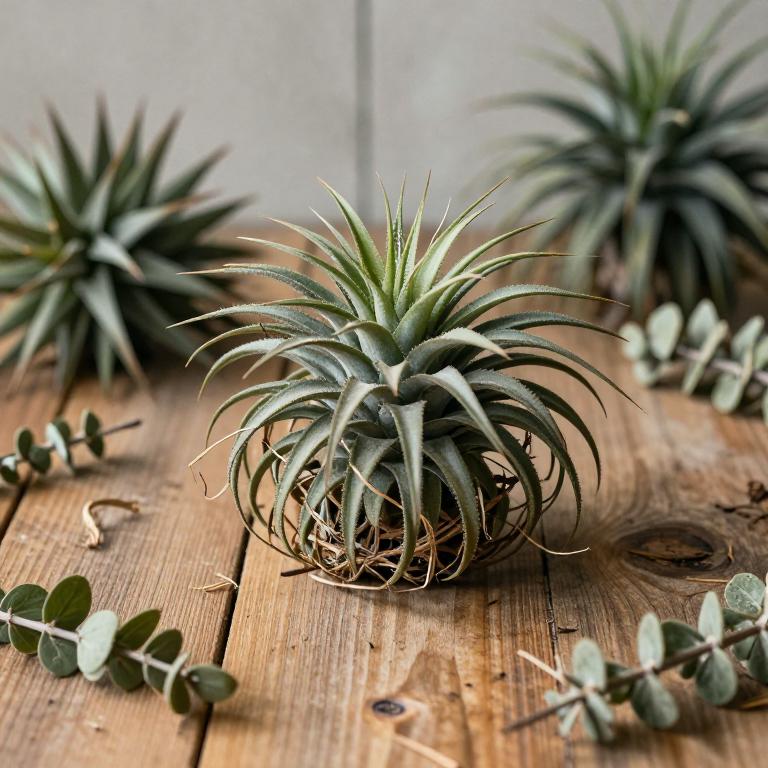
Names and Synonyms
Common Names
- Giant Airplant
- Cardinal Air Plant
- Common Wild Pine
- Stiff-Leaved Wild Pine
Scientific Names
Accepted name
Tillandsia fasciculataRegional and Traditional Names
Spanish:
- Gallito
- guiche
Sources: Wikidata, Catalogue of Life
Taxonomical Classification
This plant belongs to the kingdom Plantae and the phylum Streptophyta, falling under the class Equisetopsida and subclass Magnoliidae. Within the order Poales, it is classified under the family Bromeliaceae. Finally, it is identified by its specific genus, Tillandsia.
| Rank | Classification |
|---|---|
| Kingdom | Plantae |
| Phylum | Streptophyta |
| Class | Equisetopsida |
| Subclass | Magnoliidae |
| Order | Poales |
| Family | Bromeliaceae |
| Genus | Tillandsia |
Sources: The World Checklist of Vascular Plants (WCVP)
Distribution
This plant is primarily distributed across the Southeastern United States, with a significant presence in Florida. Its range extends deep into Mexico, where it can be found throughout the central regions. Furthermore, it inhabits the northeastern parts of Mexico, contributing to its diverse presence in the country. The species is also established along the Mexican Gulf coastlines. Finally, its geographical reach completes its pattern by spreading into the northwestern territories of Mexico.
| Region | Area |
|---|---|
| Southeastern U.S.A. | Florida |
| Mexico | Mexico Central |
| Mexico | Mexico Northeast |
| Mexico | Mexico Gulf |
| Mexico | Mexico Northwest |
| Mexico | Mexico Southwest |
| Mexico | Mexico Southeast |
| Central America | Belize |
| Central America | Costa Rica |
| Central America | El Salvador |
Sources: The World Checklist of Vascular Plants (WCVP)
Botanical Identification
Ecology
The ecology of Tillandsia fasciaculata is characterized by its presence within diverse forest environments, where it occupies a broad vertical distribution across various landscapes. This species demonstrates remarkable adaptability to altitudinal gradients, ranging from sea level (0 m AMSL) up to elevations as high as 2300 m AMSL. By inhabiting these forested ecosystems, the plant thrives within specific microclimates provided by the canopy and sub-canopy, utilizing the structural complexity of the forest to secure its ecological niche.
- Elevational range max:
- 2300 m AMSL
- Elevational range min:
- 0 m AMSL
- Habitat :
- forest
Life history
The life history of Tillandsia fasciiculata is characterized by its nature as a perennial organism, allowing it to persist in its environment over multiple growing seasons. As an atmospheric epiphyte, its lifecycle is defined by a continuous process of growth and adaptation to the moisture and nutrient availability within its host canopy. The plant undergoes a developmental progression from a juvenile rosette to a mature, flowering individual, often reaching a significant size where it can support various symbiotic relationships. Its perennial habit ensures that it can withstand periods of environmental fluctuation, maintaining its structural integrity and photosynthetic capacity over many years. Throughout its lifespan, the plant undergoes cycles of vegetative expansion and episodic sexual reproduction, typically producing inflorescences that facilitate genetic dispersal before returning to a period of vegetative growth.
- Lifecycle :
- perennial
Morphology
The morphology of Tillandsia fasciiculata is characterized by its classification as a non-woody, self-supporting herb and forb. Functioning as an independent organism rather than a parasite, it exhibits an obligatory epiphyte lifestyle, specifically categorized as a holoepiphyte, which allows it to thrive in aerial environments. Although it maintains a terrestrial-like structural integrity, it is not an aquatic or semiaquatic plant; rather, it is strictly terrestrial in its physiological requirements despite its epiphytic habit. The plant does not possess climbing mechanisms such as vines or lianas, as it is entirely self-supporting in its growth form.
- Aquatic :
- terrestrial
- Climber :
- self-supporting
- Epiphyte :
- holoepiphyte
- Epiphyte :
- obligatory
- Growth form :
- herb
- Growth form :
- forb
- Parasite :
- independent
- Woodiness :
- non-woody
Physiology
The physiology of Tillandsia fasciiculata is characterized by highly specialized adaptations to epiphytic life, most notably its utilization of the CAM (Crassulacean Acid Metabolism) photosynthetic pathway. By employing this CAM mechanism, the plant is able to decouple carbon dioxide uptake from light-dependent reactions, opening its stomata primarily at night to absorb $\text{CO}_2$ and store it as malic acid in vacuoles. This temporal separation significantly enhances water-use efficiency, allowing the plant to minimize transpirational water loss during the heat of the day when stomata remain closed. Complementing this metabolic strategy, the plant possesses a sophisticated morphological physiology involving specialized leaf scales known as trichomes. These multicellular structures serve a dual physiological purpose: they act as biological valves to rapidly absorb atmospheric moisture and nutrients through capillary action while simultaneously reflecting excess solar radiation to prevent photoinhibition and overheating. Through this integration of CAM photosynthesis and specialized trichome activity, Tillandsia fasciiculata maintains osmotic balance and metabolic stability in environments with fluctuating moisture availability.
- Photosynthetic pathway :
- CAM
Reproduction
The reproduction of Tillandsia fasciiculata is a multifaceted process involving both sexual and asexual mechanisms to ensure survival in its epiphytic habitat. Sexual reproduction is facilitated by the production of flowers that attract specific pollinators, while the subsequent release of seeds is characterized by an anemochorous dispersal syndrome. This anemochory involves the utilization of wind as the primary vector for transporting lightweight, often plumose seeds over significant distances, allowing the plant to colonize new substrates. While anemochory is the predominant method, the species may also exhibit elements of other dispersal strategies, including zoochorous, autochorous, hydrochorous, or unspecialized modes, depending on environmental conditions and ecological interactions. Additionally, like many members of its genus, it can reproduce vegetatively through the production of offsets or plantlets, providing a reliable means of local propagation.
- Dispersal syndrome :
- anemochorous
Sources: Global Inventory of Floras and Traits (GIFT)
Plant Parts
Tillandsia fasciculata has 1 reported plant parts identified across 1 scientific publications and several other databases that are studied for medicinal purposes. The most consistently reported plant part include leaf.
| Plant part | Supporting sources | Consensus |
|---|---|---|
| Leaf | 1 supporting sources | ★☆☆☆☆ |
Leaf
- Journal of natural products
Chemicals
Tillandsia fasciculata has 4 reported phytochemicals identified across 1 scientific publications and several other databases. The most consistently reported chemicals include (24S)-24-isopropenyl cycloartanone, Cyclolaudenol, Cyclolaudenone, Tillandsinone.
| Chemical | Supporting sources | Consensus |
|---|---|---|
| (24S)-24-isopropenyl cycloartanone | 1 supporting sources | ★☆☆☆☆ |
| Cyclolaudenol | 1 supporting sources | ★☆☆☆☆ |
| Cyclolaudenone | 1 supporting sources | ★☆☆☆☆ |
| Tillandsinone | 1 supporting sources | ★☆☆☆☆ |
(24S)-24-isopropenyl cycloartanone
- Journal of natural products
Cyclolaudenol
- Journal of natural products
Cyclolaudenone
- Journal of natural products
Tillandsinone
- Journal of natural products