Tillandsia bergeri
Tillandsia bergeri · Accepted scientific name
Scientific literature: Very Sparse (3 studies) · ★☆☆☆☆
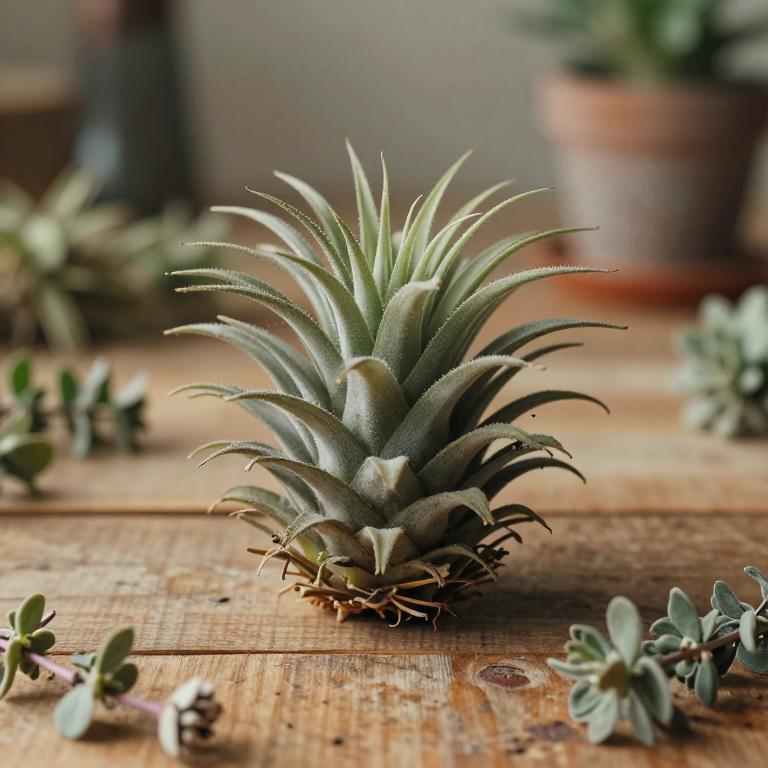
, scientifically known as Tillandsia bergeri, is a captivating air plant native to tropical regions. Often called "the air plant," it thrives by absorbing moisture and nutrients through its leaves rather than soil. Its delicate, silvery foliage and unique growth habit make it a stunning addition to medicinal botanical collections.
- Family
- Bromeliaceae
- Native range
- Europe
- Parts used
- Leaf
- Common names
- Not available
- Scientific synonyms
- Tillandsia Dianthoidea Var. Grisea
Names and Synonyms
Scientific Names
Accepted name
Tillandsia bergeriSynonyms
- Tillandsia dianthoidea var. grisea
Sources: Wikidata, Catalogue of Life
Taxonomical Classification
This plant, known scientifically as Tillandsia bergeri, belongs to the kingdom Plantae and the phylum Streptophyta. Within the class Equisetopsida and subclass Magnoliidae, it is categorized under the order Poales and the family Bromeliaceae. Ultimately, it is classified under the genus Tillandsia.
| Rank | Classification |
|---|---|
| Kingdom | Plantae |
| Phylum | Streptophyta |
| Class | Equisetopsida |
| Subclass | Magnoliidae |
| Order | Poales |
| Family | Bromeliaceae |
| Genus | Tillandsia |
Sources: The World Checklist of Vascular Plants (WCVP)
Distribution
This plant exhibits a varied geographical distribution that spans across several distinct regions. In Northern Europe, its presence can be observed specifically within Great Britain. Moving to South America, it is widely found throughout Brazil South. The distribution also extends into Southern South America, specifically covering the Northeast region of Argentina. These scattered locations highlight the unique environmental niches where the species thrives.
| Region | Area |
|---|---|
| Northern Europe | Great Britain |
| Brazil | Brazil South |
| Southern South America | Argentina Northeast |
Sources: The World Checklist of Vascular Plants (WCVP)
Botanical Identification
Ecology
The ecology of Tillandsia bergeri is defined by its specific niche within low-altitude ecosystems, occurring across an elevational range from 0 to 100 m AMSL. This species thrives primarily within the Floresta Estacional Semidecidual, where it integrates into the seasonal dynamics of the forest structure. Additionally, it is characteristic of specialized microhabitats, specifically found in vegetation growing over rocky outcrops (Vegetação Sobre Afloramentos Rochosos), where it utilizes these surfaces for attachment and resource acquisition.
- Elevational range max:
- 100 m AMSL
- Elevational range min:
- 0 m AMSL
- Habitat :
- Floresta Estacional Semidecidual, Vegetação Sobre Afloramentos Rochosos
Life history
The life history of Tillandsia bergeri is characterized by a perennial lifecycle, allowing the plant to persist in its environment over multiple growing seasons. As an atmospheric epiphyte, its development is closely tied to the availability of moisture and nutrients captured from the air, rather than through soil. Throughout its life, the plant undergoes continuous vegetative growth, often forming dense clusters through the production of offsets or "pups" from the base of the parent plant, which facilitates colonial expansion. Its reproductive cycle typically involves the production of inflorescences that yield seeds, which are dispersed by wind to colonize new substrates. Because it is a perennial, the individual plants can survive long periods of environmental fluctuation, provided they maintain access to the necessary atmospheric resources required to sustain their long-term physiological functions.
- Lifecycle :
- perennial
Morphology
The morphology of Tillandsia bergeri is characterized by its growth form as a non-woody herb. As a self-supporting organism, it does not function as a climber and maintains an independent existence, categorized as an independent plant rather than a parasite. Although it exhibits an obligatory epiphytic nature, its biological classification encompasses terrestrial traits. The plant is fundamentally non-aquatic, classified instead as a terrestrial species within its ecological niche.
- Aquatic :
- terrestrial
- Climber :
- self-supporting
- Epiphyte :
- terrestrial
- Epiphyte :
- obligatory
- Growth form :
- herb
- Parasite :
- independent
- Woodiness :
- non-woody
Sources: Global Inventory of Floras and Traits (GIFT)
Plant Parts
Tillandsia bergeri has 1 reported plant parts identified across 1 scientific publications and several other databases that are studied for medicinal purposes. The most consistently reported plant part include leaf.
| Plant part | Supporting sources | Consensus |
|---|---|---|
| Leaf | 1 supporting sources | ★☆☆☆☆ |
Leaf
- ACS omega
Chemicals
Tillandsia bergeri has 2 reported phytochemicals identified across 1 scientific publications and several other databases. The most consistently reported chemicals include Penduletin, VISCOSINE.
| Chemical | Supporting sources | Consensus |
|---|---|---|
| Penduletin | 1 supporting sources | ★☆☆☆☆ |
| VISCOSINE | 1 supporting sources | ★☆☆☆☆ |
Penduletin
- ACS omega
VISCOSINE
- ACS omega
Preparations
Tillandsia bergeri has 1 reported preparations identified across 1 scientific publications and several other databases. The most consistently reported preparations include Soxhlet extraction of predried and grinded leaves.
| Preparation | Supporting sources | Consensus |
|---|---|---|
| Soxhlet extraction of predried and grinded leaves | 1 supporting sources | ★☆☆☆☆ |
Soxhlet extraction of predried and grinded leaves
- ACS omega