Spanish thyme
Thymus zygis · Accepted scientific name
Scientific literature: Very Extensive (261 studies) · ★★★★★
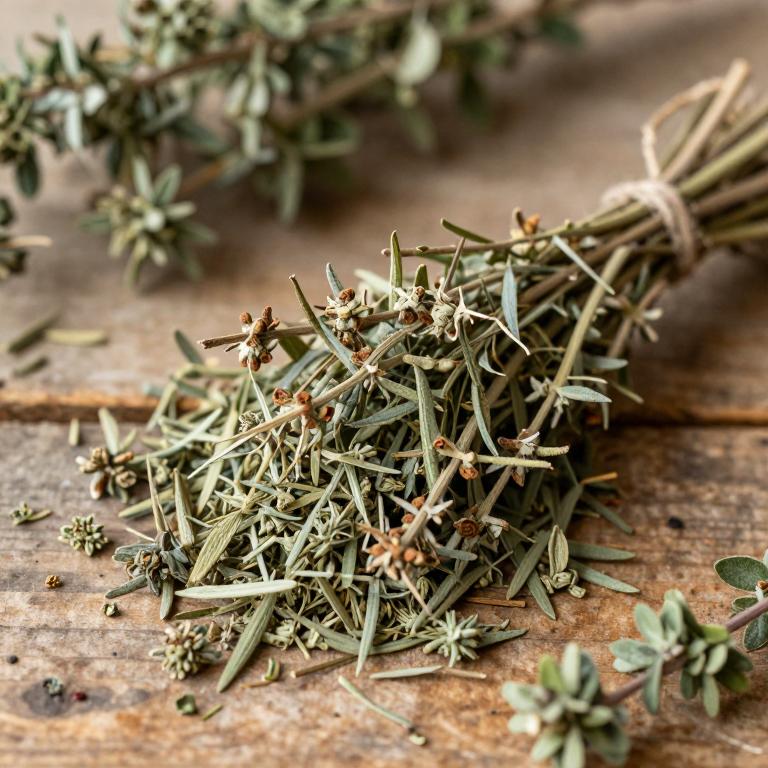
Spanish thyme, scientifically known as Thymus zygis, is a fragrant, woody perennial native to the Mediterranean. Renowned for its potent essential oils, this aromatic herb offers significant medicinal properties, including antimicrobial and antioxidant effects. It is traditionally used to support digestive health and alleviate respiratory congestion through its healing essence.
- Family
- Lamiaceae
- Native range
- Europe
- Parts used
- Not available
- Common names
- Spanish Thyme · Sauce Thyme · 1 more
- Scientific synonyms
- Origanum Zygis
Names and Synonyms
Common Names
- Spanish thyme
- sauce thyme
- white thyme
Scientific Names
Accepted name
Thymus zygisSynonyms
- Origanum zygis
Regional and Traditional Names
Spanish:
- Tomillo salsero
- Tomillo Salsero
German:
- Joch-Thymian
- Joch-Thymian
Sources: Wikidata, Catalogue of Life
Taxonomical Classification
This plant belongs to the kingdom Plantae and the phylum Streptophyta, falling under the class Equisetopsida and subclass Magnoliidae. Within the order Lamiales and the family Lamiaceae, it is classified under the genus Thymus. As a member of this specific lineage, Thymus zygis represents a distinct medicinal species within its taxonomic group.
| Rank | Classification |
|---|---|
| Kingdom | Plantae |
| Phylum | Streptophyta |
| Class | Equisetopsida |
| Subclass | Magnoliidae |
| Order | Lamiales |
| Family | Lamiaceae |
| Genus | Thymus |
Sources: The World Checklist of Vascular Plants (WCVP)
Distribution
This plant exhibits a specific geographical range concentrated within the Mediterranean region. In Southwestern Europe, its presence is documented across the territories of Portugal and Spain. Moving across the Mediterranean Sea, the species is also found within Northern Africa. Specifically, its distribution extends into the countries of Algeria and Morocco. Therefore, its habitat is primarily defined by these four distinct nations.
| Region | Area |
|---|---|
| Southwestern Europe | Portugal |
| Southwestern Europe | Spain |
| Northern Africa | Algeria |
| Northern Africa | Morocco |
Sources: The World Checklist of Vascular Plants (WCVP)
Botanical Identification
Ecology
The ecology of Thymus zygis is characterized by its preference for specific geological substrates and altitudinal niches. This species thrives primarily in stony places, where its root systems can navigate rocky terrains and sparse soil compositions. Its distribution is closely tied to specific vertical gradients, with an observed mean elevational range of 1111 m AMSL, indicating its adaptation to mid-altitude environmental conditions.
- Elevational range mean:
- 1111 m AMSL
- Habitat :
- stony places
Life history
The life history of Thymus zygis is characterized by its classification as a perennial plant, allowing it to persist through multiple growing seasons. Structurally, it exhibits a chamaephyte life form, meaning its perennating buds are located close to the soil surface, typically just above it, which facilitates its survival in specific environmental niches. This chamaephyte growth habit, consistent across its primary life form descriptions, enables the species to maintain a low-growing, resilient stature throughout its extended life cycle.
- Life form :
- chamaephyte
- Lifecycle :
- perennial
Morphology
The morphology of Thymus zygis is characterized by its growth form as a woody subshrub, displaying a distinct level of woodiness in its structural development. As a terrestrial plant, it lacks any epiphytic tendencies, growing directly within its soil environment. The species functions as an independent organism, exhibiting no parasitic behavior toward other plants. Furthermore, it does not possess climbing habits, as it is entirely self-supporting rather than being an obligatory or facultative climber.
- Climber :
- self-supporting
- Epiphyte :
- terrestrial
- Growth form :
- subshrub
- Parasite :
- independent
- Woodiness :
- woody
Reproduction
The reproduction of Thymus zygis is characterized by a specific seasonal flowering period that typically commences in July and concludes in August. During this reproductive phase, the plant produces seeds that exhibit a highly consistent mass, with a mean, maximum, and minimum value all recorded at 2e-04 g. The dispersal of these seeds follows an anemochorous syndrome, indicating that the plant relies on wind as the primary mechanism for transporting its progeny to new locations.
- Dispersal syndrome :
- anemochorous
- Flowering time :
- Jul
- Flowering time :
- Aug
- Seed mass mean:
- 2e-04 g
Sources: Global Inventory of Floras and Traits (GIFT)
Chemicals
Thymus zygis has 30 reported phytochemicals identified across 0 scientific publications and several other databases. The most consistently reported chemicals include THYMOL, CARVACROL, P-CYMENE, Borneol, 1,8-Cineole.
| Chemical | Supporting sources | Consensus |
|---|---|---|
| THYMOL | 5 supporting sources | ★★★☆☆ |
| CARVACROL | 4 supporting sources | ★★☆☆☆ |
| P-CYMENE | 3 supporting sources | ★★☆☆☆ |
| Borneol | 2 supporting sources | ★☆☆☆☆ |
| 1,8-Cineole | 1 supporting sources | ★☆☆☆☆ |
| ALPHA-PINENE | 1 supporting sources | ★☆☆☆☆ |
| ALPHA-TERPINYL ACETATE | 1 supporting sources | ★☆☆☆☆ |
| Alpha terpinene | 1 supporting sources | ★☆☆☆☆ |
| Aromadendrene | 1 supporting sources | ★☆☆☆☆ |
| BETA-CARYOPHYLLENE | 1 supporting sources | ★☆☆☆☆ |
THYMOL
- Dr. Duke
- Plants (Basel, Switzerland)
- Molecules (Basel, Switzerland)
- Life (Basel, Switzerland)
- Natural product communications
CARVACROL
- Dr. Duke
- Plants (Basel, Switzerland)
- Molecules (Basel, Switzerland)
- Natural product communications
P-CYMENE
- Dr. Duke
- Molecules (Basel, Switzerland)
- Natural product communications
Borneol
- Dr. Duke
- TheScientificWorldJournal
1,8-Cineole
- Dr. Duke
ALPHA-PINENE
- Dr. Duke
ALPHA-TERPINYL ACETATE
- Dr. Duke
Alpha terpinene
- Dr. Duke
Aromadendrene
- Dr. Duke
BETA-CARYOPHYLLENE
- Dr. Duke
Activities
Thymus zygis has 209 reported activities identified across 0 scientific publications and several other databases. The most consistently reported activities include Antibacterial, Antioxidant, Antiseptic, (-)-Chronotropic, (-)-Inotropic.
| Activity | Supporting sources | Consensus |
|---|---|---|
| Antibacterial | 2 supporting sources | ★☆☆☆☆ |
| Antioxidant | 2 supporting sources | ★☆☆☆☆ |
| Antiseptic | 2 supporting sources | ★☆☆☆☆ |
| (-)-Chronotropic | 1 supporting sources | ★☆☆☆☆ |
| (-)-Inotropic | 1 supporting sources | ★☆☆☆☆ |
| ACE-Inhibitor | 1 supporting sources | ★☆☆☆☆ |
| AChE-Inhibitor | 1 supporting sources | ★☆☆☆☆ |
| Acaricide | 1 supporting sources | ★☆☆☆☆ |
| Aldose-Reductase-Inhibitor | 1 supporting sources | ★☆☆☆☆ |
| Allelochemic | 1 supporting sources | ★☆☆☆☆ |
Antibacterial
- Dr. Duke
- Archives of oral biology
Antioxidant
- Dr. Duke
- Plants (Basel, Switzerland)
Antiseptic
- Dr. Duke
- Plants (Basel, Switzerland)
(-)-Chronotropic
- Dr. Duke
(-)-Inotropic
- Dr. Duke
ACE-Inhibitor
- Dr. Duke
AChE-Inhibitor
- Dr. Duke
Acaricide
- Dr. Duke
Aldose-Reductase-Inhibitor
- Dr. Duke
Allelochemic
- Dr. Duke
Conditions
Thymus zygis has 6 reported investigations on conditions identified across 0 scientific publications and several other databases. The most consistently reported conditions include Enterococcus faecalis, Giardia duodenalis, Methicillin-Resistant Staphylococcus aureus, Streptococcus mitis, Streptococcus sanguinis.
| Condition | Supporting sources | Consensus |
|---|---|---|
| Enterococcus faecalis | 1 supporting sources | ★☆☆☆☆ |
| Giardia duodenalis | 1 supporting sources | ★☆☆☆☆ |
| Methicillin-resistant staphylococcus aureus | 1 supporting sources | ★☆☆☆☆ |
| Streptococcus mitis | 1 supporting sources | ★☆☆☆☆ |
| Streptococcus sanguinis | 1 supporting sources | ★☆☆☆☆ |
| Antiseptic | 1 supporting sources | ★☆☆☆☆ |
Enterococcus faecalis
- Archives of oral biology
Giardia duodenalis
- Veterinary parasitology
Methicillin-resistant staphylococcus aureus
- Pharmaceuticals (Basel, Switzerland)
Streptococcus mitis
- Archives of oral biology
Streptococcus sanguinis
- Archives of oral biology
Antiseptic
- Plants (Basel, Switzerland)
Preparations
Thymus zygis has 7 reported preparations identified across 0 scientific publications and several other databases. The most consistently reported preparations include essential oils, EOs, Methanolic extracts, essential oil, ethyl ether extracts.
| Preparation | Supporting sources | Consensus |
|---|---|---|
| Essential oils | 3 supporting sources | ★★☆☆☆ |
| Eos | 1 supporting sources | ★☆☆☆☆ |
| Methanolic extracts | 1 supporting sources | ★☆☆☆☆ |
| Essential oil | 1 supporting sources | ★☆☆☆☆ |
| Ethyl ether extracts | 1 supporting sources | ★☆☆☆☆ |
| Medicinal plant essential oils | 1 supporting sources | ★☆☆☆☆ |
| Methanol extracts | 1 supporting sources | ★☆☆☆☆ |
Essential oils
- Molecules (Basel, Switzerland)
- Archives of oral biology
- TheScientificWorldJournal
Eos
- Natural product communications
Methanolic extracts
- Free radical research
Essential oil
- Molecules (Basel, Switzerland)
Ethyl ether extracts
- Free radical research
Medicinal plant essential oils
- Pharmaceuticals (Basel, Switzerland)
Methanol extracts
- Free radical research