Origanum syriacum
Thymus syriacus · Accepted scientific name
Scientific literature: Very Extensive (309 studies) · ★★★★★
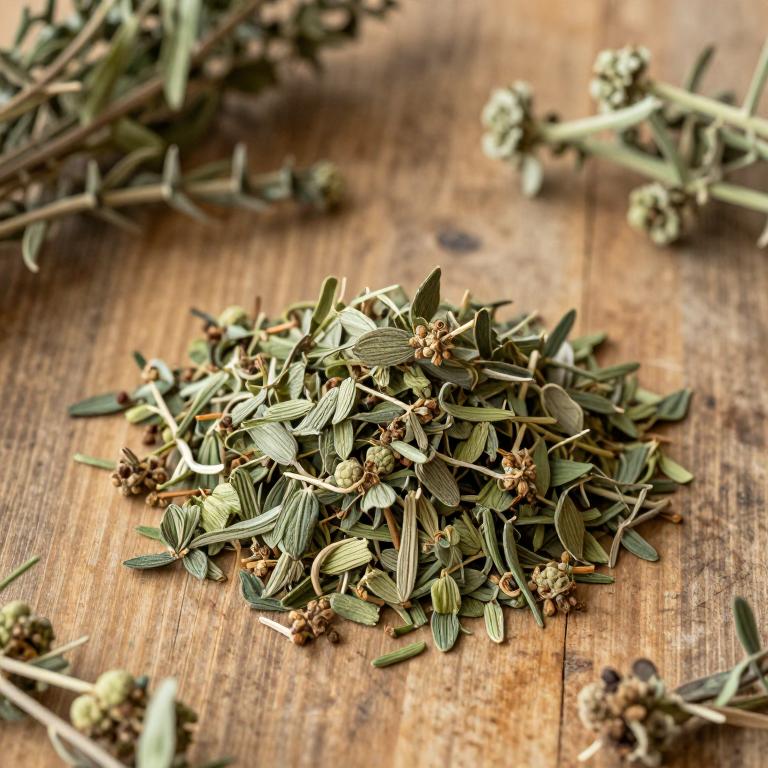
Origanum syriacum, scientifically known as Thymus syriacus, is a fragrant Mediterranean shrub celebrated for its potent therapeutic properties. Rich in essential oils like thymol, this aromatic herb offers powerful antibacterial, antifungal, and antioxidant benefits. Widely used in traditional medicine, it supports respiratory health and aids digestive wellness effectively.
- Family
- Lamiaceae
- Native range
- Asia-Temperate
- Parts used
- Leaf
- Common names
- Origanum Syriacum · Biblical-Hyssop · 4 more
- Scientific synonyms
- Not available
Names and Synonyms
Common Names
- Origanum syriacum
- Biblical-hyssop
- Lebanese oregano
- Syrian oregano
- white oregano
- Bible Hyssop
Scientific Names
Accepted name
Thymus syriacusRegional and Traditional Names
Spanish:
- Origanum syriacum
German:
- Origanum syriacum
French:
- Origanum syriacum
Sources: Wikidata, Catalogue of Life
Taxonomical Classification
This plant belongs to the kingdom Plantae and the phylum Streptophyta, falling under the class Equisetopsida and subclass Magnoliidae. Within the order Lamiales and the family Lamiaceae, it is classified under the genus Thymus.
| Rank | Classification |
|---|---|
| Kingdom | Plantae |
| Phylum | Streptophyta |
| Class | Equisetopsida |
| Subclass | Magnoliidae |
| Order | Lamiales |
| Family | Lamiaceae |
| Genus | Thymus |
Sources: The World Checklist of Vascular Plants (WCVP)
Distribution
This plant, known scientifically as Thymus syriacus, possesses a specific geographical range within the Middle East. Its natural habitat is primarily concentrated in the region of Western Asia. Specifically, it can be found growing within the borders of Iraq. Additionally, the species is widely distributed across the Lebanon-Syria area. These specific locations define the environmental niche where this medicinal herb thrives.
| Region | Area |
|---|---|
| Western Asia | Iraq |
| Western Asia | Lebanon-Syria |
Sources: The World Checklist of Vascular Plants (WCVP)
Botanical Identification
Life history
The life history of Thymus syriacus is characterized by its classification as a chamaephyte, a growth form where the majority of the plant's regenerative buds are located close to the soil surface, typically just above the ground level. Within the specialized ecological frameworks of life forms, it is consistently identified as a chamaephyte, distinguishing it from taller phanerophytes or annual therophytes. This life strategy allows the plant to withstand environmental stressors by keeping its vital structures low to the substrate, a trait further categorized under the specific morphological classification of chamaephyte. This consistent positioning of buds near the earth's surface ensures its survival and persistence within its natural habitat.
- Life form :
- chamaephyte
Morphology
The morphology of Thymus syriacus is characterized by a growth form that functions as both a shrub and a subshrub, exhibiting a woody nature in its structural development. It is a terrestrial plant, existing as an independent organism rather than a parasite, and it does not possess epiphytic qualities. In terms of its physical habit, the plant is self-supporting, meaning it does not rely on other structures for climbing, nor does it exhibit any aquatic or semiaquatic characteristics.
- Aquatic :
- terrestrial
- Climber :
- self-supporting
- Epiphyte :
- terrestrial
- Growth form :
- shrub
- Growth form :
- subshrub
- Parasite :
- independent
- Woodiness :
- woody
Reproduction
The reproduction of Thymus syriacus is characterized by the production of highly minute seeds that exhibit specific variations in mass depending on the sample or environmental conditions. Data indicates a distinct set of seed mass profiles, with one recorded grouping showing a highly uniform mass where the mean, maximum, and minimum values all converge at exactly 0.00052 g. In contrast, another observed distribution of seed mass demonstrates greater variability, featuring a mean mass of 0.000175 g, which fluctuates between a minimum value of 0.00013 g and a maximum value of 0.00022 g. These metrics highlight the microscopic scale of the plant's reproductive units and the subtle differences in seed weight present within its developmental cycles.
- Seed mass max:
- 0.00022 g
- Seed mass mean:
- 0.00052 g
- Seed mass mean:
- 0.000175 g
- Seed mass min:
- 0.00013 g
Sources: Global Inventory of Floras and Traits (GIFT)
Plant Parts
Thymus syriacus has 1 reported plant parts identified across 1 scientific publications and several other databases that are studied for medicinal purposes. The most consistently reported plant part include leaf.
| Plant part | Supporting sources | Consensus |
|---|---|---|
| Leaf | 1 supporting sources | ★☆☆☆☆ |
Leaf
- Biological & pharmaceutical bulletin
Chemicals
Thymus syriacus has 55 reported phytochemicals identified across 1 scientific publications and several other databases. The most consistently reported chemicals include CARVACROL, THYMOL, 1-OCTEN-3-OL, 2,5-diethyl tetrahydrofuran, 3-OCTANOL.
| Chemical | Supporting sources | Consensus |
|---|---|---|
| CARVACROL | 5 supporting sources | ★★★☆☆ |
| THYMOL | 4 supporting sources | ★★☆☆☆ |
| 1-OCTEN-3-OL | 1 supporting sources | ★☆☆☆☆ |
| 2,5-diethyl tetrahydrofuran | 1 supporting sources | ★☆☆☆☆ |
| 3-OCTANOL | 1 supporting sources | ★☆☆☆☆ |
| ALPHA-PHELLANDRENE | 1 supporting sources | ★☆☆☆☆ |
| ALPHA-PINENE | 1 supporting sources | ★☆☆☆☆ |
| ALPHA-THUJENE | 1 supporting sources | ★☆☆☆☆ |
| Alpha terpinene | 1 supporting sources | ★☆☆☆☆ |
| BETA-CARYOPHYLLENE | 1 supporting sources | ★☆☆☆☆ |
CARVACROL
- Dr. Duke
- Nutrition research (New York, N.Y.)
- Plants (Basel, Switzerland)
- Veterinarni medicina
- Saudi pharmaceutical journal : SPJ : the official publication of the Saudi Pharmaceutical Society
THYMOL
- Dr. Duke
- Plants (Basel, Switzerland)
- Veterinarni medicina
- Saudi pharmaceutical journal : SPJ : the official publication of the Saudi Pharmaceutical Society
1-OCTEN-3-OL
- Dr. Duke
2,5-diethyl tetrahydrofuran
- Dr. Duke
3-OCTANOL
- Dr. Duke
ALPHA-PHELLANDRENE
- Dr. Duke
ALPHA-PINENE
- Dr. Duke
ALPHA-THUJENE
- Dr. Duke
Alpha terpinene
- Dr. Duke
BETA-CARYOPHYLLENE
- Dr. Duke
Activities
Thymus syriacus has 193 reported activities identified across 1 scientific publications and several other databases. The most consistently reported activities include Antioxidant, Antimicrobial, Antibacterial, (-)-Chronotropic, (-)-Inotropic.
| Activity | Supporting sources | Consensus |
|---|---|---|
| Antioxidant | 5 supporting sources | ★★★☆☆ |
| Antimicrobial | 4 supporting sources | ★★☆☆☆ |
| Antibacterial | 2 supporting sources | ★☆☆☆☆ |
| (-)-Chronotropic | 1 supporting sources | ★☆☆☆☆ |
| (-)-Inotropic | 1 supporting sources | ★☆☆☆☆ |
| ACE-Inhibitor | 1 supporting sources | ★☆☆☆☆ |
| AChE-Inhibitor | 1 supporting sources | ★☆☆☆☆ |
| Acaricide | 1 supporting sources | ★☆☆☆☆ |
| Aldose-Reductase-Inhibitor | 1 supporting sources | ★☆☆☆☆ |
| Allelochemic | 1 supporting sources | ★☆☆☆☆ |
Antioxidant
- Dr. Duke
- Plants (Basel, Switzerland)
- Molecules (Basel, Switzerland)
- Food science & nutrition
- Saudi pharmaceutical journal : SPJ : the official publication of the Saudi Pharmaceutical Society
Antimicrobial
- Plants (Basel, Switzerland)
- Molecules (Basel, Switzerland)
- Journal of infection in developing countries
- Food science & nutrition
Antibacterial
- Dr. Duke
- Saudi pharmaceutical journal : SPJ : the official publication of the Saudi Pharmaceutical Society
(-)-Chronotropic
- Dr. Duke
(-)-Inotropic
- Dr. Duke
ACE-Inhibitor
- Dr. Duke
AChE-Inhibitor
- Dr. Duke
Acaricide
- Dr. Duke
Aldose-Reductase-Inhibitor
- Dr. Duke
Allelochemic
- Dr. Duke
Conditions
Thymus syriacus has 1 reported investigations on conditions identified across 1 scientific publications and several other databases. The most consistently reported conditions include brucellosis.
| Condition | Supporting sources | Consensus |
|---|---|---|
| Brucellosis | 1 supporting sources | ★☆☆☆☆ |
Brucellosis
- Iranian journal of medical sciences
Preparations
Thymus syriacus has 6 reported preparations identified across 1 scientific publications and several other databases. The most consistently reported preparations include essential oil, Ethyl acetate extracts, Methanolic extracts, dried Origanum syriacum, essential oils.
| Preparation | Supporting sources | Consensus |
|---|---|---|
| Essential oil | 2 supporting sources | ★☆☆☆☆ |
| Ethyl acetate extracts | 1 supporting sources | ★☆☆☆☆ |
| Methanolic extracts | 1 supporting sources | ★☆☆☆☆ |
| Dried origanum syriacum | 1 supporting sources | ★☆☆☆☆ |
| Essential oils | 1 supporting sources | ★☆☆☆☆ |
| Extract | 1 supporting sources | ★☆☆☆☆ |
Essential oil
- Biological & pharmaceutical bulletin
- Saudi pharmaceutical journal : SPJ : the official publication of the Saudi Pharmaceutical Society
Ethyl acetate extracts
- Journal of ethnopharmacology
Methanolic extracts
- Journal of infection in developing countries
Dried origanum syriacum
- Plants (Basel, Switzerland)
Essential oils
- Iranian journal of medical sciences
Extract
- Saudi pharmaceutical journal : SPJ : the official publication of the Saudi Pharmaceutical Society