lemon thyme
Thymus pulegioides · Accepted scientific name
Scientific literature: Very Sparse (13 studies) · ★☆☆☆☆
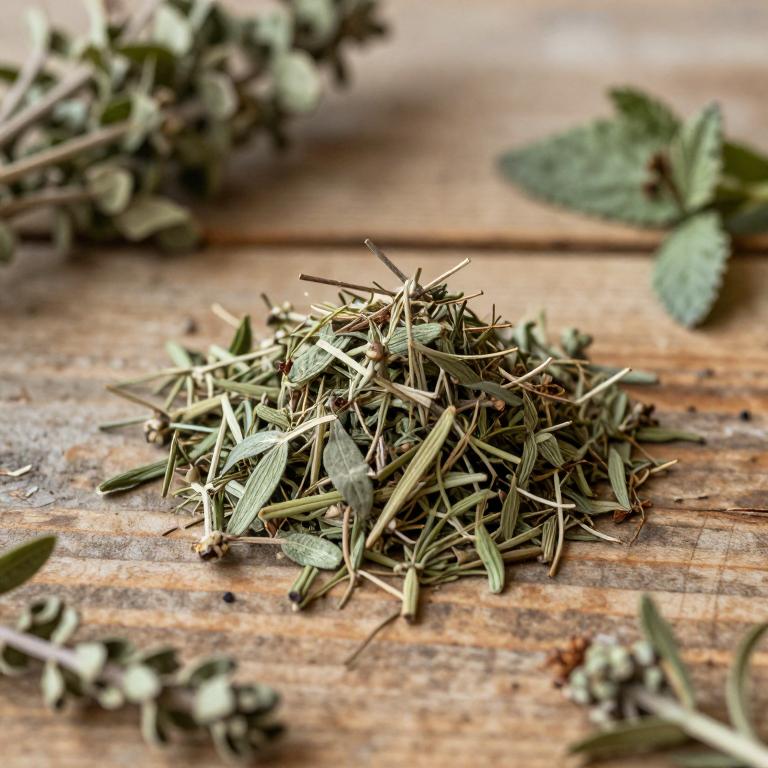
Lemon thyme, scientifically known as Thymus puliegioides, is a fragrant, aromatic perennial herb cherished for its bright, citrus-scented leaves. Native to specific Mediterranean regions, this resilient plant offers potent antimicrobial properties. It is widely utilized in herbal medicine and culinary arts to enhance flavor and support digestive wellness.
- Family
- Lamiaceae
- Native range
- Europe
- Parts used
- Not available
- Common names
- Creeping Thyme · Large Thyme · 5 more
- Scientific synonyms
- Thymus Chamaedrys Var. Pulegioides
Names and Synonyms
Common Names
- creeping thyme
- large thyme
- lemon thyme
- wild thyme
- Large Garden
- Large Wild Thyme
- large-garden
Scientific Names
Accepted name
Thymus pulegioidesSynonyms
- Thymus chamaedrys var. pulegioides
Regional and Traditional Names
Spanish:
- Serpillo
- Serpillo
German:
- Breitblättriger Thymian
- Arznei-Thymian
- Gewöhnlicher Thymian
- Feld-Thymian
- Gemeiner Thymian
- Quendel-Thymian
- Arzneithymian
- Arznei-Thymian
- Arznei-Feld-Thymian
- Breitblättriger Thymian
French:
- serpolet commun
- Thym faux pouliot
- thym de bergère
- thym faux-pouliot
- thym laineux
- thym serpolet
- Thym pouliot
- Thym faux pouliot
- Thym à larges feuilles
Sources: Wikidata, Catalogue of Life
Taxonomical Classification
This plant belongs to the kingdom Plantae and the phylum Streptophyta, specifically falling under the class Equisetopsida and subclass Magnoliidae. Within the order Lamiales and the family Lamiaceae, it is classified under the genus Thymus.
| Rank | Classification |
|---|---|
| Kingdom | Plantae |
| Phylum | Streptophyta |
| Class | Equisetopsida |
| Subclass | Magnoliidae |
| Order | Lamiales |
| Family | Lamiaceae |
| Genus | Thymus |
Sources: The World Checklist of Vascular Plants (WCVP)
Distribution
This plant, known as Thymus pulleoides, exhibits a specific geographical range across several Northern European territories. Its distribution can be traced through various coastal and inland regions of Great Britain and Ireland. Furthermore, the species is documented within the northern reaches of the continent, including Norway and Denmark. It also maintains a presence in the more eastern northern landscapes of Finland. Together, these locations define the primary natural habitat for this medicinal species.
| Region | Area |
|---|---|
| Northern Europe | Denmark |
| Northern Europe | Finland |
| Northern Europe | Great Britain |
| Northern Europe | Ireland |
| Northern Europe | Norway |
| Northern Europe | Sweden |
| Middle Europe | Austria |
| Middle Europe | Belgium |
| Middle Europe | Czechia-Slovakia |
| Middle Europe | Germany |
Sources: The World Checklist of Vascular Plants (WCVP)
Botanical Identification
Ecology
The ecology of Thymus pulegioides is fundamentally defined by its preference for forest environments, where it integrates into the complex understory or edge dynamics of these ecosystems. Within these forest habitats, the species typically occupies specific niches that provide a balance of light availability and soil moisture, often favoring areas where the canopy allows for filtered sunlight to reach the ground. Its distribution is closely tied to the structural characteristics of the forest, such as the composition of leaf litter and the microclimatic stability provided by surrounding woody vegetation. By inhabiting these woodland settings, Thymus pulegioides participates in localized nutrient cycling and provides specialized resources for forest-dwelling pollinators, playing a subtle yet integral role in the botanical diversity of its forest ecosystem.
- Habitat :
- forest
Life history
The life history of Thymus pulegioides is characterized by its status as a perennial plant, allowing it to persist through multiple growing seasons. It exhibits a chamaephyte life form, meaning its reproductive shoots are located near the soil surface, often protected by a layer of leaf litter or ground cover. This species maintains an evergreen deciduousness, retaining its foliage throughout the year to facilitate continuous metabolic activity when environmental conditions permit.
- Deciduousness :
- evergreen
- Life form :
- chamaephyte
- Lifecycle :
- perennial
Morphology
The morphology of Thymus pulegioides is characterized by a shrubby growth form that exhibits woody characteristics. It is a terrestrial, independent plant that does not function as a parasite or an epiphyte. In terms of its structural habit, it is a self-supporting species rather than a climber or vine, featuring a prostrate shoot orientation. The plant's stature is relatively low, with a height that ranges from a minimum of 0.02 m to a maximum of 0.36 m, resulting in a mean plant height of approximately 0.182 m.
- Aquatic :
- terrestrial
- Climber :
- self-supporting
- Epiphyte :
- terrestrial
- Growth form :
- shrub
- Parasite :
- independent
- Plant height max:
- 0.36 m
- Plant height mean:
- 0.182 m
- Plant height min:
- 0.02 m
- Shoot orientation :
- prostrate
- Woodiness :
- woody
Physiology
The physiology of Thymus pulegioides is characterized by a C3 photosynthetic pathway, which dictates its carbon fixation processes and metabolic efficiency. As a non-carnivorous species, it relies entirely on soil-derived nutrients rather than the absorption of organic matter through specialized structures. The plant's leaf morphology exhibits a highly consistent structure, with a leaf width that remains constant at a mean, minimum, and maximum of 0.3 cm. In terms of longitudinal development, the leaves reach a maximum length of 0.6 cm. Furthermore, the plant possesses a mean Specific Leaf Area (SLA) of 246.75 cm²/g, a metric that reflects its leaf thickness and the efficiency of its resource allocation between photosynthetic tissue and structural biomass.
- Carnivory :
- non-carnivorous
- Leaf length max:
- 0.6 cm
- Leaf width mean:
- 0.3 cm
- Photosynthetic pathway :
- C3
- Specific Leaf Area (SLA) mean:
- 246.75 cm²/g
Reproduction
The reproduction of Thymus pulegioides is primarily a sexual process, as asexual reproduction is notably absent. The flowering period typically commences in June and extends through August, facilitating the reproductive cycle during the summer months. This plant relies on biotic pollination syndromes, specifically utilizing insects, with bees serving as a key pollinator. Following successful pollination, the plant produces seeds characterized by a mean mass of 0.000151 g, with individual seed weights ranging from a minimum of 0.00012 g to a maximum of 0.00018 g. Once mature, the dispersal of these seeds is achieved through an anemochorous syndrome, meaning they are dispersed by the wind.
- Dispersal syndrome :
- anemochorous
- Flowering time :
- Jun
- Flowering time :
- Aug
- Pollination syndrome :
- insect
- Pollination syndrome :
- bee
- Pollination syndrome :
- biotic
- Reproduction asexual :
- absent
- Seed mass max:
- 0.00018 g
- Seed mass mean:
- 0.000151 g
- Seed mass min:
- 0.00012 g
Sources: Global Inventory of Floras and Traits (GIFT)
Chemicals
Thymus pulegioides has 9 reported phytochemicals identified across 0 scientific publications and several other databases. The most consistently reported chemicals include CARVACROL, ALGINIC ACID, GERANIOL, Galacturonic acid, THYMOL.
| Chemical | Supporting sources | Consensus |
|---|---|---|
| CARVACROL | 2 supporting sources | ★☆☆☆☆ |
| ALGINIC ACID | 1 supporting sources | ★☆☆☆☆ |
| GERANIOL | 1 supporting sources | ★☆☆☆☆ |
| Galacturonic acid | 1 supporting sources | ★☆☆☆☆ |
| THYMOL | 1 supporting sources | ★☆☆☆☆ |
| glucose | 1 supporting sources | ★☆☆☆☆ |
| glucuronic acid | 1 supporting sources | ★☆☆☆☆ |
| mannose | 1 supporting sources | ★☆☆☆☆ |
| xylose | 1 supporting sources | ★☆☆☆☆ |
CARVACROL
- Molecules (Basel, Switzerland)
- Journal of medical microbiology
ALGINIC ACID
- Spectrochimica acta. Part A, Molecular and biomolecular spectroscopy
GERANIOL
- Molecules (Basel, Switzerland)
Galacturonic acid
- Spectrochimica acta. Part A, Molecular and biomolecular spectroscopy
THYMOL
- Journal of medical microbiology
glucose
- Spectrochimica acta. Part A, Molecular and biomolecular spectroscopy
glucuronic acid
- Spectrochimica acta. Part A, Molecular and biomolecular spectroscopy
mannose
- Spectrochimica acta. Part A, Molecular and biomolecular spectroscopy
xylose
- Spectrochimica acta. Part A, Molecular and biomolecular spectroscopy
Conditions
Thymus pulegioides has 2 reported investigations on conditions identified across 0 scientific publications and several other databases. The most consistently reported conditions include Aspergillus, Candida.
| Condition | Supporting sources | Consensus |
|---|---|---|
| Aspergillus | 1 supporting sources | ★☆☆☆☆ |
| Candida | 1 supporting sources | ★☆☆☆☆ |
Aspergillus
- Journal of medical microbiology
Candida
- Journal of medical microbiology
Preparations
Thymus pulegioides has 3 reported preparations identified across 0 scientific publications and several other databases. The most consistently reported preparations include Essential Oil, Essential oil, essential oils.
| Preparation | Supporting sources | Consensus |
|---|---|---|
| Essential oil | 1 supporting sources | ★☆☆☆☆ |
| Essential oil | 1 supporting sources | ★☆☆☆☆ |
| Essential oils | 1 supporting sources | ★☆☆☆☆ |
Essential oil
- Molecules (Basel, Switzerland)
Essential oil
- Journal of medical microbiology
Essential oils
- Molecules (Basel, Switzerland)