Camphor Thyme
Thymus camphoratus · Accepted scientific name
Scientific literature: Very Sparse (10 studies) · ★☆☆☆☆
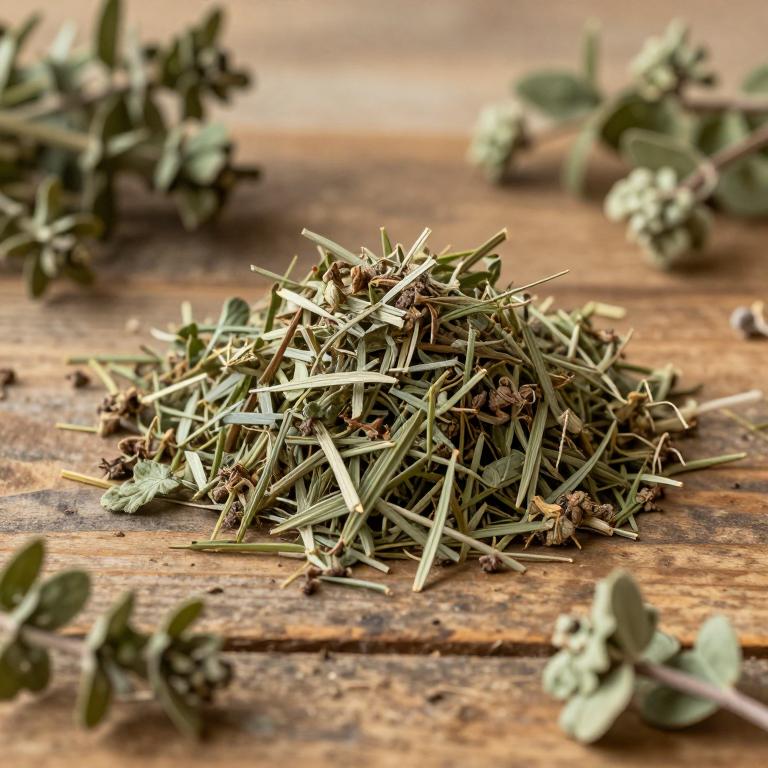
Camphor Thyme, scientifically known as Thymus camphoratus, is a fragrant, aromatic shrub native to Southern Africa. Renowned for its potent essential oils, this medicinal plant possesses significant antibacterial, antifungal, and antiseptic properties. It is widely utilized in traditional medicine to treat respiratory ailments, skin infections, and digestive issues.
- Family
- Lamiaceae
- Native range
- Europe
- Parts used
- Not available
- Common names
- Camphor Thyme
- Scientific synonyms
- Thymus Camphoratus Subsp. Congestus · Thymus Mastichina Var. Camphoratus · 1 more
Names and Synonyms
Common Names
- Camphor Thyme
Scientific Names
Accepted name
Thymus camphoratusSynonyms
- Thymus camphoratus subsp. congestus
- Thymus mastichina var. camphoratus
- Thymus algarbiensis
Sources: Wikidata, Catalogue of Life
Taxonomical Classification
This plant belongs to the kingdom Plantae and is classified within the phylum Streptophyta and class Equisetopsida. Following the subclass Magnoliidae, it is further organized under the order Lamiales and the family Lamiaceae. Ultimately, it is identified by the genus Thymus, specifically as the species Thymus camphoratus.
| Rank | Classification |
|---|---|
| Kingdom | Plantae |
| Phylum | Streptophyta |
| Class | Equisetopsida |
| Subclass | Magnoliidae |
| Order | Lamiales |
| Family | Lamiaceae |
| Genus | Thymus |
Sources: The World Checklist of Vascular Plants (WCVP)
Distribution
This plant is characterized by a very specific and limited geographical range. Its natural occurrence is primarily confined to the region of Southwestern Europe. Within this territory, the species is specifically documented in Portugal. This narrow distribution suggests that the plant thrives under particular environmental conditions found in that area. Consequently, its presence is a distinct feature of the Portuguese landscape.
| Region | Area |
|---|---|
| Southwestern Europe | Portugal |
Sources: The World Checklist of Vascular Plants (WCVP)
Botanical Identification
Life history
The life history of Thymus camphoratus is characterized by its classification as a chamaephyte, a life form that dictates its survival strategy and structural development. Specifically, it functions as a chamaephyte, meaning its perennating buds are located close to the soil surface, typically just above it, which allows the plant to withstand environmental stressors while maintaining a low-growing profile. This life form strategy enables the species to thrive in its specific ecological niche by protecting its vital regenerative tissues near the ground level, ensuring persistence through seasonal changes. This growth habit facilitates its ability to form dense, aromatic mats that are resilient to various climatic conditions.
- Life form :
- chamaephyte
Morphology
The morphology of Thymus camphoratus is characterized by its growth habit as a self-supporting plant, meaning it does not rely on external structures for vertical ascent and functions as a self-supporting climber in its structural arrangement. It is an independent organism, functioning as a non-parasitic species that maintains its own metabolic processes without relying on a host. Furthermore, it is a terrestrial plant, growing directly in soil rather than existing as an epiphyte on other vegetation.
- Climber :
- self-supporting
- Epiphyte :
- terrestrial
- Parasite :
- independent
Sources: Global Inventory of Floras and Traits (GIFT)
Chemicals
Thymus camphoratus has 3 reported phytochemicals identified across 0 scientific publications and several other databases. The most consistently reported chemicals include 1,8-Cineole, Borneol, Linalool.
| Chemical | Supporting sources | Consensus |
|---|---|---|
| 1,8-Cineole | 2 supporting sources | ★☆☆☆☆ |
| Borneol | 1 supporting sources | ★☆☆☆☆ |
| Linalool | 1 supporting sources | ★☆☆☆☆ |
1,8-Cineole
- Journal of ethnopharmacology
- Letters in applied microbiology
Borneol
- Journal of ethnopharmacology
Linalool
- Letters in applied microbiology
Conditions
Thymus camphoratus has 5 reported investigations on conditions identified across 0 scientific publications and several other databases. The most consistently reported conditions include Candida albicans, Escherichia coli, Listeria monocytogenes, Proteus mirabilis, Staphylococcus aureus.
| Condition | Supporting sources | Consensus |
|---|---|---|
| Candida albicans | 1 supporting sources | ★☆☆☆☆ |
| Escherichia coli | 1 supporting sources | ★☆☆☆☆ |
| Listeria monocytogenes | 1 supporting sources | ★☆☆☆☆ |
| Proteus mirabilis | 1 supporting sources | ★☆☆☆☆ |
| Staphylococcus aureus | 1 supporting sources | ★☆☆☆☆ |
Candida albicans
- Letters in applied microbiology
Escherichia coli
- Letters in applied microbiology
Listeria monocytogenes
- Letters in applied microbiology
Proteus mirabilis
- Letters in applied microbiology
Staphylococcus aureus
- Letters in applied microbiology
Preparations
Thymus camphoratus has 1 reported preparations identified across 0 scientific publications and several other databases. The most consistently reported preparations include essential oils.
| Preparation | Supporting sources | Consensus |
|---|---|---|
| Essential oils | 1 supporting sources | ★☆☆☆☆ |
Essential oils
- Journal of ethnopharmacology