Algerian thyme
Thymus algeriensis · Accepted scientific name
Scientific literature: Very Sparse (26 studies) · ★☆☆☆☆
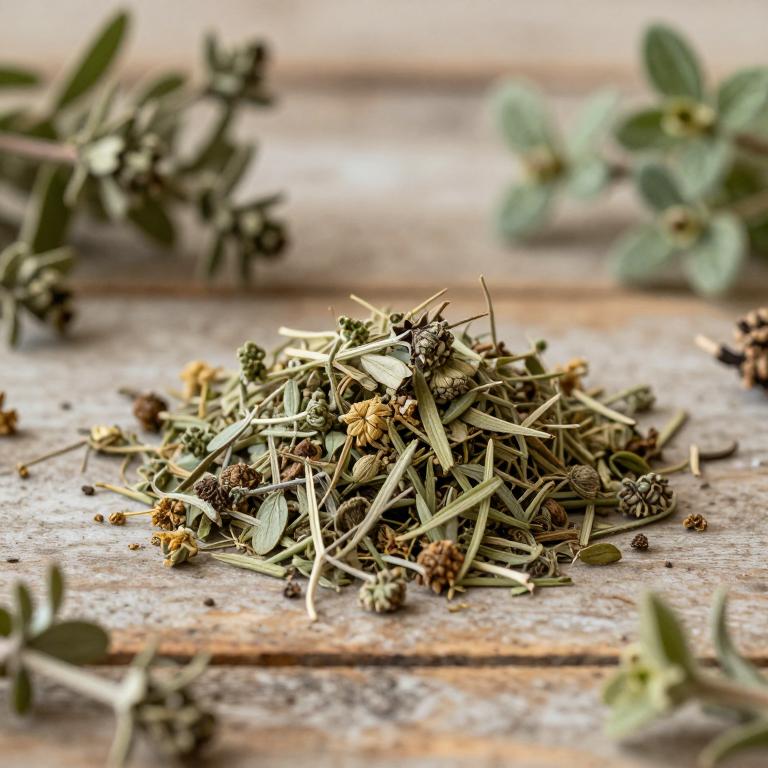
Algerian thyme, scientifically known as Thymus algeriensis, is a resilient perennial shrub native to the Mediterranean region. Renowned for its aromatic foliage, this medicinal plant possesses potent antimicrobial and antioxidant properties. It is traditionally utilized in herbal remedies to support respiratory health, digestion, and overall immune system function.
- Family
- Lamiaceae
- Native range
- Africa
- Parts used
- Not available
- Common names
- Algerian Thyme
- Scientific synonyms
- Thymus Ciliatus Subsp. Algeriensis · Thymus Zattarellus · 9 more
Names and Synonyms
Common Names
- Algerian thyme
Scientific Names
Accepted name
Thymus algeriensisSynonyms
- Thymus ciliatus subsp. algeriensis
- Thymus zattarellus
- Thymus tunetanus
- Thymus algeriensis var. masculensis
- Thymus hirtus var. cinerascens
- Thymus algeriensis var. cinerascens
- Thymus algeriensis var. pomelii
- Thymus algeriensis var. villicaulis
- Thymus ciliatus var. zattarellus
- Thymus hirtus var. battandieri
- Thymus hirtus subsp. algeriensis
Regional and Traditional Names
French:
- Thym algérien
Sources: Wikidata, Catalogue of Life
Taxonomical Classification
This plant belongs to the kingdom Plantae within the phylum Streptophyta and is classified under the class Equisetopsida. It is further categorized under the subclass Magnoliidae and the order Lamiales, falling into the family Lamiaceae. Finally, it is identified by its genus, Thymus.
| Rank | Classification |
|---|---|
| Kingdom | Plantae |
| Phylum | Streptophyta |
| Class | Equisetopsida |
| Subclass | Magnoliidae |
| Order | Lamiales |
| Family | Lamiaceae |
| Genus | Thymus |
Sources: The World Checklist of Vascular Plants (WCVP)
Distribution
This plant is indigenous to the North African region, where it thrives in specific natural habitats. Its primary geographical range is concentrated within the northernmost territories of the African continent. Specifically, it can be found growing across the landscapes of Algeria and Libya. Furthermore, its distribution extends westward into the country of Morocco. Finally, the species is also documented to inhabit the territory of Tunisia.
| Region | Area |
|---|---|
| Northern Africa | Algeria |
| Northern Africa | Libya |
| Northern Africa | Morocco |
| Northern Africa | Tunisia |
Sources: The World Checklist of Vascular Plants (WCVP)
Botanical Identification
Life history
The life history of Thymus algeriensis is characterized by its classification as a chamaephyte, a life form that allows it to thrive in specific ecological niches. Within this botanical framework, it exhibits traits consistent with both the nanophanerophyte and chamaephyte categories, indicating that its perennating buds are located close to or just above the soil surface. This growth habit is an evolutionary adaptation to its environment, enabling the plant to endure seasonal fluctuations and environmental stressors by maintaining a low-growing, woody structure. By positioning its reproductive and vegetative buds near the ground level, Thymus algeriensis can effectively manage resource allocation and survive varying climatic conditions typical of its habitat.
- Life form :
- chamaephyte
Morphology
The morphology of Thymus algeriensis is characterized by a growth habit that is entirely terrestrial, functioning as an independent organism without any reliance on other plants for support or nutrients. It does not exhibit any climbing tendencies, being neither an obligatory nor a facultative climber; instead, it maintains a self-supporting structure typical of low-growing subshrubs. As an independent species, it is not a parasite, maintaining its own metabolic processes and structural integrity within its natural habitat.
- Climber :
- self-supporting
- Epiphyte :
- terrestrial
- Parasite :
- independent
Sources: Global Inventory of Floras and Traits (GIFT)
Chemicals
Thymus algeriensis has 8 reported phytochemicals identified across 0 scientific publications and several other databases. The most consistently reported chemicals include 1,8-Cineole, 4-Terpineol, Terpenyl acetate, Viridiflorol, camphor.
| Chemical | Supporting sources | Consensus |
|---|---|---|
| 1,8-Cineole | 1 supporting sources | ★☆☆☆☆ |
| 4-Terpineol | 1 supporting sources | ★☆☆☆☆ |
| Terpenyl acetate | 1 supporting sources | ★☆☆☆☆ |
| Viridiflorol | 1 supporting sources | ★☆☆☆☆ |
| camphor | 1 supporting sources | ★☆☆☆☆ |
| cis-Sabinene hydrate | 1 supporting sources | ★☆☆☆☆ |
| kaempferol | 1 supporting sources | ★☆☆☆☆ |
| rosmarinic acid | 1 supporting sources | ★☆☆☆☆ |
1,8-Cineole
- Lipids in health and disease
4-Terpineol
- Lipids in health and disease
Terpenyl acetate
- Lipids in health and disease
Viridiflorol
- Lipids in health and disease
camphor
- Lipids in health and disease
cis-Sabinene hydrate
- Lipids in health and disease
kaempferol
- Food research international (Ottawa, Ont.)
rosmarinic acid
- Food research international (Ottawa, Ont.)
Activities
Thymus algeriensis has 5 reported activities identified across 0 scientific publications and several other databases. The most consistently reported activities include Antioxidant, Anticancer, Antimicrobial, Analgesic, Digestive.
| Activity | Supporting sources | Consensus |
|---|---|---|
| Antioxidant | 3 supporting sources | ★★☆☆☆ |
| Anticancer | 2 supporting sources | ★☆☆☆☆ |
| Antimicrobial | 2 supporting sources | ★☆☆☆☆ |
| Analgesic | 1 supporting sources | ★☆☆☆☆ |
| Digestive | 1 supporting sources | ★☆☆☆☆ |
Antioxidant
- Molecules (Basel, Switzerland)
- Foods (Basel, Switzerland)
- Oxidative medicine and cellular longevity
Anticancer
- Foods (Basel, Switzerland)
- Oxidative medicine and cellular longevity
Antimicrobial
- Foods (Basel, Switzerland)
- Oxidative medicine and cellular longevity
Analgesic
- Molecules (Basel, Switzerland)
Digestive
- Oxidative medicine and cellular longevity
Conditions
Thymus algeriensis has 7 reported investigations on conditions identified across 0 scientific publications and several other databases. The most consistently reported conditions include inflammation, Bacillus cereus, Escherichia coli, Micrococcus luteus, Proteus mirabilis.
| Condition | Supporting sources | Consensus |
|---|---|---|
| Inflammation | 2 supporting sources | ★☆☆☆☆ |
| Bacillus cereus | 1 supporting sources | ★☆☆☆☆ |
| Escherichia coli | 1 supporting sources | ★☆☆☆☆ |
| Micrococcus luteus | 1 supporting sources | ★☆☆☆☆ |
| Proteus mirabilis | 1 supporting sources | ★☆☆☆☆ |
| Salmonella typhimurium | 1 supporting sources | ★☆☆☆☆ |
| Rheumatism | 1 supporting sources | ★☆☆☆☆ |
Inflammation
- Molecules (Basel, Switzerland)
- Oxidative medicine and cellular longevity
Bacillus cereus
- Food research international (Ottawa, Ont.)
Escherichia coli
- Food research international (Ottawa, Ont.)
Micrococcus luteus
- Food research international (Ottawa, Ont.)
Proteus mirabilis
- Food research international (Ottawa, Ont.)
Salmonella typhimurium
- Food research international (Ottawa, Ont.)
Rheumatism
- Oxidative medicine and cellular longevity
Preparations
Thymus algeriensis has 2 reported preparations identified across 0 scientific publications and several other databases. The most consistently reported preparations include Essential Oils, essential oils.
| Preparation | Supporting sources | Consensus |
|---|---|---|
| Essential oils | 1 supporting sources | ★☆☆☆☆ |
| Essential oils | 1 supporting sources | ★☆☆☆☆ |
Essential oils
- Molecules (Basel, Switzerland)
Essential oils
- Lipids in health and disease