Felty germander
Teucrium capitatum · Accepted scientific name
Scientific literature: Very Sparse (11 studies) · ★☆☆☆☆
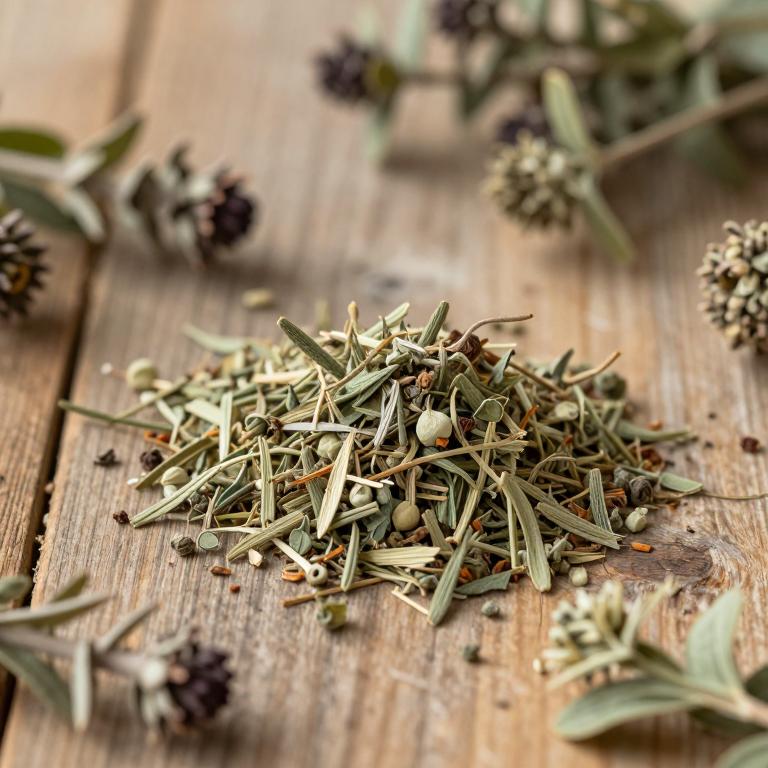
Felty germander, scientifically known as Teucrium capitatum, is a distinctive perennial herb native to the rocky regions of South Africa. Characterized by its soft, textured foliage and delicate blooms, this medicinal plant is valued in traditional practices for its unique botanical properties and its striking ornamental presence in gardens.
- Family
- Lamiaceae
- Native range
- Europe
- Parts used
- Not available
- Common names
- Felty Germander
- Scientific synonyms
- Polium Capitatum · Teucrium Capitatum Subvar. Rubriflorum · 24 more
Names and Synonyms
Common Names
- Felty Germander
Scientific Names
Accepted name
Teucrium capitatumSynonyms
- Polium capitatum
- Teucrium capitatum subvar. rubriflorum
- Teucrium capitatum subsp. gypsicola
- Teucrium capitatum subsp. gussonii
- Chamaedrys capitata
- Teucrium commune var. intermedium
- Teucrium capitatum subsp. capitatum
- Teucrium commune var. polioides
- Teucrium capitatum var. polioides
- Teucrium album
- Teucrium capitatum var. riojanus
- Teucrium achaemenis
- Teucrium capitatum var. microcephalum
- Teucrium majorana
- Teucrium capitatum var. mirandanum
- Teucrium cymosum
- Teucrium polium subsp. album
- Teucrium polycephalum
- Teucrium polium var. tonsum
- Teucrium polium subsp. capitatum
- Teucrium polium var. achaemenis
- Teucrium capitatum var. lazari
- Teucrium polium var. humbertii
- Teucrium polium var. max-onnoi
- Teucrium polium var. polycephalum
- Teucrium polium var. scoparium
Regional and Traditional Names
Spanish:
- poleo montano
German:
- Kopfiger Gamander
French:
- Germandrée à têtes
Sources: Wikidata, Catalogue of Life
Taxonomical Classification
This plant belongs to the kingdom Plantae and the phylum Streptophyta, falling under the class Equisetopsida and subclass Magnoliidae. It is further classified within the order Lamiales and the family Lamiaceae. Finally, it is identified by its genus name, Teucrium.
| Rank | Classification |
|---|---|
| Kingdom | Plantae |
| Phylum | Streptophyta |
| Class | Equisetopsida |
| Subclass | Magnoliidae |
| Order | Lamiales |
| Family | Lamiaceae |
| Genus | Teucrium |
Sources: The World Checklist of Vascular Plants (WCVP)
Distribution
This plant exhibits a specific geographical distribution across various parts of the Mediterranean region. Within Southwestern Europe, it can be found inhabiting the territories of Portugal and Spain. Its presence is also noted on the Mediterranean islands of Corse and Sardegna. Additionally, the species extends its range into Southeastern Europe, specifically within Albania. Consequently, these diverse locations highlight its localized habitat within these specific coastal and island areas.
| Region | Area |
|---|---|
| Southwestern Europe | Corse |
| Southwestern Europe | Portugal |
| Southwestern Europe | Sardegna |
| Southwestern Europe | Spain |
| Southeastern Europe | Albania |
| Southeastern Europe | Bulgaria |
| Southeastern Europe | Greece |
| Southeastern Europe | Italy |
| Southeastern Europe | Kriti |
| Southeastern Europe | Romania |
Sources: The World Checklist of Vascular Plants (WCVP)
Botanical Identification
Life history
The life history of Teucrium capitatum is characterized by its status as a perennial plant, allowing it to persist through multiple growing seasons. In terms of its structural growth strategy, the species is classified as a chamaephyte, a life form where the permanent shoots are located close to the soil surface, often protected by leaf litter or ground cover. This specific life form, categorized both as a chamaephyte and a member of the broader chamaephyte group, dictates its ability to survive environmental fluctuations by maintaining its regenerative buds at or near the ground level.
- Life form :
- chamaephyte
- Lifecycle :
- perennial
Morphology
The morphology of Teucrium capitatum is characterized by its growth form as a woody subshrub. It is a self-supporting plant, exhibiting neither climbing nor vine-like behaviors, and functions as an independent organism rather than a parasite. Its habitat and ecological positioning are primarily terrestrial, as it does not function as an epiphyte or occupy aquatic and semiaquatic niches. The plant's structure is defined by its woody nature, which provides the necessary stability for its subshrub habit.
- Aquatic :
- terrestrial
- Climber :
- self-supporting
- Epiphyte :
- terrestrial
- Growth form :
- subshrub
- Parasite :
- independent
- Woodiness :
- woody
Reproduction
The reproduction of Teucrium capitatum is characterized by the production of seeds that exhibit highly consistent physical properties. Based on quantitative data, the seed mass is uniform across the observed samples, with a mean value of 8e-04 g. This consistency is reflected in the recorded minimum and maximum seed mass values, which both stand at 8e-04 g, indicating a lack of significant variance in the weight of the individual seeds produced during its reproductive cycle.
- Seed mass mean:
- 8e-04 g
Sources: Global Inventory of Floras and Traits (GIFT)
Activities
Teucrium capitatum has 9 reported activities identified across 0 scientific publications and several other databases. The most consistently reported activities include Antioxidant, Antibacterial, Anticancer, Antidiabetic, Antifungal.
| Activity | Supporting sources | Consensus |
|---|---|---|
| Antioxidant | 2 supporting sources | ★☆☆☆☆ |
| Antibacterial | 1 supporting sources | ★☆☆☆☆ |
| Anticancer | 1 supporting sources | ★☆☆☆☆ |
| Antidiabetic | 1 supporting sources | ★☆☆☆☆ |
| Antifungal | 1 supporting sources | ★☆☆☆☆ |
| Antitumor | 1 supporting sources | ★☆☆☆☆ |
| Hepatoprotective | 1 supporting sources | ★☆☆☆☆ |
| Hypoglycemic | 1 supporting sources | ★☆☆☆☆ |
| Hypolipidemic | 1 supporting sources | ★☆☆☆☆ |
Antioxidant
- Avicenna journal of phytomedicine
- Pharmaceutical biology
Antibacterial
- Avicenna journal of phytomedicine
Anticancer
- Avicenna journal of phytomedicine
Antidiabetic
- Avicenna journal of phytomedicine
Antifungal
- Avicenna journal of phytomedicine
Antitumor
- Pharmaceutical biology
Hepatoprotective
- Avicenna journal of phytomedicine
Hypoglycemic
- Avicenna journal of phytomedicine
Hypolipidemic
- Avicenna journal of phytomedicine
Conditions
Teucrium capitatum has 1 reported investigations on conditions identified across 0 scientific publications and several other databases. The most consistently reported conditions include diabetes mellitus.
| Condition | Supporting sources | Consensus |
|---|---|---|
| Diabetes mellitus | 1 supporting sources | ★☆☆☆☆ |
Diabetes mellitus
- Complementary therapies in clinical practice