tamarisk
Tamarix aphylla · Accepted scientific name
Scientific literature: Very Sparse (29 studies) · ★☆☆☆☆
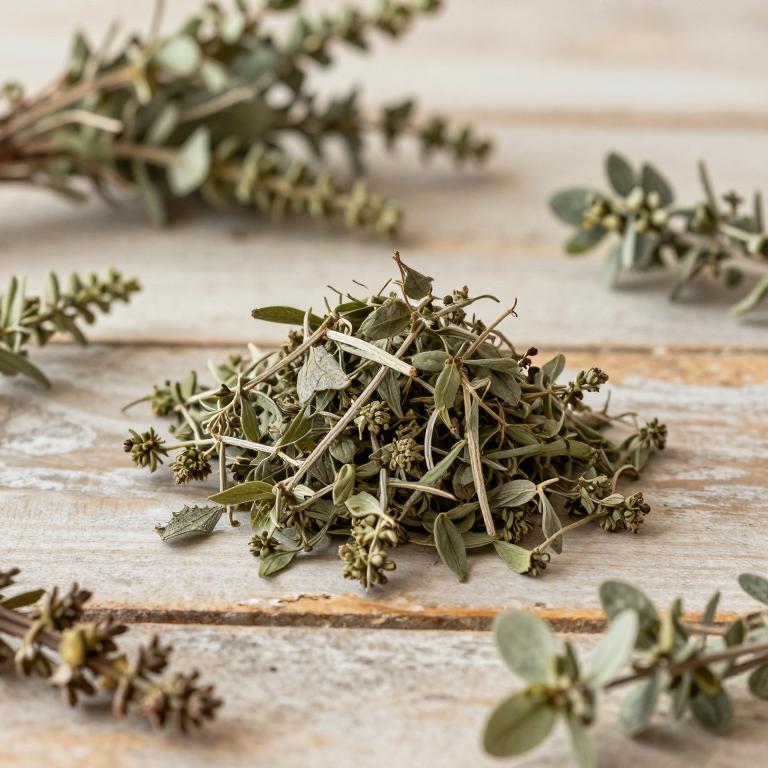
Tamarisk, scientifically known as Tamarix aphylla, is a resilient shrub renowned for its diverse therapeutic properties. Often found in arid regions, this plant is traditionally utilized in folk medicine to treat inflammatory conditions, skin ailments, and respiratory issues. Its unique chemical composition offers significant potential for modern pharmacological research.
Names and Synonyms
Common Names
- Athel Pine
- athel-pine
- atheltree
- desert tamarix
- salt-cedar
Scientific Names
Accepted name
Tamarix aphyllaSynonyms
- Tamarix faras
- Tamarix orientalis
- Tamarix furas
- Thuja aphylla
- Tetraclinis aphylla
Regional and Traditional Names
Spanish:
- taray
- Pino salado mediterráneo
German:
- Tamariske
French:
- tamaris
- Grand Tamaris
Sources: Wikidata, Catalogue of Life
Taxonomical Classification
This plant belongs to the kingdom Plantae and is classified within the phylum Streptophyta and the class Equisetopsida. As a member of the subclass Magnoliidae and the order Caryophyllales, it is placed in the family Tamaricaceae. Finally, it is categorized under the genus Tamarix.
| Rank | Classification |
|---|---|
| Kingdom | Plantae |
| Phylum | Streptophyta |
| Class | Equisetopsida |
| Subclass | Magnoliidae |
| Order | Caryophyllales |
| Family | Tamaricaceae |
| Genus | Tamarix |
Sources: The World Checklist of Vascular Plants (WCVP)
Distribution
This plant, Tamarix aphylla, exhibits a specific distribution across the Mediterranean region. In Southwestern Europe, its presence is documented within the borders of Spain. Its range extends significantly into Northern Africa, where it can be found in Morocco and Algeria. Furthermore, the species is widely distributed throughout the North African territories of Libya and Egypt. Together, these locations define the primary geographical footprint of this medicinal species.
| Region | Area |
|---|---|
| Southwestern Europe | Spain |
| Northern Africa | Algeria |
| Northern Africa | Egypt |
| Northern Africa | Libya |
| Northern Africa | Morocco |
| Northern Africa | Tunisia |
| Macaronesia | Canary Is. |
| West Tropical Africa | Mauritania |
| West Tropical Africa | Niger |
| West Tropical Africa | Senegal |
Sources: The World Checklist of Vascular Plants (WCVP)
Botanical Identification
Ecology
The ecology of Tamarix aphylla is characterized by its adaptation to specific topographical gradients, primarily thriving within a defined altitudinal belt. This species is most frequently encountered in environments ranging from a minimum elevation of 500 m AMSL to a maximum elevation of 1000 m AMSL. Within this elevational range, the plant occupies niche habitats that typically involve saline or semi-arid conditions, often associated with riparian zones or dry riverbeds where it can manage osmotic stress. Its distribution is closely tied to these mid-altitude zones, where the interplay of soil salinity, moisture availability, and temperature allows it to outcompete less salt-tolerant vegetation.
- Elevational range max:
- 1000 m AMSL
- Elevational range min:
- 500 m AMSL
Life history
The life history of Tamarix aphylla is characterized by its status as a perennial plant, allowing it to persist through multiple growing seasons and maintain a long-term presence in its ecosystem. As a phanerophyte, its regenerative buds are located on aerial shoots well above the ground, a structural adaptation that contributes to its robust growth habit. This species exhibits an evergreen nature, retaining its specialized photosynthetic structures throughout the year to ensure continuous metabolic activity. Its life form is further categorized as a phanerophyte, reflecting its ability to develop significant woody height and maintain complex branching systems over its lifespan.
- Deciduousness :
- evergreen
- Life form :
- phanerophyte
- Lifecycle :
- perennial
Morphology
The morphology of Tamarix aphylla is characterized by a woody structure that functions as a self-supporting plant. It exhibits a versatile growth form, manifesting as both a tree and a shrub, with a maximum plant height reaching approximately 10 m. As a terrestrial species, it is neither aquatic nor an epiphyte, and it maintains an independent lifestyle rather than acting as a parasite. The plant is not a climber, maintaining a self-supporting habit throughout its development.
- Aquatic :
- terrestrial
- Climber :
- self-supporting
- Epiphyte :
- terrestrial
- Growth form :
- tree
- Growth form :
- shrub
- Parasite :
- independent
- Plant height mean:
- 10 m
- Woodiness :
- woody
Physiology
The physiology of Tamarix aphylla is characterized by specialized adaptations to arid environments, most notably through its leaf morphology and metabolic processes. The plant exhibits highly reduced leaf structures, with leaf lengths typically ranging from a minimum of 0.1 cm to a maximum of 0.2 cm, a trait that minimizes surface area to reduce transpirational water loss. In terms of carbon assimilation, the species utilizes a C3 photosynthetic pathway to facilitate energy production. Furthermore, Tamarix aphylla does not function as a nitrogen fixer, relying instead on the availability of nitrogen within the soil substrate for its nutritional requirements.
- Leaf length max:
- 0.2 cm
- Leaf length min:
- 0.1 cm
- Nitrogen fixer :
- no
- Photosynthetic pathway :
- C3
Reproduction
The reproduction of Tamarix aphylla is characterized by a complex biological process involving specific phenological stages and specialized pollination mechanisms. The flowering period typically begins in October and continues through to February, demonstrating a seasonal cycle that allows for extended reproductive opportunities. The plant relies on biotic pollination syndromes to ensure successful fertilization, specifically utilizing insect-driven methods where bees play a significant role in the transfer of pollen. Once pollination is achieved, the plant develops its fruit, which is classified as a capsule. This fruit is dehiscent, meaning it undergoes a natural splitting process to facilitate the release of its seeds. The resulting seeds are notably small and lightweight, with a mean seed mass of approximately 0.000995 g, though individual seed weights vary between a minimum of 0.0004 g and a maximum of 0.00159 g.
- Dehiscence :
- dehiscent
- Flowering time :
- Oct
- Flowering time :
- Feb
- Fruit type :
- capsule
- Pollination syndrome :
- insect
- Pollination syndrome :
- bee
- Pollination syndrome :
- biotic
- Seed mass max:
- 0.00159 g
- Seed mass mean:
- 0.000995 g
- Seed mass min:
- 4e-04 g
Sources: Global Inventory of Floras and Traits (GIFT)
Plant Parts
Tamarix aphylla has 1 reported plant parts identified across 3 scientific publications and several other databases that are studied for medicinal purposes. The most consistently reported plant part include leaf.
| Plant part | Supporting sources | Consensus |
|---|---|---|
| Leaf | 3 supporting sources | ★★☆☆☆ |
Leaf
- PloS one
- TheScientificWorldJournal
- Food technology and biotechnology
Chemicals
Tamarix aphylla has 13 reported phytochemicals identified across 3 scientific publications and several other databases. The most consistently reported chemicals include Flavonoids, 6,10,14-TRIMETHYL-2-PENTADECANONE, Dehydrodigallic acid, Ellagic, Flavonoid.
| Chemical | Supporting sources | Consensus |
|---|---|---|
| Flavonoids | 3 supporting sources | ★★☆☆☆ |
| 6,10,14-TRIMETHYL-2-PENTADECANONE | 1 supporting sources | ★☆☆☆☆ |
| Dehydrodigallic acid | 1 supporting sources | ★☆☆☆☆ |
| Ellagic | 1 supporting sources | ★☆☆☆☆ |
| Flavonoid | 1 supporting sources | ★☆☆☆☆ |
| Phytol | 1 supporting sources | ★☆☆☆☆ |
| Polyphenol | 1 supporting sources | ★☆☆☆☆ |
| Sesquiterpenes | 1 supporting sources | ★☆☆☆☆ |
| Tannins | 1 supporting sources | ★☆☆☆☆ |
| Terpenoids | 1 supporting sources | ★☆☆☆☆ |
Flavonoids
- Journal of integrative medicine
- TheScientificWorldJournal
- Current pharmaceutical biotechnology
6,10,14-TRIMETHYL-2-PENTADECANONE
- Evidence-based complementary and alternative medicine : eCAM
Dehydrodigallic acid
- Saudi journal of biological sciences
Ellagic
- Applied biochemistry and biotechnology
Flavonoid
- Journal of integrative medicine
Phytol
- Saudi journal of biological sciences
Polyphenol
- Journal of integrative medicine
Sesquiterpenes
- Journal of integrative medicine
Tannins
- Journal of integrative medicine
Terpenoids
- Journal of integrative medicine
Activities
Tamarix aphylla has 2 reported activities identified across 3 scientific publications and several other databases. The most consistently reported activities include Antioxidant, Antiproliferative.
| Activity | Supporting sources | Consensus |
|---|---|---|
| Antioxidant | 2 supporting sources | ★☆☆☆☆ |
| Antiproliferative | 1 supporting sources | ★☆☆☆☆ |
Antioxidant
- Applied biochemistry and biotechnology
- Current pharmaceutical biotechnology
Antiproliferative
- Current pharmaceutical biotechnology
Conditions
Tamarix aphylla has 6 reported investigations on conditions identified across 3 scientific publications and several other databases. The most consistently reported conditions include Alzheimer's disease, Candida albicans, Enterococcus faecalis, Escherichia coli, Parkinson's disease.
| Condition | Supporting sources | Consensus |
|---|---|---|
| Alzheimer's disease | 1 supporting sources | ★☆☆☆☆ |
| Candida albicans | 1 supporting sources | ★☆☆☆☆ |
| Enterococcus faecalis | 1 supporting sources | ★☆☆☆☆ |
| Escherichia coli | 1 supporting sources | ★☆☆☆☆ |
| Parkinson's disease | 1 supporting sources | ★☆☆☆☆ |
| Pancreatic carcinoma | 1 supporting sources | ★☆☆☆☆ |
Alzheimer's disease
- Applied biochemistry and biotechnology
Candida albicans
- Molecules (Basel, Switzerland)
Enterococcus faecalis
- Molecules (Basel, Switzerland)
Escherichia coli
- Molecules (Basel, Switzerland)
Parkinson's disease
- PloS one
Pancreatic carcinoma
- Evidence-based complementary and alternative medicine : eCAM
Preparations
Tamarix aphylla has 4 reported preparations identified across 3 scientific publications and several other databases. The most consistently reported preparations include EtOAc extracts, T. aphylla extract, ethanolic extract, methanolic extract of dry leaves.
| Preparation | Supporting sources | Consensus |
|---|---|---|
| Etoac extracts | 1 supporting sources | ★☆☆☆☆ |
| T. aphylla extract | 1 supporting sources | ★☆☆☆☆ |
| Ethanolic extract | 1 supporting sources | ★☆☆☆☆ |
| Methanolic extract of dry leaves | 1 supporting sources | ★☆☆☆☆ |
Etoac extracts
- Applied biochemistry and biotechnology
T. aphylla extract
- PloS one
Ethanolic extract
- TheScientificWorldJournal
Methanolic extract of dry leaves
- Food technology and biotechnology