Sterculia striata
Sterculia striata · Accepted scientific name
Scientific literature: Very Sparse (4 studies) · ★☆☆☆☆
Sterculia striata, scientifically known as Sterculia striata, is a versatile medicinal tree native to tropical regions. Renowned for its therapeutic properties, various parts of the plant, including its bark and leaves, are utilized in traditional medicine to treat ailments such as skin infections, inflammation, and digestive issues effectively.
- Family
- Malvaceae
- Native range
- Southern America
- Parts used
- Not available
- Common names
- Not available
- Scientific synonyms
- Clompanus Striata · Sterculia Lasiantha
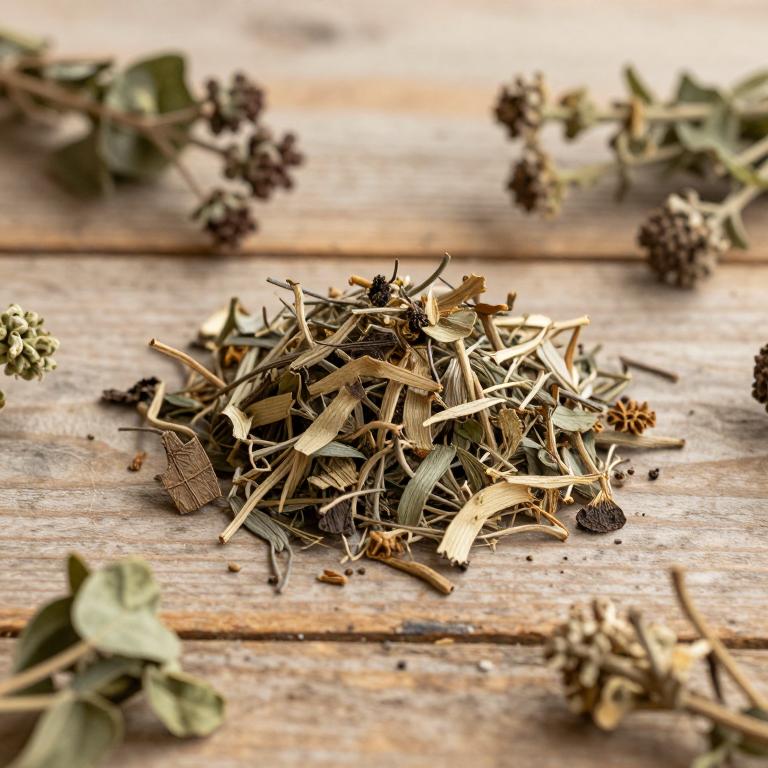
Names and Synonyms
Scientific Names
Accepted name
Sterculia striataSynonyms
- Clompanus striata
- Sterculia lasiantha
Sources: Wikidata, Catalogue of Life
Taxonomical Classification
This plant belongs to the kingdom Plantae and the phylum Streptophyta, falling under the class Equisetopsida and subclass Magnoliidae. Within the order Malvales, it is classified under the family Malvaceae. Finally, it is identified by its specific genus, Sterculia.
| Rank | Classification |
|---|---|
| Kingdom | Plantae |
| Phylum | Streptophyta |
| Class | Equisetopsida |
| Subclass | Magnoliidae |
| Order | Malvales |
| Family | Malvaceae |
| Genus | Sterculia |
Sources: The World Checklist of Vascular Plants (WCVP)
Distribution
This plant exhibits a broad presence across several regions in South America. In the western part of the continent, it can be found within the country of Bolivia. Its distribution extends extensively throughout Brazil, covering a significant portion of the landmass. Specifically, it is documented in the North, Northeast, Southeast, and West-Central regions of Brazil. These various locations highlight the plant's diverse ecological reach across the tropical landscape.
| Region | Area |
|---|---|
| Western South America | Bolivia |
| Brazil | Brazil West-Central |
| Brazil | Brazil Northeast |
| Brazil | Brazil Southeast |
| Brazil | Brazil North |
| Southern South America | Paraguay |
Sources: The World Checklist of Vascular Plants (WCVP)
Botanical Identification
Ecology
The ecology of Sterculia striata is characterized by its presence across a diverse array of Brazilian biomes and forest types, including the Caatinga (strictu sensu), Cerrado (lato sensu), Floresta Ciliar or Galeria, Floresta de Terra Firme, Floresta Estacional Semi-decidual, and Floresta Ombrófila (also known as Floresta Pluvial). This plant exhibits a specific altitudinal distribution, typically thriving at relatively low elevations. Its elevational range spans from a minimum of 100 m AMSL to a maximum of 500 m AMSL, with a mean elevation of approximately 250 m AMSL, reflecting its adaptation to these varying lowland and transitional ecological niches.
- Elevational range max:
- 500 m AMSL
- Elevational range mean:
- 250 m AMSL
- Elevational range min:
- 100 m AMSL
- Habitat :
- Caatinga (stricto sensu), Cerrado (lato sensu), Floresta Ciliar ou Galeria, Floresta de Terra Firme, Floresta Estacional Semidecidual, Floresta Ombrófila (= Floresta Pluvial)
Life history
The life history of Sterculia striata is characterized by its status as a perennial plant, allowing it to persist in its environment through multiple growing seasons. As a phanerophyte, its vital organs and buds are elevated above the ground level, typically manifesting as a woody tree structure. This species exhibits a deciduous nature, undergoing a period of leaf shedding which is often synchronized with seasonal environmental changes. Its biological strategy as a phanerophyte ensures its survival and structural dominance within its ecological niche over an extended lifespan.
- Deciduousness :
- deciduous
- Life form :
- phanerophyte
- Lifecycle :
- perennial
Morphology
The morphology of Sterculia striata is characterized by its growth form as a woody tree that is entirely self-supporting, rather than acting as a climber or a vine. As a terrestrial species, it does not exhibit aquatic or semiaquatic tendencies, nor does it function as an epiphyte or a parasite, maintaining an independent life cycle. The plant reaches significant dimensions, with an average height of approximately 12 meters and the potential to reach a maximum height of up to 22 meters.
- Aquatic :
- terrestrial
- Climber :
- self-supporting
- Epiphyte :
- terrestrial
- Growth form :
- tree
- Parasite :
- independent
- Plant height max:
- 22 m
- Plant height mean:
- 12 m
- Woodiness :
- woody
Physiology
The physiology of Sterculia striata is characterized by complex metabolic processes and specific nutrient acquisition strategies that support its growth in various tropical environments. Regarding its nutrient cycling capabilities, the plant does not function as a nitrogen fixer, meaning it lacks the symbiotic relationship with diazotrophic bacteria required to convert atmospheric nitrogen into usable forms for its own development. Instead, it relies on the uptake of nitrates and ammonium from the soil through its root system. The plant's physiological framework involves efficient photosynthetic pathways to drive biomass production and specialized secondary metabolic pathways that facilitate the synthesis of bioactive compounds. These metabolic processes are integral to its survival and its medicinal properties, allowing the plant to adapt to environmental stressors while maintaining its internal chemical balance.
- Nitrogen fixer :
- no
Sources: Global Inventory of Floras and Traits (GIFT)
Chemicals
Sterculia striata has 1 reported phytochemicals identified across 0 scientific publications and several other databases. The most consistently reported chemicals include Lupeol.
| Chemical | Supporting sources | Consensus |
|---|---|---|
| Lupeol | 1 supporting sources | ★☆☆☆☆ |
Lupeol
- Zeitschrift fur Naturforschung. C, Journal of biosciences
Activities
Sterculia striata has 1 reported activities identified across 0 scientific publications and several other databases. The most consistently reported activities include Antinociceptive.
| Activity | Supporting sources | Consensus |
|---|---|---|
| Antinociceptive | 1 supporting sources | ★☆☆☆☆ |
Antinociceptive
- Journal of medicinal food
Conditions
Sterculia striata has 2 reported investigations on conditions identified across 0 scientific publications and several other databases. The most consistently reported conditions include edema, nociception.
| Condition | Supporting sources | Consensus |
|---|---|---|
| Edema | 1 supporting sources | ★☆☆☆☆ |
| Nociception | 1 supporting sources | ★☆☆☆☆ |
Edema
- Journal of medicinal food
Nociception
- Journal of medicinal food