Sterculia africana
Sterculia africana · Accepted scientific name
Scientific literature: Very Sparse (3 studies) · ★☆☆☆☆
Sterculia africana, scientifically known as Sterculia africana, is a versatile medicinal tree native to African woodlands. Renowned for its therapeutic properties, various parts of the plant, including the bark and leaves, are utilized in traditional medicine to treat ailments such as inflammation, digestive issues, and skin infections.
- Family
- Not available
- Native range
- Africa
- Parts used
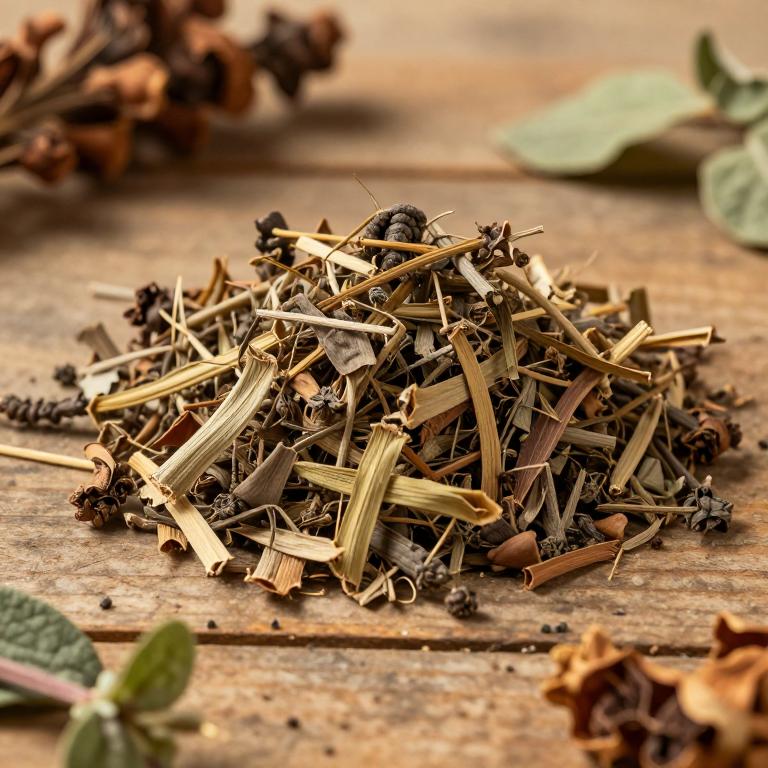
- Stem
- Common names
- Not available
- Scientific synonyms
- Not available
Names and Synonyms
Scientific Names
Accepted name
Sterculia africanaDistribution
This plant exhibits a specific geographical range concentrated within the Northeast Tropical Africa region. It can be found growing in the country of Djibouti, spanning across various local landscapes. The species is also documented in Eritrea and Ethiopia, where it adapts to the regional environment. Furthermore, its distribution extends to the island of Socotra. Finally, the plant is commonly located within the borders of Somalia.
| Region | Area |
|---|---|
| Northeast Tropical Africa | Djibouti |
| Northeast Tropical Africa | Eritrea |
| Northeast Tropical Africa | Ethiopia |
| Northeast Tropical Africa | Socotra |
| Northeast Tropical Africa | Somalia |
| Northeast Tropical Africa | Sudan-South Sudan |
| East Tropical Africa | Tanzania |
| South Tropical Africa | Angola |
| South Tropical Africa | Malawi |
| South Tropical Africa | Mozambique |
Sources: The World Checklist of Vascular Plants (WCVP)
Botanical Identification
Ecology
The ecology of Sterculia africana is characterized by its preference for specific low-to-mid altitude environments, primarily thriving within dry Acacia bushland and bushed grassland habitats. This species occupies a distinct altitudinal niche, with its distribution ranging from a minimum elevation of 106 m AMSL to a maximum elevation of 915 m AMSL. These environmental conditions suggest an adaptation to semi-arid or seasonally dry ecosystems where it coexists with various Acacia species in open or semi-open vegetation structures.
- Elevational range max:
- 915 m AMSL
- Elevational range min:
- 106 m AMSL
- Habitat :
- dry Acacia bushland and bushed grassland
Life history
The life history of Sterculia africana is characterized by its status as a perennial species, allowing it to establish long-term presence within its ecosystem. Throughout its developmental stages, the plant exhibits a deciduous growth habit, shedding its foliage in response to seasonal environmental changes or dry periods. This cyclical pattern of leaf senescence and regrowth is a fundamental aspect of its survival strategy, ensuring its persistence over many years.
- Deciduousness :
- deciduous
- Lifecycle :
- perennial
Morphology
The morphology of Sterculia africana is characterized by its stature as a robust, woody tree that functions as a self-supporting organism. Reaching significant dimensions, the plant typically attains a mean height of 10 m, with growth ranging from a minimum of 10 m to a maximum height of approximately 25 m. As a terrestrial species, it does not exhibit aquatic or semiaquatic tendencies, nor does it function as an epiphyte. The growth form is strictly tree-like, and it operates as an independent organism rather than a parasite. Furthermore, it possesses a self-supporting structure rather than a climbing habit, such as a liana or vine, maintaining its upright integrity through its woody composition.
- Aquatic :
- terrestrial
- Climber :
- self-supporting
- Epiphyte :
- terrestrial
- Growth form :
- tree
- Parasite :
- independent
- Plant height max:
- 25 m
- Plant height mean:
- 10 m
- Woodiness :
- woody
Physiology
The physiology of Sterculia africana is characterized by a standard C3 photosynthetic pathway, meaning it utilizes the Calvin cycle for carbon fixation without the specialized adaptations found in C4 or CAM plants. In terms of nutrient cycling and symbiotic relationships, the species does not function as a nitrogen fixer, lacking the specialized root nodules required to convert atmospheric nitrogen into bioavailable forms.
- Nitrogen fixer :
- no
- Photosynthetic pathway :
- C3
Reproduction
The reproduction of Sterculia africana is characterized by the production of seeds that exhibit specific morphological variations in weight. Based on quantitative data, the seed mass within a population demonstrates a range of sizes, with a recorded minimum mass of 0.063 g and a maximum mass reaching up to 0.18942 g. On average, the seed mass is measured at 0.12621 g, reflecting a standardized central tendency for the species' reproductive output.
- Seed mass max:
- 0.18942 g
- Seed mass mean:
- 0.12621 g
- Seed mass min:
- 0.063 g
Sources: Global Inventory of Floras and Traits (GIFT)
Plant Parts
Sterculia africana has 1 reported plant parts identified across 1 scientific publications and several other databases that are studied for medicinal purposes. The most consistently reported plant part include stem.
| Plant part | Supporting sources | Consensus |
|---|---|---|
| Stem | 1 supporting sources | ★☆☆☆☆ |
Stem
- Journal of parasitology research
Conditions
Sterculia africana has 2 reported investigations on conditions identified across 1 scientific publications and several other databases. The most consistently reported conditions include malaria, oral candidiasis.
| Condition | Supporting sources | Consensus |
|---|---|---|
| Malaria | 1 supporting sources | ★☆☆☆☆ |
| Oral candidiasis | 1 supporting sources | ★☆☆☆☆ |
Malaria
- Journal of parasitology research
Oral candidiasis
- Journal of ethnopharmacology
Preparations
Sterculia africana has 1 reported preparations identified across 1 scientific publications and several other databases. The most consistently reported preparations include stem bark.
| Preparation | Supporting sources | Consensus |
|---|---|---|
| Stem bark | 1 supporting sources | ★☆☆☆☆ |
Stem bark
- Journal of parasitology research