Stanhopea tigrina
Stanhopea tigrina · Accepted scientific name
Scientific literature: Very Sparse (6 studies) · ★☆☆☆☆
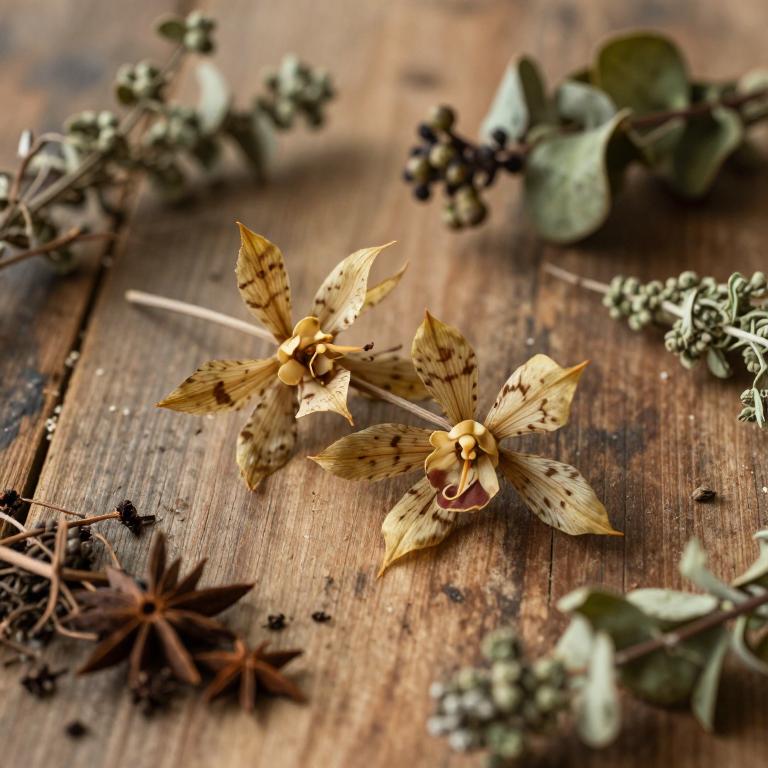
, scientifically known as Stanhopea tigrina, is a captivating orchid native to Central and South America. Renowned for its large, fragrant blooms and complex structures, this species holds significant botanical interest. Beyond its ornamental beauty, it plays a vital role in forest ecosystems, attracting specific pollinators through its intense aroma.
- Family
- Orchidaceae
- Native range
- Northern America
- Parts used
- Not available
- Common names
- Not available
- Scientific synonyms
- Not available
Names and Synonyms
Scientific Names
Accepted name
Stanhopea tigrinaRegional and Traditional Names
Spanish:
- Cabeza de víbora
Sources: Wikidata, Catalogue of Life
Taxonomical Classification
This plant belongs to the kingdom Plantae and is classified under the phylum Streptophyta and class Equisetopsida. Within the subclass Magnoliidae and order Asparagales, it is a member of the family Orchidaceae. Specifically, it is categorized under the genus Stanhopea.
| Rank | Classification |
|---|---|
| Kingdom | Plantae |
| Phylum | Streptophyta |
| Class | Equisetopsida |
| Subclass | Magnoliidae |
| Order | Asparagales |
| Family | Orchidaceae |
| Genus | Stanhopea |
Sources: The World Checklist of Vascular Plants (WCVP)
Distribution
This plant is widely distributed across several key regions within the country of Mexico. Specifically, its presence is noted throughout Mexico Central and the Mexico Northeast. It also thrives within the humid environments of the Mexico Gulf region. Furthermore, the species can be found extending into the Mexico Southwest. Finally, its geographical range encompasses the lush landscapes of the Mexico Southeast.
| Region | Area |
|---|---|
| Mexico | Mexico Central |
| Mexico | Mexico Northeast |
| Mexico | Mexico Gulf |
| Mexico | Mexico Southwest |
| Mexico | Mexico Southeast |
Sources: The World Checklist of Vascular Plants (WCVP)
Botanical Identification
Life history
The life history of Stanhopea tigrina is characterized by its status as a perennial species, meaning it persists through multiple growing seasons rather than completing a single reproductive cycle. As a long-lived epiphyte, its development follows a continuous cycle of vegetative growth and periodic flowering. The plant begins its life cycle through the germination of seeds, which require specific fungal associations to thrive, eventually developing into specialized pseudobulbs that serve as primary energy storage organs. These pseudobulbs allow the plant to withstand fluctuations in moisture and nutrients within its tropical canopy habitat. Over several years, the plant accumulates enough biomass to support the production of its complex, large-scale inflorescences. The reproductive phase is highly specialized, often synchronized with the activity of specific pollinators, such as euglossine bees, which are attracted to the intricate scents produced by the blooms. Following successful pollination, the plant enters a seed-production phase, eventually dispersing seeds to begin the cycle anew, all while maintaining its permanent vegetative presence in the ecosystem.
- Lifecycle :
- perennial
Morphology
The morphology of Stanhopea tigrina is characterized by its growth form as a non-woody herb, specifically functioning as an obligatory epiphyte rather than a terrestrial, aquatic, or semiaquatic species. Unlike lianas or vines that require external support, this plant is self-supporting in its structural habit, though it relies on host trees for its elevated position in the canopy. It exists as an independent organism, lacking any parasitic tendencies, and maintains a non-woody composition throughout its vegetative structure.
- Aquatic :
- terrestrial
- Climber :
- self-supporting
- Epiphyte :
- obligatory
- Growth form :
- herb
- Parasite :
- independent
- Woodiness :
- non-woody
Sources: Global Inventory of Floras and Traits (GIFT)
Activities
Stanhopea tigrina has 5 reported activities identified across 0 scientific publications and several other databases. The most consistently reported activities include Antioxidant, Anxiolytic, Diuretic, Hypnotic, Sedative.
| Activity | Supporting sources | Consensus |
|---|---|---|
| Antioxidant | 1 supporting sources | ★☆☆☆☆ |
| Anxiolytic | 1 supporting sources | ★☆☆☆☆ |
| Diuretic | 1 supporting sources | ★☆☆☆☆ |
| Hypnotic | 1 supporting sources | ★☆☆☆☆ |
| Sedative | 1 supporting sources | ★☆☆☆☆ |
Antioxidant
- Pharmaceuticals (Basel, Switzerland)
Anxiolytic
- Pharmaceuticals (Basel, Switzerland)
Diuretic
- Pharmaceuticals (Basel, Switzerland)
Hypnotic
- Pharmaceuticals (Basel, Switzerland)
Sedative
- Pharmaceuticals (Basel, Switzerland)
Conditions
Stanhopea tigrina has 1 reported investigations on conditions identified across 0 scientific publications and several other databases. The most consistently reported conditions include mental disorders.
| Condition | Supporting sources | Consensus |
|---|---|---|
| Mental disorders | 1 supporting sources | ★☆☆☆☆ |
Mental disorders
- Pharmaceuticals (Basel, Switzerland)