False Button Weed
Spermacoce ocymoides · Accepted scientific name
Scientific literature: Very Sparse (5 studies) · ★☆☆☆☆
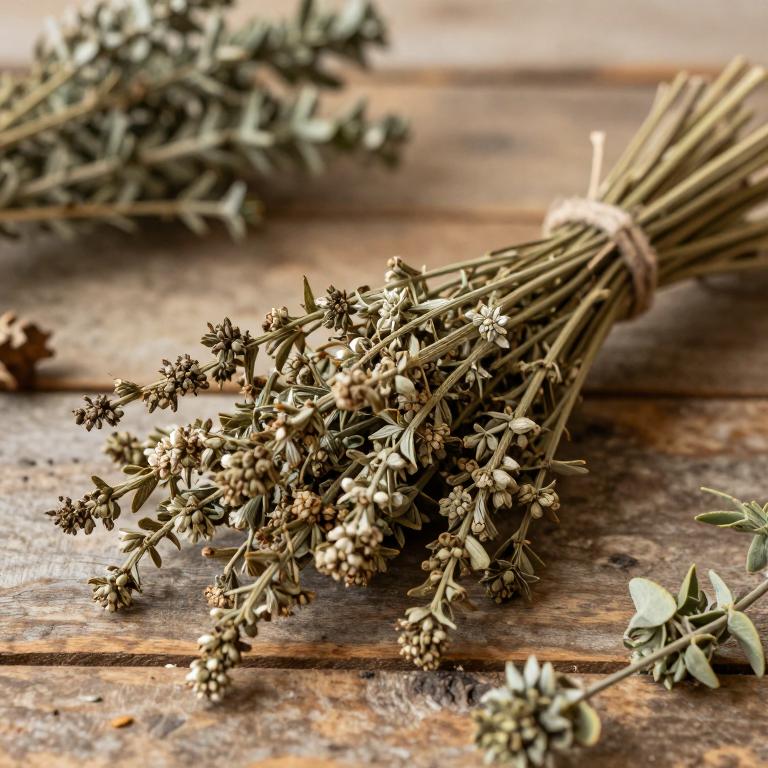
False Button Weed, scientifically known as Spermacoce ocymoides, is a resilient herbaceous plant valued in traditional medicine. Often found in tropical regions, it is recognized for its unique floral structure. This species is frequently studied for its bioactive compounds, offering significant potential in treating various ailments through natural healing.
- Family
- Rubiaceae
- Native range
- Africa
- Parts used
- Leaf
- Common names
- Basil-Like Button Weed · Prostrate False Buttonweed
- Scientific synonyms
- Bigelovia Ocymoides · Bigelovia Stricta · 13 more
Names and Synonyms
Common Names
- Basil-like Button Weed
- prostrate false buttonweed
Scientific Names
Accepted name
Spermacoce ocymoidesSynonyms
- Bigelovia ocymoides
- Bigelovia stricta
- Bigelovia tenera
- Borreria stricta
- Borreria ocymoides var. minorifolia
- Spermacoce tenera
- Spermacoce trichantha
- Tardavel ocymoides
- Tardavel stricta
- Borreria trichantha
- Borreria ocymoides
- Borreria ocymoides var. thekkumalensis
- Borreria laevicaulis
- Bigelovia laevicaulis
- Bigelovia parviflora
Regional and Traditional Names
Spanish:
- hierba del cáncer macho
Sources: Wikidata, Catalogue of Life
Taxonomical Classification
This plant belongs to the kingdom Plantae and is classified within the phylum Streptophyta and the class Equisetopsida. It falls under the subclass Magnoliidae and the order Gentianaales, specifically within the family Rubiaceae. Ultimately, its taxonomic identity is defined by its placement in the genus Spermacoce.
| Rank | Classification |
|---|---|
| Kingdom | Plantae |
| Phylum | Streptophyta |
| Class | Equisetopsida |
| Subclass | Magnoliidae |
| Order | Gentianales |
| Family | Rubiaceae |
| Genus | Spermacoce |
Sources: The World Checklist of Vascular Plants (WCVP)
Distribution
This plant, Spermacoce ocymoides, is distributed across specific regions within West Tropical Africa. Its documented presence begins in the nation of Burkina. Furthermore, the species can be found inhabiting the territory of Gambia. The geographical range also extends into Ghana and Guinea-Bissau. Finally, its distribution includes the coastal landscapes of the Ivory Coast.
| Region | Area |
|---|---|
| West Tropical Africa | Burkina |
| West Tropical Africa | Gambia |
| West Tropical Africa | Ghana |
| West Tropical Africa | Guinea-Bissau |
| West Tropical Africa | Ivory Coast |
| West Tropical Africa | Liberia |
| West Tropical Africa | Mali |
| West Tropical Africa | Nigeria |
| West Tropical Africa | Senegal |
| West Tropical Africa | Sierra Leone |
Sources: The World Checklist of Vascular Plants (WCVP)
Botanical Identification
Ecology
The ecology of Spermacoce ocymoides is characterized by its specific preference for montane environments, where it occupies a distinct vertical niche within its habitat. This species is primarily found within a precise altitudinal belt, thriving at elevations ranging from a minimum of 700 m AMSL to a maximum of 850 m AMSL. This relatively narrow elevational range suggests that the plant is adapted to the particular microclimatic conditions, soil compositions, and moisture levels found within this specific sub-montane stratum.
- Elevational range max:
- 850 m AMSL
- Elevational range min:
- 700 m AMSL
Life history
The life history of Spermacoce ocymoides is characterized by an annual lifecycle, meaning the plant completes its entire developmental process from germination to seed production within a single growing season. In terms of its ecological structure and survival strategy, it is classified as a therophyte, relying on seeds to endure unfavorable environmental conditions between growing periods. Furthermore, its growth habit identifies it as a chamaephyte, indicating that its perennating buds are located close to the soil surface, which helps the plant navigate its specific habitat requirements during its brief active phase.
- Life form :
- chamaephyte
- Life form :
- therophyte
- Lifecycle :
- annual
Morphology
Morphologically, Spermacoce ocymoides is characterized as a non-woody herb with a growth form that is strictly self-supporting rather than acting as a vine or liana. This terrestrial plant typically maintains a modest stature, with heights ranging from a minimum of approximately 0.15 m to a maximum of 0.5 m, resulting in an average plant height of 0.4 m. It functions as an independent organism, neither exhibiting parasitic behavior nor growing as an epiphyte, as it remains grounded in a terrestrial habitat.
- Aquatic :
- terrestrial
- Climber :
- self-supporting
- Epiphyte :
- terrestrial
- Growth form :
- herb
- Parasite :
- independent
- Plant height max:
- 0.5 m
- Plant height mean:
- 0.4 m
- Plant height min:
- 0.152400305 m
- Woodiness :
- non-woody
Physiology
The physiology of Spermacoce ocymoides is characterized by distinct metabolic processes and nutrient acquisition strategies adapted to its specific ecological niche. Regarding its nitrogen metabolism, the plant does not function as a nitrogen fixer, meaning it lacks the symbiotic relationship with diazotrophic bacteria (such as Rhizobium) necessary to convert atmospheric nitrogen into bioavailable forms. Consequently, its physiological survival depends entirely on the uptake of nitrates and ammonium from the surrounding soil through its root system. This dependency dictates its nutrient requirements and influences its growth patterns in nitrogen-limited environments. The plant's internal regulatory mechanisms focus on optimizing the assimilation of available soil nutrients and managing the metabolic costs associated with vegetative development and reproductive cycles.
- Nitrogen fixer :
- no
Sources: Global Inventory of Floras and Traits (GIFT)
Plant Parts
Spermacoce ocymoides has 1 reported plant parts identified across 1 scientific publications and several other databases that are studied for medicinal purposes. The most consistently reported plant part include leaf.
| Plant part | Supporting sources | Consensus |
|---|---|---|
| Leaf | 1 supporting sources | ★☆☆☆☆ |
Leaf
- The Journal of applied bacteriology
Chemicals
Spermacoce ocymoides has 4 reported phytochemicals identified across 1 scientific publications and several other databases. The most consistently reported chemicals include Cardiac Glycosides, Saponins, Tannins, polyphenols.
| Chemical | Supporting sources | Consensus |
|---|---|---|
| Cardiac Glycosides | 1 supporting sources | ★☆☆☆☆ |
| Saponins | 1 supporting sources | ★☆☆☆☆ |
| Tannins | 1 supporting sources | ★☆☆☆☆ |
| polyphenols | 1 supporting sources | ★☆☆☆☆ |
Cardiac Glycosides
- The Journal of applied bacteriology
Saponins
- The Journal of applied bacteriology
Tannins
- The Journal of applied bacteriology
polyphenols
- The Journal of applied bacteriology
Preparations
Spermacoce ocymoides has 1 reported preparations identified across 1 scientific publications and several other databases. The most consistently reported preparations include leaves.
| Preparation | Supporting sources | Consensus |
|---|---|---|
| Leaves | 1 supporting sources | ★☆☆☆☆ |
Leaves
- The Journal of applied bacteriology