Indian Red Wood
Soymida febrifuga · Accepted scientific name
Scientific literature: Very Sparse (11 studies) · ★☆☆☆☆
Indian Red Wood, scientifically known as Soymida febrifuga, is a remarkable medicinal plant renowned for its potent therapeutic properties. Traditionally utilized in various healing practices, it is primarily valued for its antipyretic capabilities to combat fevers. This resilient botanical offers significant potential for developing natural treatments in modern pharmacology.
- Family
- Meliaceae
- Native range
- Asia-Tropical
- Parts used
- Leaf · Root
- Common names
- Indian Red Wood · Indian-Redwood
- Scientific synonyms
- Swietenia Febrifuga
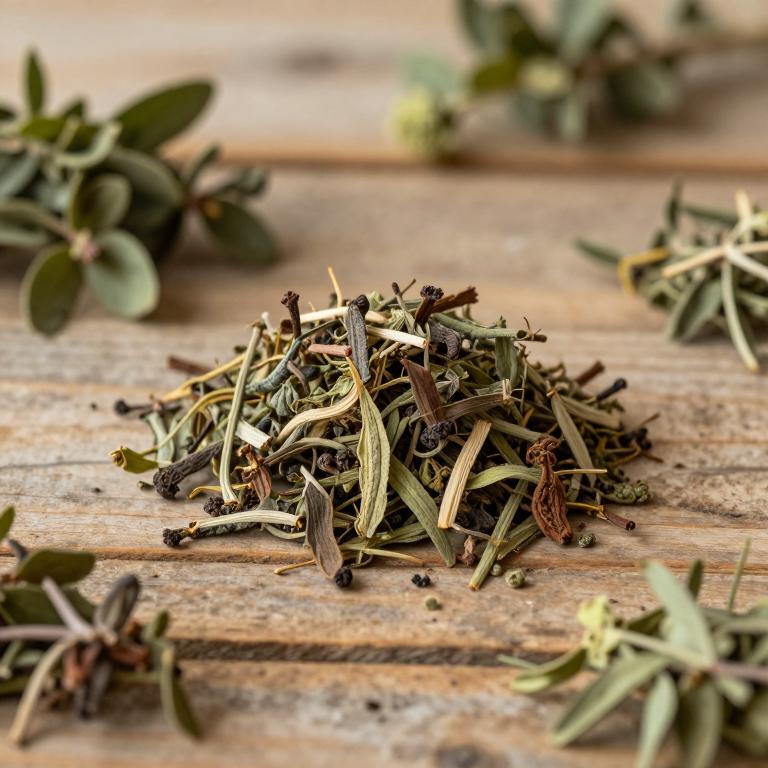
Names and Synonyms
Common Names
- Indian Red Wood
- Indian-redwood
Scientific Names
Accepted name
Soymida febrifugaSynonyms
- Swietenia febrifuga
Sources: Wikidata, Catalogue of Life
Taxonomical Classification
This plant belongs to the kingdom Plantae within the phylum Streptophyta and the class Equisetopsida. As a member of the subclass Magnoliidae, it is categorized under the order Sapindales and the family Meliaceae. Its specific taxonomic classification concludes with the genus Soymida.
| Rank | Classification |
|---|---|
| Kingdom | Plantae |
| Phylum | Streptophyta |
| Class | Equisetopsida |
| Subclass | Magnoliidae |
| Order | Sapindales |
| Family | Meliaceae |
| Genus | Soymida |
Sources: The World Checklist of Vascular Plants (WCVP)
Distribution
This plant, Soymida febrifuga, exhibits a specific geographical range concentrated within certain parts of Asia. In the Indian Subcontinent, it is widely documented across the nation of India. Its presence is also noted in the neighboring country of Bangladesh. Furthermore, the species can be found growing within the borders of Sri Lanka. Beyond the subcontinent, its distribution extends into the Indo-China region, specifically within Myanmar.
| Region | Area |
|---|---|
| Indian Subcontinent | Bangladesh |
| Indian Subcontinent | India |
| Indian Subcontinent | Sri Lanka |
| Indo-China | Myanmar |
Sources: The World Checklist of Vascular Plants (WCVP)
Botanical Identification
Life history
The life history of Soymida febrifuga is characterized by its classification as a perennial organism, allowing it to persist through multiple growing seasons rather than completing its life cycle in a single year. As a perennial species, it establishes a robust physiological foundation that supports long-term survival and repeated reproductive efforts. This longevity enables the plant to adapt to its specific ecological niche over time, developing complex root systems or storage organs that facilitate regrowth following periods of dormancy or environmental stress. Unlike annuals or biennials, its extended lifespan allows for a more stable presence within its habitat, contributing to a continuous cycle of growth, flowering, and seed dispersal across several years.
- Lifecycle :
- perennial
Morphology
The morphology of Soymida febrifuga is characterized by a tree growth form, manifesting as a robust, woody plant that can reach a significant plant height with a mean of 25 m. It is a terrestrial species, functioning as an independent organism rather than an epiphyte or a parasite, and it maintains a self-supporting structure without the need for climbing as a liana or vine.
- Aquatic :
- terrestrial
- Climber :
- self-supporting
- Epiphyte :
- terrestrial
- Growth form :
- tree
- Parasite :
- independent
- Plant height mean:
- 25 m
- Woodiness :
- woody
Physiology
The physiology of Soymida febrifuga is characterized by a metabolic framework that utilizes the C3 photosynthetic pathway, meaning it relies on the initial fixation of carbon dioxide through the enzyme RuBisCO to produce three-carbon compounds during the Calvin cycle. This pathway dictates its carbon assimilation efficiency and water-use patterns within its specific ecological niche. Furthermore, the plant does not function as a nitrogen fixer, lacking the symbiotic relationships with nitrogen-fixing bacteria or the specialized biological mechanisms required to convert atmospheric nitrogen into usable forms, and thus depends on the availability of nitrogenous compounds directly within the soil substrate for its growth and development.
- Nitrogen fixer :
- no
- Photosynthetic pathway :
- C3
Reproduction
The reproduction of Soymida febribruga is characterized by the production of seeds that exhibit a highly consistent physical profile across observed specimens. The seed mass remains uniform, with a recorded mean, maximum, and minimum value all measured at exactly 0.10152 g. This lack of variance in seed mass suggests a highly regulated developmental process during the maturation phase, ensuring that each unit of propagation maintains a standardized weight of 0.10152 g. Such precision in seed mass is a critical factor in the plant's reproductive strategy, likely influencing its dispersal mechanisms and subsequent germination success within its natural habitat.
- Seed mass mean:
- 0.10152 g
Sources: Global Inventory of Floras and Traits (GIFT)
Plant Parts
Soymida febrifuga has 2 reported plant parts identified across 2 scientific publications and several other databases that are studied for medicinal purposes. The most consistently reported plant part include leaf, root.
| Plant part | Supporting sources | Consensus |
|---|---|---|
| Leaf | 1 supporting sources | ★☆☆☆☆ |
| Root | 1 supporting sources | ★☆☆☆☆ |
Leaf
- Phytotherapy research : PTR
Root
- Investigational new drugs
Chemicals
Soymida febrifuga has 2 reported phytochemicals identified across 2 scientific publications and several other databases. The most consistently reported chemicals include METHYL ANGOLENSATE, Luteolin 7-O-glucoside.
| Chemical | Supporting sources | Consensus |
|---|---|---|
| METHYL ANGOLENSATE | 2 supporting sources | ★☆☆☆☆ |
| Luteolin 7-O-glucoside | 1 supporting sources | ★☆☆☆☆ |
METHYL ANGOLENSATE
- International journal of biomedical science : IJBS
- Investigational new drugs
Luteolin 7-O-glucoside
- International journal of biomedical science : IJBS
Activities
Soymida febrifuga has 3 reported activities identified across 2 scientific publications and several other databases. The most consistently reported activities include Antimicrobial, Antioxidant, Cytotoxic.
| Activity | Supporting sources | Consensus |
|---|---|---|
| Antimicrobial | 1 supporting sources | ★☆☆☆☆ |
| Antioxidant | 1 supporting sources | ★☆☆☆☆ |
| Cytotoxic | 1 supporting sources | ★☆☆☆☆ |
Antimicrobial
- Phytotherapy research : PTR
Antioxidant
- Phytotherapy research : PTR
Cytotoxic
- Investigational new drugs
Conditions
Soymida febrifuga has 1 reported investigations on conditions identified across 2 scientific publications and several other databases. The most consistently reported conditions include Burkitt's lymphoma.
| Condition | Supporting sources | Consensus |
|---|---|---|
| Burkitt's lymphoma | 1 supporting sources | ★☆☆☆☆ |
Burkitt's lymphoma
- Investigational new drugs
Preparations
Soymida febrifuga has 6 reported preparations identified across 2 scientific publications and several other databases. The most consistently reported preparations include aqueous extracts, crude extract of the root callus, hexane (LH) extracts, hexane extract, methanol (LM) and aqueous (LA) extracts.
| Preparation | Supporting sources | Consensus |
|---|---|---|
| Aqueous extracts | 1 supporting sources | ★☆☆☆☆ |
| Crude extract of the root callus | 1 supporting sources | ★☆☆☆☆ |
| Hexane (lh) extracts | 1 supporting sources | ★☆☆☆☆ |
| Hexane extract | 1 supporting sources | ★☆☆☆☆ |
| Methanol (lm) and aqueous (la) extracts | 1 supporting sources | ★☆☆☆☆ |
| Methanol extract | 1 supporting sources | ★☆☆☆☆ |
Aqueous extracts
- Phytotherapy research : PTR
Crude extract of the root callus
- Investigational new drugs
Hexane (lh) extracts
- Phytotherapy research : PTR
Hexane extract
- Phytotherapy research : PTR
Methanol (lm) and aqueous (la) extracts
- Phytotherapy research : PTR
Methanol extract
- Phytotherapy research : PTR