mountain karee
Searsia leptodictya · Accepted scientific name
Scientific literature: Very Sparse (2 studies) · ★☆☆☆☆
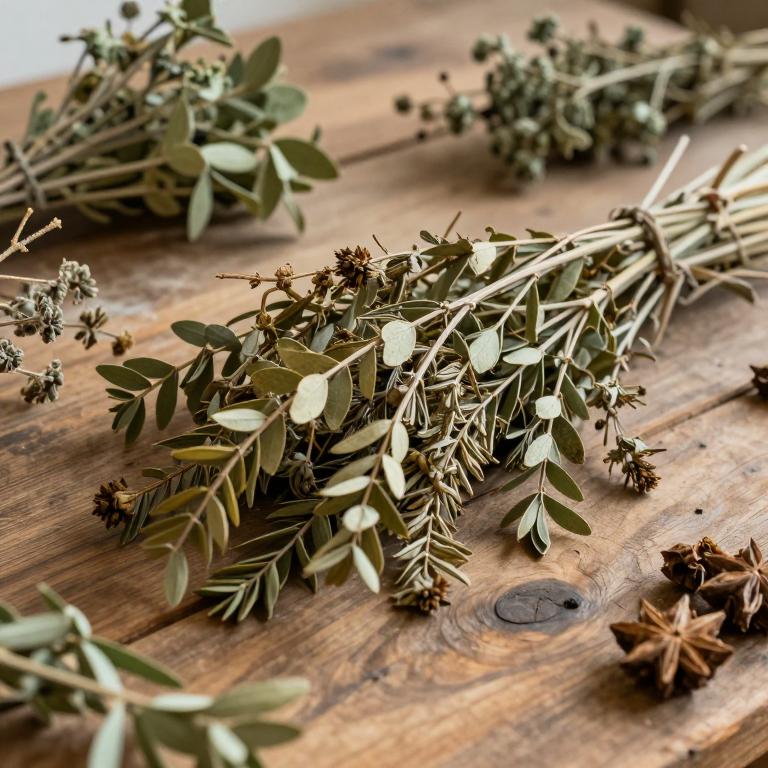
Mountain karee, scientifically known as Searsia leptodictya, is a resilient, evergreen shrub native to South Africa. Renowned for its tough, leathery leaves, this plant holds significant ethnobotanical value. Traditionally, various parts are utilized in herbal remedies to treat ailments ranging from skin irritations to digestive issues and inflammation.
Names and Synonyms
Common Names
- mountain karee
- Mountain Karee-Rhus
- Rock Karee
- Rock Karee-rhus
- Rock Rhus
Scientific Names
Accepted name
Searsia leptodictyaSynonyms
- Searsia leptodictya f. pilosa
- Rhus leptodictya f. pilosa
- Rhus leptodictya
- Rhus amerina
- Rhus rhombocarpa
Regional and Traditional Names
German:
- Berg-Kareebaum
Sources: Wikidata, Catalogue of Life
Taxonomical Classification
This plant belongs to the kingdom Plantae and the phylum Streptophyta, falling under the class Equisetopsida and subclass Magnoliidae. Within the order Sapindales and family Anacardiaceae, it is classified under the genus Searsia.
| Rank | Classification |
|---|---|
| Kingdom | Plantae |
| Phylum | Streptophyta |
| Class | Equisetopsida |
| Subclass | Magnoliidae |
| Order | Sapindales |
| Family | Anacardiaceae |
| Genus | Searsia |
Sources: The World Checklist of Vascular Plants (WCVP)
Distribution
This plant is widely distributed across several regions within the South Tropical Africa zone. Specifically, its presence has been recorded in the countries of Angola, Malawi, and Mozambique. Additionally, it can be found growing within the borders of Zimbabwe. Beyond the tropical regions, the species also extends its range into Southern Africa. This distribution pattern confirms that it is native to Botswana as well.
| Region | Area |
|---|---|
| South Tropical Africa | Angola |
| South Tropical Africa | Malawi |
| South Tropical Africa | Mozambique |
| South Tropical Africa | Zimbabwe |
| Southern Africa | Botswana |
| Southern Africa | Namibia |
| Southern Africa | Free State |
| Southern Africa | Eswatini |
| Southern Africa | Northern Provinces |
Sources: The World Checklist of Vascular Plants (WCVP)
Botanical Identification
Ecology
The ecology of Searsia leptodictya is defined by its ability to thrive across a diverse altitudinal gradient, ranging from as low as 50 m AMSL to a maximum elevation of 2000 m AMSL. This broad elevational range allows the species to inhabit various topographical zones, facilitating its presence in a variety of environmental niches. Its distribution is typically linked to specific climatic conditions and soil types found within these varying altitudes, enabling it to adapt to different temperature regimes and moisture availability levels. This ecological plasticity ensures its survival across a wide spectrum of landscapes, from lowland coastal or riverine areas to higher-altitude montane environments.
- Elevational range max:
- 2000 m AMSL
- Elevational range min:
- 50 m AMSL
Life history
The life history of Searsia leptodictya is characterized by its status as a perennial plant, allowing it to persist in its environment over many successive growing seasons. As a long-lived woody species, it undergoes a continuous developmental cycle that includes vegetative growth, maturation, and reproductive phases. Its perennial nature enables the plant to establish a robust root system and structural framework that can withstand seasonal fluctuations, facilitating repeated flowering and fruiting cycles throughout its lifespan. This enduring life cycle is essential for its ecological role and its ability to maintain stable populations within its natural habitat.
- Lifecycle :
- perennial
Morphology
The morphology of Searsia leptodictya is characterized by a woody growth form that manifests as both a tree and a shrub. As an independent organism, it does not function as a parasite or an epiphyte, maintaining a strictly terrestrial existence rather than an aquatic or semiaquatic one. The plant is self-supporting in its structure, lacking the climbing habits of a liana or vine. In terms of stature, it exhibits significant vertical development, with a plant height ranging from a minimum of 1 meter to a maximum of 9 meters.
- Aquatic :
- terrestrial
- Climber :
- self-supporting
- Epiphyte :
- terrestrial
- Growth form :
- tree
- Growth form :
- shrub
- Parasite :
- independent
- Plant height max:
- 9 m
- Plant height min:
- 1 m
- Woodiness :
- woody
Physiology
The physiology of Searsia leptodictya is characterized by a fundamental metabolic framework defined by its photosynthetic pathway, which utilizes the C3 pathway to facilitate carbon fixation. In this process, the plant captures atmospheric carbon dioxide through its stomata, where the enzyme RuBisCO incorporates the CO2 directly into a three-carbon compound during the Calvin cycle. This C3 mechanism dictates the plant's water-use efficiency and gas exchange strategies, influencing how it manages transpiration and energy production in response to environmental fluctuations. The reliance on this specific pathway shapes its overall carbon assimilation rates and governs its physiological adaptations to light intensity and temperature variations within its ecological niche.
- Photosynthetic pathway :
- C3
Reproduction
The reproduction of Searsia leptodictya is characterized by specific morphological parameters regarding its seed and fruit development. The plant produces fruits categorized by a dry texture, lacking fleshy qualities. The seeds associated with these fruits exhibit high consistency in their physical dimensions, with a recorded seed volume that remains constant at a mean, maximum, and minimum of 9.3 mm³. Furthermore, the seed mass is remarkably uniform, with the minimum, mean, and maximum values all measuring 0.00952 g, indicating a highly standardized reproductive output per seed.
- Fruit dryness :
- dry
- Seed mass mean:
- 0.00952 g
- Seed volume max:
- 9.3 mm³
Sources: Global Inventory of Floras and Traits (GIFT)
Plant Parts
Searsia leptodictya has 1 reported plant parts identified across 1 scientific publications and several other databases that are studied for medicinal purposes. The most consistently reported plant part include leaf.
| Plant part | Supporting sources | Consensus |
|---|---|---|
| Leaf | 1 supporting sources | ★☆☆☆☆ |
Leaf
- Molecules (Basel, Switzerland)
Activities
Searsia leptodictya has 1 reported activities identified across 1 scientific publications and several other databases. The most consistently reported activities include Antibacterial.
| Activity | Supporting sources | Consensus |
|---|---|---|
| Antibacterial | 1 supporting sources | ★☆☆☆☆ |
Antibacterial
- Evidence-based complementary and alternative medicine : eCAM