Bramble currant
Searsia batophylla · Accepted scientific name
Scientific literature: Very Sparse (1 studies) · ★☆☆☆☆
Bramble currant, scientifically known as Searsia batophyllia, is a versatile shrub native to Southern Africa. Highly valued in traditional medicine, its various parts are utilized to treat ailments ranging from skin irritations to digestive issues. This resilient plant offers significant ethnobotanical importance, blending ecological value with therapeutic potential.
- Family
- Anacardiaceae
- Native range
- Africa
- Parts used
- Not available
- Common names
- Bramble Crowberry · Bramble Currant · 4 more
- Scientific synonyms
- Rhus Batophylla
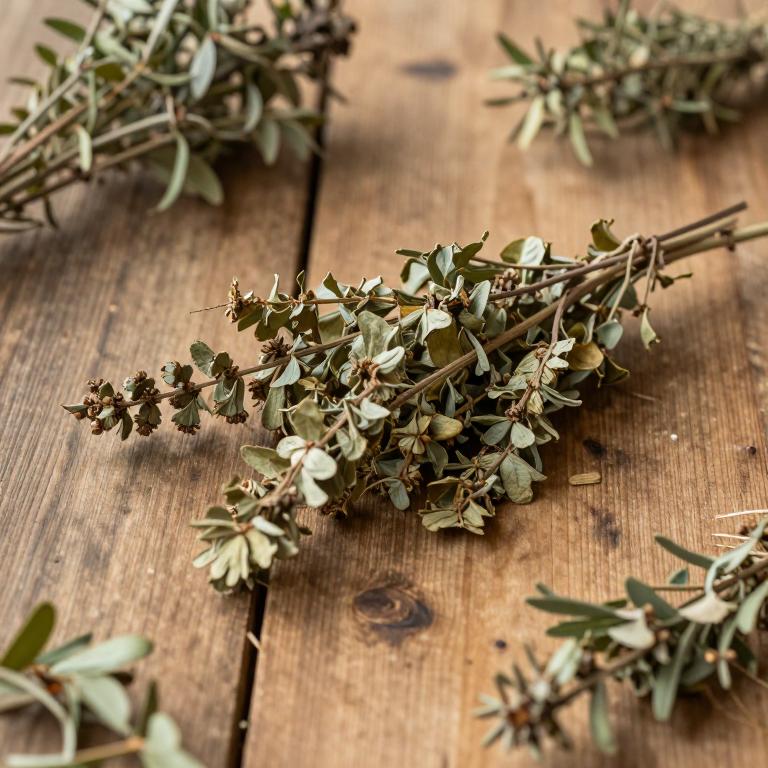
Names and Synonyms
Common Names
- Bramble Crowberry
- Bramble Currant
- Bramble Currant-Rhus
- Bramble Currantrhus
- Red-Berried Grey Karee
- Red-Berry Grey Karee
Scientific Names
Accepted name
Searsia batophyllaSynonyms
- Rhus batophylla
Sources: Wikidata, Catalogue of Life
Taxonomical Classification
This plant belongs to the kingdom Plantae and is classified under the phylum Streptophyta and class Equisetopsida. Within the subclass Magnoliidae, it is organized under the order Sapindales and the family Anacardiaceae. Finally, it is identified by its genus, Searsia.
| Rank | Classification |
|---|---|
| Kingdom | Plantae |
| Phylum | Streptophyta |
| Class | Equisetopsida |
| Subclass | Magnoliidae |
| Order | Sapindales |
| Family | Anacardiaceae |
| Genus | Searsia |
Sources: The World Checklist of Vascular Plants (WCVP)
Distribution
This plant is specifically found within the southern portion of the African continent. Its geographical range is quite localized, focusing primarily on the region of Southern Africa. Within this vast area, its presence is most notable in the Northern Provinces. This specific distribution suggests that the species thrives under the particular environmental conditions found there. Consequently, understanding these precise locations is essential for studying its natural habitat.
| Region | Area |
|---|---|
| Southern Africa | Northern Provinces |
Sources: The World Checklist of Vascular Plants (WCVP)
Botanical Identification
Ecology
The ecology of Searsia batophyllla is characterized by its adaptation to specific montane and mid-altitude environments, primarily occupying a niche defined by its altitudinal distribution. This species thrives within a distinct elevational range, typically found at altitudes starting from a minimum of 650 m AMSL and extending up to a maximum of 975 m AMSL. This relatively narrow vertical distribution suggests that the plant is specialized to the specific climatic conditions, such as temperature gradients and moisture availability, found within these sub-montane zones. Its presence within this specific elevational bracket plays a role in the structural complexity of its habitat, contributing to the local biodiversity and the stability of the ecosystems it inhabits.
- Elevational range max:
- 975 m AMSL
- Elevational range min:
- 650 m AMSL
Life history
The life history of Searsia batophyllla is characterized by its nature as a perennial organism, meaning it persists through multiple growing seasons rather than completing its cycle within a single year. As a long-lived woody species, it establishes itself in its habitat and undergoes continuous growth cycles, allowing it to develop a robust structural presence over time. This perennial lifecycle enables the plant to withstand seasonal fluctuations and invest energy into complex developmental stages, including the maturation of its root systems and the repetitive production of foliage and reproductive structures across successive years.
- Lifecycle :
- perennial
Morphology
The morphology of Searsia batophyllas is characterized by a woody growth form, primarily manifesting as a shrub or subshrub. This plant is a self-supporting, non-climbing species that grows in a terrestrial habitat, rather than being aquatic or epiphytic. It functions as an independent organism, showing no parasitic tendencies. In terms of stature, the plant typically reaches a minimum height of 1 meter, with a maximum growth potential of up to 2 meters.
- Aquatic :
- terrestrial
- Climber :
- self-supporting
- Epiphyte :
- terrestrial
- Growth form :
- shrub
- Parasite :
- independent
- Plant height max:
- 2 m
- Plant height min:
- 1 m
- Woodiness :
- woody
Reproduction
The reproduction of Searsia batophyllla is characterized by the production of specific seed units that exhibit a highly consistent mass profile. Based on empirical data, the seeds produced by this species demonstrate no variance in weight, maintaining a uniform seed mass where both the mean, maximum, and minimum values are recorded at exactly 0.01632 g. This lack of deviation in seed mass suggests a highly standardized reproductive output, ensuring that each seed carries a consistent nutrient load to support early seedling development.
- Seed mass mean:
- 0.01632 g
Sources: Global Inventory of Floras and Traits (GIFT)
Activities
Searsia batophylla has 1 reported activities identified across 0 scientific publications and several other databases. The most consistently reported activities include Antibacterial.
| Activity | Supporting sources | Consensus |
|---|---|---|
| Antibacterial | 1 supporting sources | ★☆☆☆☆ |
Antibacterial
- Evidence-based complementary and alternative medicine : eCAM