Сиксаликс атропурпуреа
Scabiosa atropurpurea · Accepted scientific name
Scientific literature: Very Sparse (9 studies) · ★☆☆☆☆
Сиксаликс атропурпуреа, scientifically known as Scabiosa atropurpurea, is a striking perennial valued for its deep purple blooms. Beyond its ornamental beauty, this plant holds traditional medicinal significance, often studied for its potential bioactive properties. It thrives in well-drained soils, adding both aesthetic charm and herbal interest to gardens.
- Family
- Caprifoliaceae
- Native range
- Europe
- Parts used
- Not available
- Common names
- Not available
- Scientific synonyms
- Asterocephalus Atropurpureus · Cyrtostemma Atropurpureum · 5 more
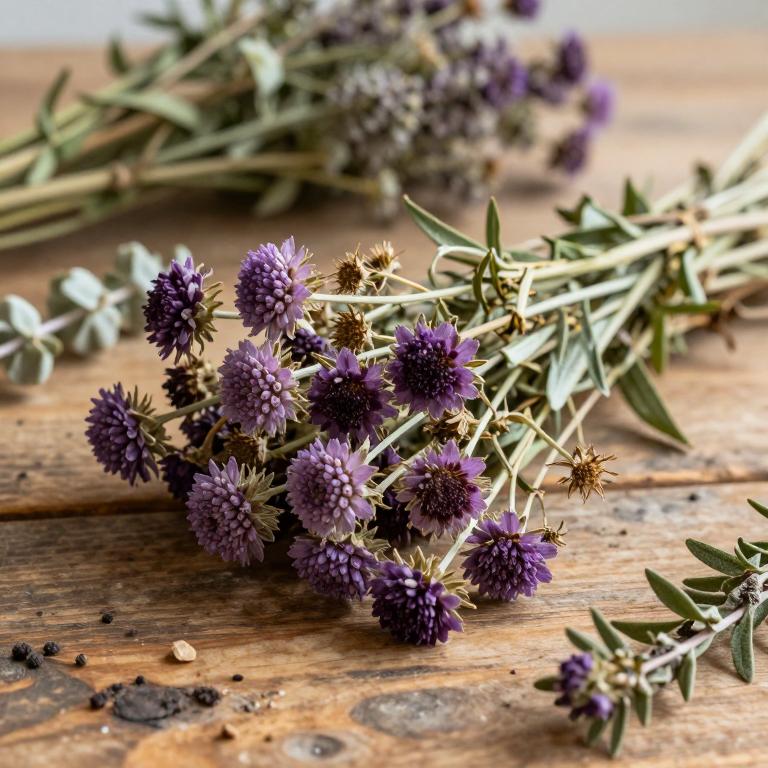
Names and Synonyms
Scientific Names
Accepted name
Scabiosa atropurpureaSynonyms
- Asterocephalus atropurpureus
- Cyrtostemma atropurpureum
- Columbaria atropurpurea
- Spongostemma atropurpureum
- Sclerostemma atropurpureum
- Sixalix atropurpurea
- Scabiosa maritima var. atropurpurea
Regional and Traditional Names
Spanish:
- Corona de clérigo
- Сомбреро де обиспо
- Скабиоза интегрированная
- Сукциза атропурпуреа
- Сиксаликс атропурпуреа
- Прекрасная дама
- Прекрасная мать
- Скабиоза крупноцветковая
- Эскабиоза морская
- Скабиоза Купани
- Астероцефалус атропурпуреус
- Сомбреро де вьюда
- Сомбреро бланко
- Ботинки дамы
- Скабиоза атеридои
- Циртостемма атропурпуреа
- Корона священника
German:
- Samt-Skabiose
Sources: Wikidata
Taxonomical Classification
This plant belongs to the kingdom Plantae and the phylum Streptophyta, falling under the class Equisetopsida and subclass Magnoliidae. Within the order Dipsacales and the family Caprifoliaceae, it is classified under the genus Scabiosa.
| Rank | Classification |
|---|---|
| Kingdom | Plantae |
| Phylum | Streptophyta |
| Class | Equisetopsida |
| Subclass | Magnoliidae |
| Order | Dipsacales |
| Family | Caprifoliaceae |
| Genus | Scabiosa |
Sources: The World Checklist of Vascular Plants (WCVP)
Distribution
This plant exhibits a diverse geographical distribution across several regions of the European continent. In Northern Europe, its presence can be documented within Great Britain. Moving into Middle Europe, the species is found inhabiting parts of Germany. Its range extends significantly into Southwestern Europe, where it grows in France and on the island of Corse. Additionally, the plant is distributed throughout the Baleares located in the same southwestern region.
| Region | Area |
|---|---|
| Northern Europe | Great Britain |
| Middle Europe | Germany |
| Southwestern Europe | Baleares |
| Southwestern Europe | Corse |
| Southwestern Europe | France |
| Southwestern Europe | Portugal |
| Southwestern Europe | Sardegna |
| Southwestern Europe | Spain |
| Southeastern Europe | Albania |
| Southeastern Europe | Bulgaria |
Sources: The World Checklist of Vascular Plants (WCVP)
Botanical Identification
Ecology
The ecology of Scabiosa atropurpurea is characterized by a broad altitudinal distribution and specific environmental preferences. This species inhabits a diverse range of elevations, beginning at sea level (0 m AMSL) and extending up to a maximum altitude of 1250 m AMSL, with a mean elevational range centered around 2600 m AMSL. In terms of landscape preference, the plant is frequently found in coastal habitats, where it adapts to the specific maritime conditions of these regions.
- Elevational range max:
- 1250 m AMSL
- Elevational range mean:
- 2600 m AMSL
- Elevational range min:
- 0 m AMSL
- Habitat :
- Coastal
Life history
The life history of Scabiosa atropurpurea is characterized by its classification as a perennial plant, allowing it to persist through multiple growing seasons. Structurally, the species exhibits a life form defined as a hemicryptophyte, meaning its perennating buds are located at or just below the soil surface, protected by leaf litter or substrate during unfavorable conditions. This developmental strategy ensures its survival and ability to re-emerge annually, maintaining a stable presence within its ecological niche.
- Life form :
- hemicryptophyte
- Lifecycle :
- perennial
Morphology
The morphology of Scabiosa atropurpurea is characterized by its growth form as a non-woody herb and forb. The plant is a terrestrial species that functions as an independent organism, lacking parasitic tendencies, and is classified as a self-supporting, non-climbing plant rather than a liana or vine. Its shoots exhibit an erect orientation, providing a stable structure for its development. In terms of stature, the plant displays variable height, with minimum measurements of 0.2 m, a mean height of 0.55 m, and a maximum height reaching up to 1.25 m.
- Aquatic :
- terrestrial
- Climber :
- self-supporting
- Epiphyte :
- terrestrial
- Growth form :
- herb
- Growth form :
- forb
- Parasite :
- independent
- Plant height max:
- 1.25 m
- Plant height mean:
- 0.55 m
- Plant height min:
- 0.2 m
- Shoot orientation :
- erect
- Woodiness :
- non-woody
Physiology
The physiology of Scabiosa atropurpurea is characterized by a C3 photosynthetic pathway, which dictates its carbon fixation processes and metabolic efficiency. Its leaf morphology plays a significant role in its resource acquisition and gas exchange, featuring an elliptic leaf form with dimensions that vary considerably. The leaf length ranges from a minimum of 1.5 cm to a maximum of 20 cm, while the leaf width exhibits a mean of 2 cm, with a minimum of 2 cm and a maximum reaching up to 12 cm. This variation results in a mean leaf size of approximately 9.4675 cm². Furthermore, the plant demonstrates a mean Specific Leaf Area (SLA) of 130.1 cm²/g, reflecting its internal leaf structure and its physiological strategy for balancing light interception with water conservation and biomass investment.
- Leaf form :
- elliptic
- Leaf length max:
- 20 cm
- Leaf length min:
- 1.5 cm
- Leaf size mean:
- 9.4675 cm²
- Leaf width max:
- 12 cm
- Leaf width mean:
- 2 cm
- Photosynthetic pathway :
- C3
- Specific Leaf Area (SLA) mean:
- 130.1 cm²/g
Reproduction
The reproduction of Scabiosa atropurpurea is characterized by a sexual process through bisexual flowers that exhibit a pink coloration. The flowering period typically begins in April and continues through August, with individual flowers measuring between 0.9 cm and 2 cm in length and ranging from 2 cm to 3 cm in width. Pollination is achieved via a biotic syndrome, specifically through insect intervention, and the plant does not exhibit self-fertilization. Following successful pollination, the plant produces indehiscent fruits classified as achenes, which reach a maximum length of 0.3 cm. These fruits are prolific, containing between 101 and 1000 seeds per fruit. The seeds themselves are quite small, with a mean mass of approximately 0.002208 g, ranging from a minimum of 0.0004 g to a maximum of 0.0063 g. Dispersal of the seeds is considered unspecialized, though it also exhibits anthropochorous tendencies.
- Dehiscence :
- indehiscent
- Dispersal syndrome :
- unspecialized
- Dispersal syndrome :
- anthropochorous
- Flower colour :
- pink
- Flower length max:
- 2 cm
- Flower length min:
- 0.9 cm
- Flower width max:
- 3 cm
- Flower width min:
- 2 cm
- Flowering time :
- Apr
- Flowering time :
- Aug
- Fruit length max:
- 0.3 cm
- Fruit type :
- achene
- Pollination syndrome :
- insect
- Pollination syndrome :
- biotic
- Reproduction sexual :
- bisexual
- Seed mass max:
- 0.0063 g
- Seed mass mean:
- 0.00220833333333333 g
- Seed mass min:
- 4e-04 g
- Seeds_per_fruit :
- 101-1000
- Self fertilization :
- absent
Sources: Global Inventory of Floras and Traits (GIFT)
Chemicals
Scabiosa atropurpurea has 5 reported phytochemicals identified across 0 scientific publications and several other databases. The most consistently reported chemicals include 1,8-Cineole, Asperosaponin VI, CHLOROGENIC ACID, Cynaroside, Lutein.
| Chemical | Supporting sources | Consensus |
|---|---|---|
| 1,8-Cineole | 1 supporting sources | ★☆☆☆☆ |
| Asperosaponin VI | 1 supporting sources | ★☆☆☆☆ |
| CHLOROGENIC ACID | 1 supporting sources | ★☆☆☆☆ |
| Cynaroside | 1 supporting sources | ★☆☆☆☆ |
| Lutein | 1 supporting sources | ★☆☆☆☆ |
1,8-Cineole
- Molecules (Basel, Switzerland)
Asperosaponin VI
- Zhongguo Zhong yao za zhi = Zhongguo zhongyao zazhi = China journal of Chinese materia medica
CHLOROGENIC ACID
- Molecules (Basel, Switzerland)
Cynaroside
- Molecules (Basel, Switzerland)
Lutein
- Molecules (Basel, Switzerland)
Activities
Scabiosa atropurpurea has 4 reported activities identified across 0 scientific publications and several other databases. The most consistently reported activities include Allelopathic, Antibacterial, Antifungal, Antioxidant.
| Activity | Supporting sources | Consensus |
|---|---|---|
| Allelopathic | 1 supporting sources | ★☆☆☆☆ |
| Antibacterial | 1 supporting sources | ★☆☆☆☆ |
| Antifungal | 1 supporting sources | ★☆☆☆☆ |
| Antioxidant | 1 supporting sources | ★☆☆☆☆ |
Allelopathic
- Molecules (Basel, Switzerland)
Antibacterial
- Molecules (Basel, Switzerland)
Antifungal
- Molecules (Basel, Switzerland)
Antioxidant
- Molecules (Basel, Switzerland)