Sarracenia psittacina
Sarracenia psittacina · Accepted scientific name
Scientific literature: Very Sparse (37 studies) · ★☆☆☆☆
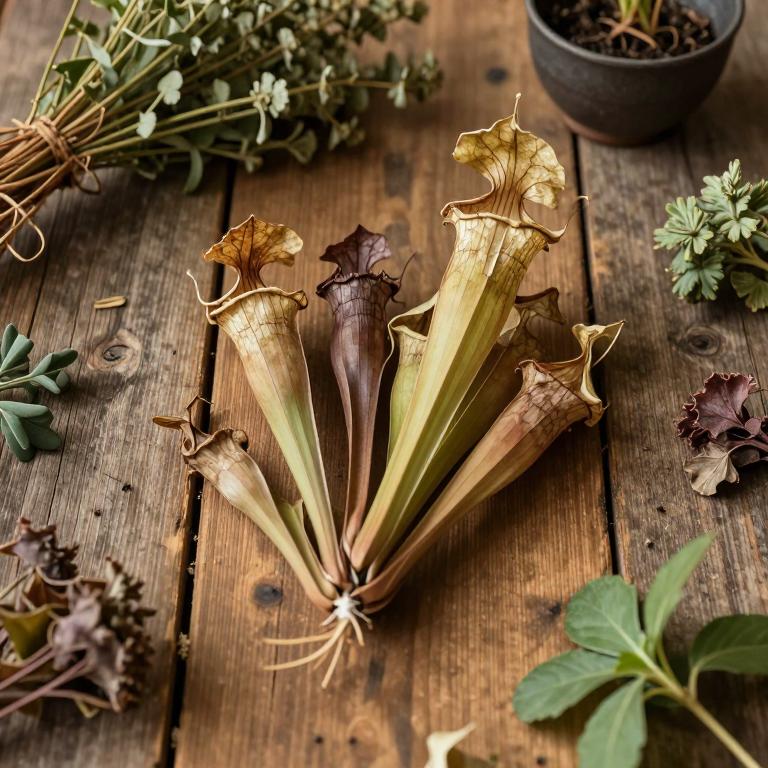
Sarracenia psittacina, scientifically known as Sarracenia psittacina, is a remarkable carnivorous pitcher plant native to North American wetlands. Often called the Parrot Pitcher due to its unique shape, it utilizes specialized foliage to trap insects, playing a vital role in nutrient cycling within its specialized ecological niche.
- Family
- Not available
- Native range
- Northern America
- Parts used
- Not available
- Common names
- Not available
- Scientific synonyms
- Not available
Names and Synonyms
Scientific Names
Accepted name
Sarracenia psittacinaDistribution
This plant is a specialized species found exclusively within the Southeastern United States. Its natural range is strictly limited to a specific cluster of Southern states. Specifically, it can be located within the borders of Alabama and Florida. The species also inhabits portions of Georgia and Mississippi. Finally, its distribution extends into the coastal regions of Louisiana.
| Region | Area |
|---|---|
| Southeastern U.S.A. | Alabama |
| Southeastern U.S.A. | Florida |
| Southeastern U.S.A. | Georgia |
| Southeastern U.S.A. | Louisiana |
| Southeastern U.S.A. | Mississippi |
Sources: The World Checklist of Vascular Plants (WCVP)
Botanical Identification
Life history
The life history of Sarracenia psittacina is characterized by a perennial lifecycle, allowing the plant to persist in its natural bog habitats over many successive growing seasons. As a perennial species, it does not die after a single reproductive cycle but instead develops robust rhizomes that facilitate long-term survival and vegetative expansion. The growth pattern involves the seasonal emergence of specialized, parrot-bill-shaped carnivorous pitchers from the base, which are replenished annually. Throughout its life, the plant undergoes distinct vegetative phases where it focuses on nutrient acquisition through insect trapping to support its slow metabolic processes, eventually transitioning into reproductive phases where it produces flowering stalks. This enduring lifecycle enables the species to navigate the fluctuations of its nutrient-poor environment, maintaining a stable presence within its ecological niche through continuous perennial development.
- Lifecycle :
- perennial
Morphology
The morphology of Sarracenia psittacina is characterized by its growth form as a non-woody herb and forb, which lacks any woody tissue throughout its structure. It functions as an independent organism, neither acting as a parasite nor as an epiphyte, as it maintains a terrestrial existence within its habitat. The plant is self-supporting rather than a climber, vine, or liana, maintaining its upright posture through its specialized vegetative structures. Although it thrives in moist environments, its ecological classification regarding moisture levels is primarily terrestrial, encompassing semiaquatic and aquatic niches within its specific wetland ecosystems.
- Aquatic :
- terrestrial
- Climber :
- self-supporting
- Epiphyte :
- terrestrial
- Growth form :
- herb
- Growth form :
- forb
- Parasite :
- independent
- Woodiness :
- non-woody
Reproduction
Reproduction in Sarracenia psittacina is a complex biological process involving the production of specialized reproductive structures that facilitate genetic dispersal. The plant produces seeds that are characterized by an extremely consistent and lightweight profile, essential for distribution via wind or water within its natural habitat. Quantitative analysis of the seed morphology reveals a highly uniform seed mass, with a mean value of 0.00169 g. This uniformity is absolute across the sampled population, as the maximum seed mass is recorded at 0.00169 g and the minimum seed mass is also 0.00169 g. This lack of variance in seed mass suggests a highly stabilized reproductive output, ensuring that each individual seed possesses the specific lightweight properties required for effective dispersal and successful germination in its ecological niche.
- Seed mass mean:
- 0.00169 g
Sources: Global Inventory of Floras and Traits (GIFT)
Chemicals
Sarracenia psittacina has 3 reported phytochemicals identified across 0 scientific publications and several other databases. The most consistently reported chemicals include Astragalin, Foeniculin, Hyperoside.
| Chemical | Supporting sources | Consensus |
|---|---|---|
| Astragalin | 1 supporting sources | ★☆☆☆☆ |
| Foeniculin | 1 supporting sources | ★☆☆☆☆ |
| Hyperoside | 1 supporting sources | ★☆☆☆☆ |
Astragalin
- Dr. Duke
Foeniculin
- Dr. Duke
Hyperoside
- Dr. Duke
Activities
Sarracenia psittacina has 34 reported activities identified across 0 scientific publications and several other databases. The most consistently reported activities include ACE-Inhibitor, Aldose-Reductase-Inhibitor, Analgesic, Antiaging, Antibacterial.
| Activity | Supporting sources | Consensus |
|---|---|---|
| ACE-Inhibitor | 1 supporting sources | ★☆☆☆☆ |
| Aldose-Reductase-Inhibitor | 1 supporting sources | ★☆☆☆☆ |
| Analgesic | 1 supporting sources | ★☆☆☆☆ |
| Antiaging | 1 supporting sources | ★☆☆☆☆ |
| Antibacterial | 1 supporting sources | ★☆☆☆☆ |
| Anticancer | 1 supporting sources | ★☆☆☆☆ |
| Anticapillary-Fragility | 1 supporting sources | ★☆☆☆☆ |
| Antidermatitic | 1 supporting sources | ★☆☆☆☆ |
| Antielastase | 1 supporting sources | ★☆☆☆☆ |
| Antiflu | 1 supporting sources | ★☆☆☆☆ |
ACE-Inhibitor
- Dr. Duke
Aldose-Reductase-Inhibitor
- Dr. Duke
Analgesic
- Dr. Duke
Antiaging
- Dr. Duke
Antibacterial
- Dr. Duke
Anticancer
- Dr. Duke
Anticapillary-Fragility
- Dr. Duke
Antidermatitic
- Dr. Duke
Antielastase
- Dr. Duke
Antiflu
- Dr. Duke