Sarracenia alata
Sarracenia alata · Accepted scientific name
Scientific literature: Very Sparse (37 studies) · ★☆☆☆☆
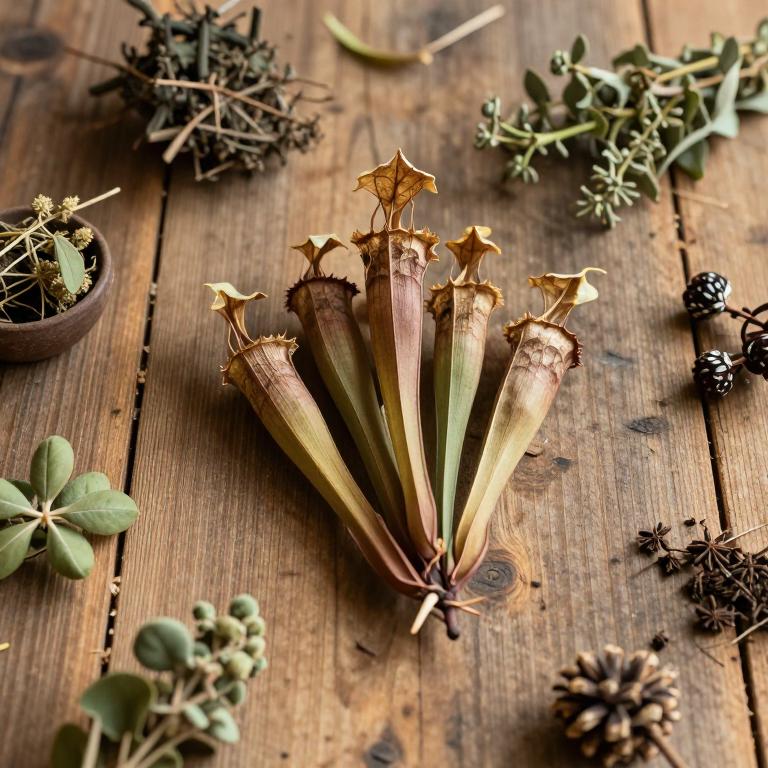
Sarracenia alata, scientifically known as Sarracenia alata, is a captivating carnivorous pitcher plant native to the southeastern United States. Renowned for its striking, trumpet-shaped leaves, it thrives in nutrient-poor wetlands by capturing and digesting insects, making it a fascinating specimen for both botanical enthusiasts and specialized collectors.
- Family
- Not available
- Native range
- Northern America
- Parts used
- Not available
- Common names
- Not available
- Scientific synonyms
- Not available
Names and Synonyms
Scientific Names
Accepted name
Sarracenia alataDistribution
This plant exhibits a specific geographical distribution concentrated within the southern regions of the United States. In the South-Central U.S.A., it can be found growing in the state of Texas. Its range extends significantly into the Southeastern U.S.A. as well. Within this southeastern region, the species is documented in Alabama and Louisiana. Furthermore, the plant is also distributed throughout the state of Mississippi.
| Region | Area |
|---|---|
| South-Central U.S.A. | Texas |
| Southeastern U.S.A. | Alabama |
| Southeastern U.S.A. | Louisiana |
| Southeastern U.S.A. | Mississippi |
Sources: The World Checklist of Vascular Plants (WCVP)
Botanical Identification
Life history
The life history of Sarracenia alata is characterized by a perennial lifecycle, allowing the plant to persist through multiple growing seasons within its native habitats. As a long-lived species, it establishes a robust rhizomatous root system that facilitates continuous growth and seasonal regeneration. Each year, the plant produces specialized leaves known as pitchers, which serve as the primary mechanism for nutrient acquisition in nutrient-poor environments. Depending on environmental conditions and resource availability, its development can exhibit variable growth rates, though it fundamentally follows a perennial pattern of seasonal emergence, maturation, and dormancy. This enduring lifecycle enables the plant to withstand fluctuations in moisture and temperature, ensuring long-term survival and the ability to reproduce over several consecutive years.
- Lifecycle :
- perennial
Morphology
The morphology of Sarracenia alata is characterized by a growth form classified as both a herb and a forb, featuring a non-woody structure that lacks any lignified tissue. As a self-supporting organism, it does not function as a climber, liana, or vine, instead maintaining its upright posture through its own structural integrity. The plant is independent in its nutritional requirements, functioning neither as an obligatory nor a facultative parasite. Regarding its habitat and ecological positioning, it is a terrestrial species rather than an epiphyte, and while it thrives in moist environments, its primary growth habit is categorized within the terrestrial, semiaquatic, or aquatic spectrum depending on the specific bog conditions.
- Aquatic :
- terrestrial
- Climber :
- self-supporting
- Epiphyte :
- terrestrial
- Growth form :
- herb
- Growth form :
- forb
- Parasite :
- independent
- Woodiness :
- non-woody
Reproduction
Reproduction in Sarracenia alata is primarily achieved through the production of numerous tiny seeds following pollination, which facilitates the dispersal and colonization of new habitats. The reproductive success of the species is closely linked to the physical characteristics of its progeny, specifically regarding the mass of the individual seeds produced. Quantitative analysis of its seed morphology reveals significant variability, with a recorded seed mass mean of 0.00124 g. This distribution spans from a minimum seed mass of 0.00049 g to a maximum seed mass of 0.00199 g, illustrating a range of developmental outputs that allow the plant to optimize its reproductive effort across varying environmental conditions.
- Seed mass max:
- 0.00199 g
- Seed mass mean:
- 0.00124 g
- Seed mass min:
- 0.00049 g
Sources: Global Inventory of Floras and Traits (GIFT)
Chemicals
Sarracenia alata has 3 reported phytochemicals identified across 0 scientific publications and several other databases. The most consistently reported chemicals include Astragalin, Foeniculin, Hyperoside.
| Chemical | Supporting sources | Consensus |
|---|---|---|
| Astragalin | 1 supporting sources | ★☆☆☆☆ |
| Foeniculin | 1 supporting sources | ★☆☆☆☆ |
| Hyperoside | 1 supporting sources | ★☆☆☆☆ |
Astragalin
- Dr. Duke
Foeniculin
- Dr. Duke
Hyperoside
- Dr. Duke
Activities
Sarracenia alata has 34 reported activities identified across 0 scientific publications and several other databases. The most consistently reported activities include ACE-Inhibitor, Aldose-Reductase-Inhibitor, Analgesic, Antiaging, Antibacterial.
| Activity | Supporting sources | Consensus |
|---|---|---|
| ACE-Inhibitor | 1 supporting sources | ★☆☆☆☆ |
| Aldose-Reductase-Inhibitor | 1 supporting sources | ★☆☆☆☆ |
| Analgesic | 1 supporting sources | ★☆☆☆☆ |
| Antiaging | 1 supporting sources | ★☆☆☆☆ |
| Antibacterial | 1 supporting sources | ★☆☆☆☆ |
| Anticancer | 1 supporting sources | ★☆☆☆☆ |
| Anticapillary-Fragility | 1 supporting sources | ★☆☆☆☆ |
| Antidermatitic | 1 supporting sources | ★☆☆☆☆ |
| Antielastase | 1 supporting sources | ★☆☆☆☆ |
| Antiflu | 1 supporting sources | ★☆☆☆☆ |
ACE-Inhibitor
- Dr. Duke
Aldose-Reductase-Inhibitor
- Dr. Duke
Analgesic
- Dr. Duke
Antiaging
- Dr. Duke
Antibacterial
- Dr. Duke
Anticancer
- Dr. Duke
Anticapillary-Fragility
- Dr. Duke
Antidermatitic
- Dr. Duke
Antielastase
- Dr. Duke
Antiflu
- Dr. Duke