Santolina Sage
Salvia santolinifolia · Accepted scientific name
Scientific literature: Very Sparse (10 studies) · ★☆☆☆☆
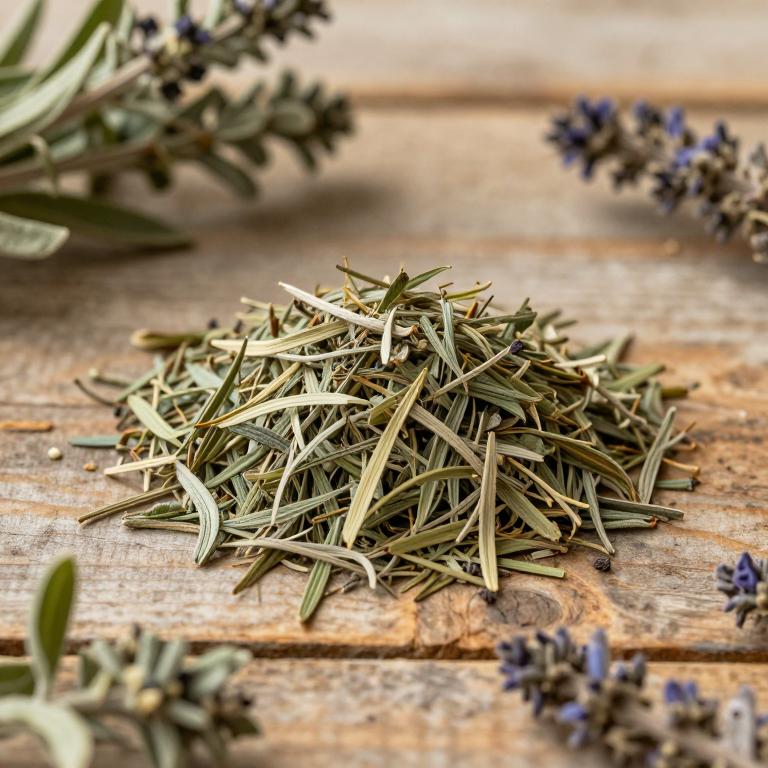
Santolina Sage, scientifically known as Salvia santolinifolia, is a resilient aromatic shrub celebrated for its therapeutic potential. Renowned for its silvery foliage and essential oils, it is traditionally utilized in herbal medicine to support digestive health, soothe skin irritations, and provide calming effects, offering a natural approach to wellness.
- Family
- Lamiaceae
- Native range
- Asia-Temperate
- Parts used
- Not available
- Common names
- Santolina Sage
- Scientific synonyms
- Pleudia Santolinifolia
Names and Synonyms
Common Names
- Santolina Sage
Scientific Names
Accepted name
Salvia santolinifoliaSynonyms
- Pleudia santolinifolia
Sources: Wikidata, Catalogue of Life
Taxonomical Classification
This plant, Salvia santolinifolia, belongs to the kingdom Plantae within the phylum Streptophyta and the class Equisetopsida. It is further classified under the subclass Magnoliidae, the order Lamiales, and the family Lamiaceae. Finally, it is situated within the genus Salvia.
| Rank | Classification |
|---|---|
| Kingdom | Plantae |
| Phylum | Streptophyta |
| Class | Equisetopsida |
| Subclass | Magnoliidae |
| Order | Lamiales |
| Family | Lamiaceae |
| Genus | Salvia |
Sources: The World Checklist of Vascular Plants (WCVP)
Distribution
This plant exhibits a wide geographical distribution spanning several distinct regions across Asia. In Western Asia, its presence is documented within the borders of both Afghanistan and Iran. Its range also extends into the Arabian Peninsula, specifically within the country of Oman. Moving toward the Indian Subcontinent, the species can be found growing in India. Finally, its habitat includes significant portions of Pakistan, completing its broad regional footprint.
| Region | Area |
|---|---|
| Western Asia | Afghanistan |
| Western Asia | Iran |
| Arabian Peninsula | Oman |
| Indian Subcontinent | India |
| Indian Subcontinent | Pakistan |
Sources: The World Checklist of Vascular Plants (WCVP)
Botanical Identification
Ecology
The ecology of Salvia santolinifolia is defined by its ability to thrive within specific altitudinal gradients, occupying diverse montane environments. This species is primarily distributed across an elevational range that extends from a minimum of 500 m AMSL to a maximum of 1800 m AMSL. This broad vertical distribution suggests an adaptability to varying microclimates, ranging from lower, potentially warmer montane foothills to higher, more temperate elevations. Such a range implies that the plant can navigate fluctuations in temperature, atmospheric pressure, and moisture availability characteristic of varying altitudes, allowing it to establish itself across a significant topographical span.
- Elevational range max:
- 1800 m AMSL
- Elevational range min:
- 500 m AMSL
Life history
The life history of Salvia santoliniifolia is characterized by its classification as a chamaephyte, a life form that dictates its survival strategy and growth pattern within its ecological niche. Specifically, it functions as a chamaephyte under both botanical life form frameworks, meaning its perennating buds are located close to the soil surface, often just above it, which allows the plant to withstand environmental stresses such as grazing or seasonal temperature fluctuations. This growth habit enables the species to maintain a low-lying profile, effectively utilizing the microclimate near the ground to protect its regenerative structures. By positioning its buds near the substrate, Salvia santoliniifolia can quickly re-emerge during favorable growing seasons, ensuring a persistent presence in its habitat through its perennial lifecycle.
- Life form :
- chamaephyte
Morphology
The morphology of Salvia santoliniifolia is characterized by its growth habit and ecological positioning, functioning as a self-supporting climber that relies on its own structural integrity rather than external support to ascend. It is an independent organism, exhibiting no parasitic tendencies toward host plants, and maintains a strictly terrestrial existence, lacking any epiphytic characteristics.
- Climber :
- self-supporting
- Epiphyte :
- terrestrial
- Parasite :
- independent
Sources: Global Inventory of Floras and Traits (GIFT)
Chemicals
Salvia santolinifolia has 3 reported phytochemicals identified across 0 scientific publications and several other databases. The most consistently reported chemicals include ALPHA-PINENE, BETA-PINENE, LIMONENE.
| Chemical | Supporting sources | Consensus |
|---|---|---|
| ALPHA-PINENE | 1 supporting sources | ★☆☆☆☆ |
| BETA-PINENE | 1 supporting sources | ★☆☆☆☆ |
| LIMONENE | 1 supporting sources | ★☆☆☆☆ |
ALPHA-PINENE
- Zeitschrift fur Naturforschung. C, Journal of biosciences
BETA-PINENE
- Zeitschrift fur Naturforschung. C, Journal of biosciences
LIMONENE
- Zeitschrift fur Naturforschung. C, Journal of biosciences
Conditions
Salvia santolinifolia has 7 reported investigations on conditions identified across 0 scientific publications and several other databases. The most consistently reported conditions include Klebsiella pneumoniae, Proteus mirabilis, Shigella boydii, Staphylococcus epidermidis, Vibrio cholerae.
| Condition | Supporting sources | Consensus |
|---|---|---|
| Klebsiella pneumoniae | 1 supporting sources | ★☆☆☆☆ |
| Proteus mirabilis | 1 supporting sources | ★☆☆☆☆ |
| Shigella boydii | 1 supporting sources | ★☆☆☆☆ |
| Staphylococcus epidermidis | 1 supporting sources | ★☆☆☆☆ |
| Vibrio cholerae | 1 supporting sources | ★☆☆☆☆ |
| Pneumonia | 1 supporting sources | ★☆☆☆☆ |
| Urinary tract infection | 1 supporting sources | ★☆☆☆☆ |
Klebsiella pneumoniae
- Pakistan journal of pharmaceutical sciences
Proteus mirabilis
- Pakistan journal of pharmaceutical sciences
Shigella boydii
- Pakistan journal of pharmaceutical sciences
Staphylococcus epidermidis
- Pakistan journal of pharmaceutical sciences
Vibrio cholerae
- Pakistan journal of pharmaceutical sciences
Pneumonia
- Pakistan journal of pharmaceutical sciences
Urinary tract infection
- Pakistan journal of pharmaceutical sciences