Greek sage
Salvia fruticosa · Accepted scientific name
Scientific literature: Very Extensive (337 studies) · ★★★★★
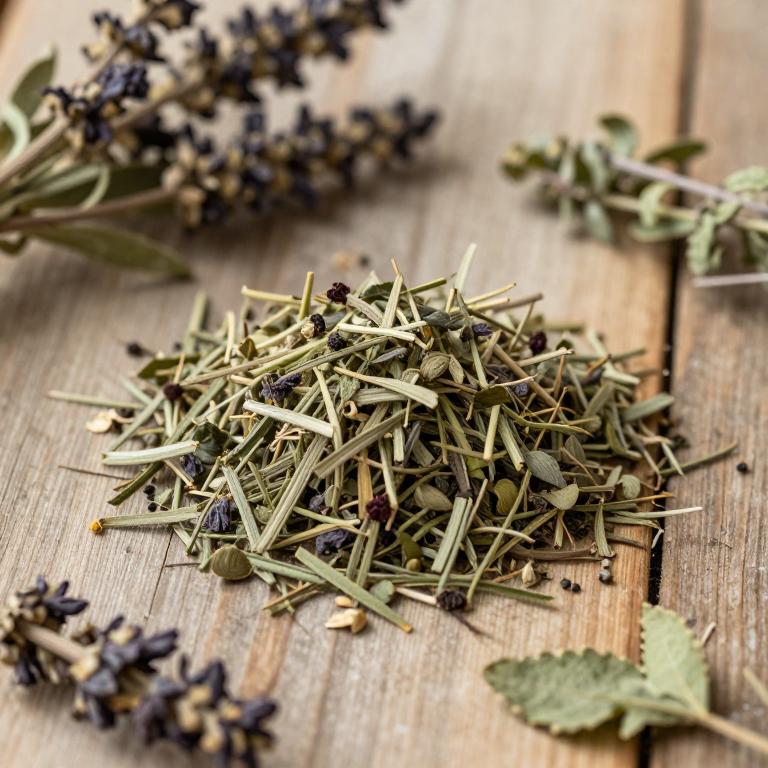
Greek sage, scientifically known as Salvia fruticosa, is a perennial shrub native to the Mediterranean region. Renowned for its aromatic, silvery-green foliage and vibrant blue flowers, this hardy plant has been used for centuries in traditional medicine to support digestive health, reduce inflammation, and promote overall wellness.
Names and Synonyms
Common Names
- Greek sage
- Greek-oregano
- three-lobe sage
- East Mediterranean Sage
Scientific Names
Accepted name
Salvia fruticosaSynonyms
- Sclarea triloba
- Salvia triloba subsp. libanotica
- Salvia triloba subsp. calpeana
- Salvia triloba var. calpeana
- Salvia subtriloba
- Salvia triloba subsp. cypria
- Salvia fruticosa subsp. cypria
- Salvia fruticosa subsp. thomasii
- Salvia triloba var. subhastata
- Salvia cypria
- Salvia clusii
- Salvia baccifera
- Salvia sipylea
- Salvia triloba
- Salvia sypilea
- Salvia thomasii
- Salvia ovata
- Salvia marrubioides
- Salvia libanotica
- Salvia lobryana
Regional and Traditional Names
Spanish:
- Salvia libanotica
- Salvia triloba subsp. calpeana
- Salvia fruticosa subsp. cypria
- Salvia incarnata
- Salvia marrubioides
- Salvia sipylea
- Salvia subtriloba
- Salvia sypilea
- Salvia lobryana
- Salvia baccifera
- Salvia cypria
- Salvia triloba subsp. libanotica
- Salvia fruticosa subsp. thomasii
- Salvia thomasii
- Salvia ovata
- Salvia triloba var. calpeana
- salvia de jardín
German:
- Griechischer Salbei
- Salvia triloba
- Dreilappiger Salbei
- griechischer Salbei
French:
- sauge arbustive
- sauge à trois lobes
- Sauge ligneuse
Sources: Wikidata, Catalogue of Life
Taxonomical Classification
This plant belongs to the kingdom Plantae and the phylum Streptophyta, falling under the class Equisetopsida and subclass Magnoliidae. Within the order Lamiales, it is classified under the family Lamiaceae and the genus Salvia.
| Rank | Classification |
|---|---|
| Kingdom | Plantae |
| Phylum | Streptophyta |
| Class | Equisetopsida |
| Subclass | Magnoliidae |
| Order | Lamiales |
| Family | Lamiaceae |
| Genus | Salvia |
Sources: The World Checklist of Vascular Plants (WCVP)
Distribution
This plant is widely distributed across several distinct regions of the Mediterranean. In Southwestern Europe, its presence is documented in both Portugal and Spain. Moving toward the eastern part of the continent, it can be found throughout Southeastern Europe. Specifically, this species inhabits the landscapes of Albania and Greece. Additionally, its geographical range extends into the Southeastern European territory of Italy.
| Region | Area |
|---|---|
| Southwestern Europe | Portugal |
| Southwestern Europe | Spain |
| Southeastern Europe | Albania |
| Southeastern Europe | Greece |
| Southeastern Europe | Italy |
| Southeastern Europe | Kriti |
| Southeastern Europe | Sicilia |
| Southeastern Europe | Türkiye-in-Europe |
| Northern Africa | Algeria |
| Northern Africa | Libya |
Sources: The World Checklist of Vascular Plants (WCVP)
Botanical Identification
Life history
The life history of Salvia fruticosa is characterized by its status as a perennial plant, allowing it to persist through multiple growing seasons and establish a stable presence within its habitat. As a nanophanerophyte, its growth form is defined by a low-growing structure where the permanent, woody stems are kept very close to the ground, typically not exceeding 25 centimeters in height. This life strategy enables the plant to endure various environmental stressors while maintaining a perennial lifecycle, ensuring its long-term survival and reproductive capability across successive years.
- Life form :
- nanophanerophyte
- Lifecycle :
- perennial
Morphology
The morphology of Salvia fruticosa is characterized by a self-supporting growth form, specifically classified as a shrub or subshrub. It possesses a woody structure and functions as an independent organism, neither acting as a parasite nor as an epiphyte, maintaining a terrestrial existence. The plant typically reaches a height ranging from a minimum of 0.3 m to a maximum of 1.5 m. Unlike climbing vines or lianas, it is entirely self-supporting and does not require external structures for elevation.
- Aquatic :
- terrestrial
- Climber :
- self-supporting
- Epiphyte :
- terrestrial
- Growth form :
- shrub
- Parasite :
- independent
- Plant height max:
- 1.5 m
- Plant height min:
- 0.3 m
- Woodiness :
- woody
Physiology
The physiological architecture of the foliage in Salvia fruticosa is characterized by significant morphological variability in leaf dimensions and structure. The leaves exhibit a distinct lobed form, a structural adaptation that influences gas exchange and surface area dynamics. In terms of longitudinal development, the leaf length is highly variable, ranging from a minimum of 1.5 cm to a maximum of 6 cm. This length is accompanied by a corresponding variation in lateral expansion, with leaf widths spanning from a narrow 0.4 cm to a broader 2 cm. These specific dimensions and the lobed morphology collectively dictate the plant's photosynthetic capacity and its ability to manage transpiration within its physiological processes.
- Leaf form :
- lobed
- Leaf length max:
- 6 cm
- Leaf length min:
- 1.5 cm
- Leaf width max:
- 2 cm
- Leaf width min:
- 0.4 cm
Reproduction
The reproduction of Salvia fruticosa is characterized by a flowering period that can vary significantly, beginning as early as December and typically concluding around June. During this reproductive phase, the plant produces blue flowers that range in length from a minimum of 1.5 cm to a maximum of 3 cm. These flowers are arranged in inflorescences that vary in length, measuring at least 0.1 m and reaching up to 0.4 m. Following pollination, the plant develops fruit in the form of an achene. These fruits are relatively small, with a length ranging from 0.2 cm to 0.28 cm and a width between 0.18 cm and 0.25 cm, and they are characterized by an indehiscent nature. The resulting seeds exhibit a mean mass of 0.00604 g, though individual seed weights can fluctuate from a minimum of 0.0004 g to a maximum of 0.00798 g.
- Dehiscence :
- indehiscent
- Flower colour :
- blue
- Flower length max:
- 3 cm
- Flower length min:
- 1.5 cm
- Flowering time :
- Dec
- Flowering time :
- Jun
- Fruit length max:
- 0.28 cm
- Fruit length min:
- 0.2 cm
- Fruit type :
- achene
- Fruit width max:
- 0.25 cm
- Fruit width min:
- 0.18 cm
- Inflorescence length max:
- 0.4 m
- Inflorescence length min:
- 0.1 m
- Seed mass max:
- 0.00798 g
- Seed mass mean:
- 0.00604 g
- Seed mass min:
- 4e-04 g
Sources: Global Inventory of Floras and Traits (GIFT)
Plant Parts
Salvia fruticosa has 1 reported plant parts identified across 1 scientific publications and several other databases that are studied for medicinal purposes. The most consistently reported plant part include leaf.
| Plant part | Supporting sources | Consensus |
|---|---|---|
| Leaf | 1 supporting sources | ★☆☆☆☆ |
Leaf
- Journal of ethnopharmacology
Chemicals
Salvia fruticosa has 44 reported phytochemicals identified across 1 scientific publications and several other databases. The most consistently reported chemicals include rosmarinic acid, 1,8-Cineole, BETA-PINENE, Carnosic acid, carnosol.
| Chemical | Supporting sources | Consensus |
|---|---|---|
| rosmarinic acid | 3 supporting sources | ★★☆☆☆ |
| 1,8-Cineole | 2 supporting sources | ★☆☆☆☆ |
| BETA-PINENE | 2 supporting sources | ★☆☆☆☆ |
| Carnosic acid | 2 supporting sources | ★☆☆☆☆ |
| carnosol | 2 supporting sources | ★☆☆☆☆ |
| 1,8-Cineol | 1 supporting sources | ★☆☆☆☆ |
| 2,3-Dehydroferruginol | 1 supporting sources | ★☆☆☆☆ |
| 2,6,11,15-Tetramethyl-hexadeca-2,6,8,10,14-pentaene | 1 supporting sources | ★☆☆☆☆ |
| 3',8,8'-Trimethoxy-3-piperidin-1-yl-2,2'-binaphthyl-1,1',4,4'-tetrone | 1 supporting sources | ★☆☆☆☆ |
| 3-Carene | 1 supporting sources | ★☆☆☆☆ |
rosmarinic acid
- Molecules (Basel, Switzerland)
- Nutrition and cancer
- Plants (Basel, Switzerland)
1,8-Cineole
- Dr. Duke
- Scientific reports
BETA-PINENE
- Dr. Duke
- Phytotherapy research : PTR
Carnosic acid
- Plant & cell physiology
- Plants (Basel, Switzerland)
carnosol
- Plant & cell physiology
- Plants (Basel, Switzerland)
1,8-Cineol
- Nutrition research (New York, N.Y.)
2,3-Dehydroferruginol
- Molecules (Basel, Switzerland)
2,6,11,15-Tetramethyl-hexadeca-2,6,8,10,14-pentaene
- Molecules (Basel, Switzerland)
3',8,8'-Trimethoxy-3-piperidin-1-yl-2,2'-binaphthyl-1,1',4,4'-tetrone
- Molecules (Basel, Switzerland)
3-Carene
- Phytotherapy research : PTR
Activities
Salvia fruticosa has 259 reported activities identified across 1 scientific publications and several other databases. The most consistently reported activities include Antioxidant, Antifertility, Antiproliferative, Hypotensive, (-)-Chronotropic.
| Activity | Supporting sources | Consensus |
|---|---|---|
| Antioxidant | 3 supporting sources | ★★☆☆☆ |
| Antifertility | 2 supporting sources | ★☆☆☆☆ |
| Antiproliferative | 2 supporting sources | ★☆☆☆☆ |
| Hypotensive | 2 supporting sources | ★☆☆☆☆ |
| (-)-Chronotropic | 1 supporting sources | ★☆☆☆☆ |
| (-)-Inotropic | 1 supporting sources | ★☆☆☆☆ |
| ACE-Inhibitor | 1 supporting sources | ★☆☆☆☆ |
| AChE-Inhibitor | 1 supporting sources | ★☆☆☆☆ |
| Abortifacient | 1 supporting sources | ★☆☆☆☆ |
| Acaricide | 1 supporting sources | ★☆☆☆☆ |
Antioxidant
- Dr. Duke
- International journal of environmental health research
- Plants (Basel, Switzerland)
Antifertility
- Dr. Duke
- Journal of ethnopharmacology
Antiproliferative
- Dr. Duke
- Nutrition and cancer
Hypotensive
- Dr. Duke
- Acta physiologica et pharmacologica Bulgarica
(-)-Chronotropic
- Dr. Duke
(-)-Inotropic
- Dr. Duke
ACE-Inhibitor
- Dr. Duke
AChE-Inhibitor
- Dr. Duke
Abortifacient
- Dr. Duke
Acaricide
- Dr. Duke
Conditions
Salvia fruticosa has 15 reported investigations on conditions identified across 1 scientific publications and several other databases. The most consistently reported conditions include Alzheimer's disease, colon cancer, hypoglycemic, Escherichia coli, Fusobacterium nucleatum.
| Condition | Supporting sources | Consensus |
|---|---|---|
| Alzheimer's disease | 4 supporting sources | ★★☆☆☆ |
| Colon cancer | 2 supporting sources | ★☆☆☆☆ |
| Hypoglycemic | 2 supporting sources | ★☆☆☆☆ |
| Escherichia coli | 1 supporting sources | ★☆☆☆☆ |
| Fusobacterium nucleatum | 1 supporting sources | ★☆☆☆☆ |
| Staphylococcus aureus | 1 supporting sources | ★☆☆☆☆ |
| Antioxidant | 1 supporting sources | ★☆☆☆☆ |
| Diarrhea | 1 supporting sources | ★☆☆☆☆ |
| Gastrointestinal disorders | 1 supporting sources | ★☆☆☆☆ |
| Hyperglycemia | 1 supporting sources | ★☆☆☆☆ |
Alzheimer's disease
- Phytotherapy research : PTR
- International journal of environmental health research
- Evidence-based complementary and alternative medicine : eCAM
- Plants (Basel, Switzerland)
Colon cancer
- Molecules (Basel, Switzerland)
- Biology
Hypoglycemic
- Journal of ethnopharmacology
- Plants (Basel, Switzerland)
Escherichia coli
- Molecules (Basel, Switzerland)
Fusobacterium nucleatum
- Journal of medicinal food
Staphylococcus aureus
- Molecules (Basel, Switzerland)
Antioxidant
- Plants (Basel, Switzerland)
Diarrhea
- Journal of ethnopharmacology
Gastrointestinal disorders
- Evidence-based complementary and alternative medicine : eCAM
Hyperglycemia
- Journal of ethnopharmacology
Preparations
Salvia fruticosa has 15 reported preparations identified across 1 scientific publications and several other databases. The most consistently reported preparations include essential oils, Decoction, Ethyl acetate extracts, Salvia triloba extract, aqueous extracts.
| Preparation | Supporting sources | Consensus |
|---|---|---|
| Essential oils | 2 supporting sources | ★☆☆☆☆ |
| Decoction | 1 supporting sources | ★☆☆☆☆ |
| Ethyl acetate extracts | 1 supporting sources | ★☆☆☆☆ |
| Salvia triloba extract | 1 supporting sources | ★☆☆☆☆ |
| Aqueous extracts | 1 supporting sources | ★☆☆☆☆ |
| Essential oils extracted from middle eastern medicinal plants using steam distillation | 1 supporting sources | ★☆☆☆☆ |
| Ethanolic extracts | 1 supporting sources | ★☆☆☆☆ |
| Hydrosols | 1 supporting sources | ★☆☆☆☆ |
| Methanolic extract | 1 supporting sources | ★☆☆☆☆ |
| Methanolic extracts | 1 supporting sources | ★☆☆☆☆ |
Essential oils
- Microorganisms
- Journal of ethnopharmacology
Decoction
- Acta physiologica et pharmacologica Bulgarica
Ethyl acetate extracts
- Journal of ethnopharmacology
Salvia triloba extract
- European review for medical and pharmacological sciences
Aqueous extracts
- Mycoses
Essential oils extracted from middle eastern medicinal plants using steam distillation
- Molecules (Basel, Switzerland)
Ethanolic extracts
- Journal of ethnopharmacology
Hydrosols
- BMC plant biology
Methanolic extract
- Fitoterapia
Methanolic extracts
- Molecules (Basel, Switzerland)