Namaqua Sage
Salvia dentata · Accepted scientific name
Scientific literature: Very Sparse (10 studies) · ★☆☆☆☆
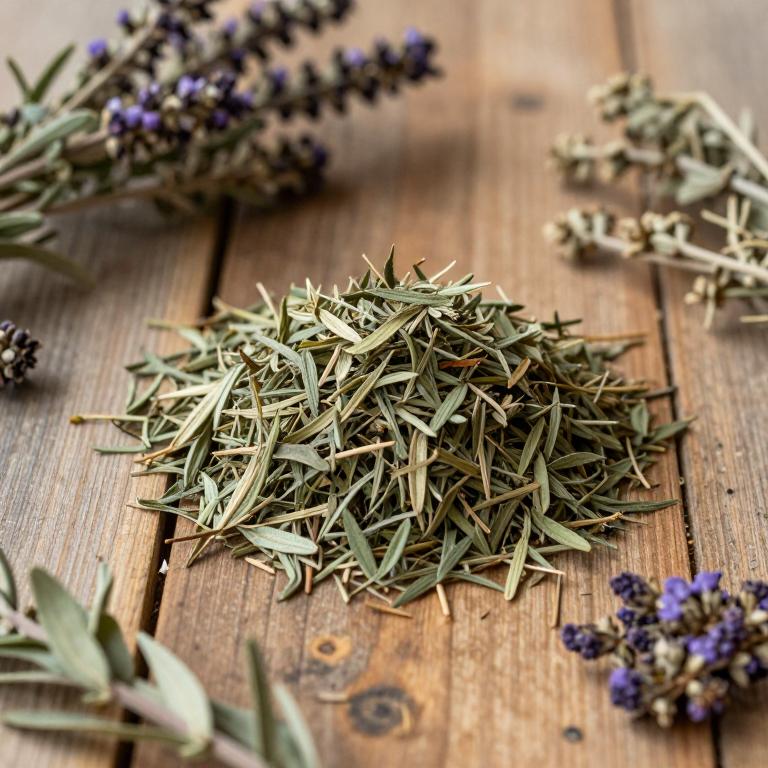
Namaqua Sage, scientifically known as Salvia dentata, is a resilient, aromatic shrub native to the arid regions of Southern Africa. Characterized by its distinctive toothed leaves and delicate blue flowers, this medicinal plant is traditionally valued for its potent essential oils, used in treating various ailments and soothing skin.
- Family
- Lamiaceae
- Native range
- Africa
- Parts used
- Not available
- Common names
- Namaqua Sage
- Scientific synonyms
- Salvia Angustifolia · Salvia Crispula · 1 more
Names and Synonyms
Common Names
- Namaqua Sage
Scientific Names
Accepted name
Salvia dentataSynonyms
- Salvia angustifolia
- Salvia crispula
- Salvia rigida
Sources: Wikidata, Catalogue of Life
Taxonomical Classification
This plant belongs to the kingdom Plantae within the phylum Streptophyta and the class Equisetopsida. Under the subclass Magnoliidae, it is categorized in the order Lamiales and the family Lamiaceae. Finally, it is classified under the genus Salvia.
| Rank | Classification |
|---|---|
| Kingdom | Plantae |
| Phylum | Streptophyta |
| Class | Equisetopsida |
| Subclass | Magnoliidae |
| Order | Lamiales |
| Family | Lamiaceae |
| Genus | Salvia |
Sources: The World Checklist of Vascular Plants (WCVP)
Distribution
This plant is primarily found within the diverse landscapes of Southern Africa. Specifically, it has a significant presence throughout the various Cape Provinces. In addition to these areas, its natural range extends into the territory of Namibia. These specific regions define the core geographical distribution of the species. Consequently, its habitat is closely tied to these southern continental environments.
| Region | Area |
|---|---|
| Southern Africa | Cape Provinces |
| Southern Africa | Namibia |
Sources: The World Checklist of Vascular Plants (WCVP)
Botanical Identification
Ecology
The ecology of Salvia dentata is characterized by its adaptability to a wide variety of topographic gradients, as it occupies a broad altitudinal spectrum. This species can be found at elevations ranging from a minimum of 151 m AMSL to a maximum of 1525 m AMSL. This expansive elevational range suggests that the plant is capable of thriving in diverse environmental conditions, from low-lying subtropical or tropical landscapes to higher, potentially more temperate montane zones. Such a wide distribution indicates a resilience to varying temperature regimes and atmospheric pressures, allowing it to colonize multiple ecological niches within its habitat.
- Elevational range max:
- 1525 m AMSL
- Elevational range min:
- 151 m AMSL
Life history
The life history of Salvia dentata is characterized by its classification as a perennial plant, allowing it to persist through multiple growing seasons. Its development typically begins with seed germination, often triggered by specific environmental cues such as moisture availability and temperature shifts. As a perennial, the plant establishes a robust root system that serves as a nutrient reservoir, enabling it to survive dormant periods and re-emerge in subsequent years. During the active growing phase, the plant undergoes vegetative growth, expanding its foliage and developing the structural components necessary for reproductive maturity. Once mature, Salvia dentata enters its reproductive cycle, producing flowering stalks that host blossoms essential for pollination. Following successful fertilization, the plant produces seeds that contribute to the next generation, while the parent organism continues its perennial life cycle, maintaining its presence in the ecosystem through successive seasons.
- Lifecycle :
- perennial
Morphology
The morphology of Salvia dentata is characterized by a woody growth form, specifically classified as a shrub or subshrub. This plant is a self-supporting organism that does not function as a climber or a liana, nor does it exhibit parasitic or epiphytic behavior, maintaining an independent and terrestrial existence. In terms of stature, it reaches a plant height ranging from a minimum of 0.6 m to a maximum of 2 m. While its ecological niche can span across aquatic, semiaquatic, and terrestrial habitats, its structural development is defined by its woody nature and upright, self-supporting habit.
- Aquatic :
- terrestrial
- Climber :
- self-supporting
- Epiphyte :
- terrestrial
- Growth form :
- shrub
- Parasite :
- independent
- Plant height max:
- 2 m
- Plant height min:
- 0.6 m
- Woodiness :
- woody
Reproduction
The reproduction of Salvia dentata is characterized by specific seed morphological properties that define its dispersal potential and establishment success. The seeds produced by this species exhibit a highly consistent mass, with no observed variation across the recorded sample. Specifically, the seed mass remains constant at a mean value of 0.00351 g, which is identical to both the maximum and minimum recorded values of 0.00351 g. This uniformity in seed mass suggests a stabilized reproductive output, where each individual seed carries a precise and predictable amount of nutrient reserves to facilitate early seedling development.
- Seed mass mean:
- 0.00351 g
Sources: Global Inventory of Floras and Traits (GIFT)
Chemicals
Salvia dentata has 4 reported phytochemicals identified across 0 scientific publications and several other databases. The most consistently reported chemicals include BORNYL ACETATE, CAMPHENE, Monoterpenes, camphor.
| Chemical | Supporting sources | Consensus |
|---|---|---|
| BORNYL ACETATE | 1 supporting sources | ★☆☆☆☆ |
| CAMPHENE | 1 supporting sources | ★☆☆☆☆ |
| Monoterpenes | 1 supporting sources | ★☆☆☆☆ |
| camphor | 1 supporting sources | ★☆☆☆☆ |
BORNYL ACETATE
- Molecules (Basel, Switzerland)
CAMPHENE
- Molecules (Basel, Switzerland)
Monoterpenes
- Molecules (Basel, Switzerland)
camphor
- Molecules (Basel, Switzerland)
Conditions
Salvia dentata has 5 reported investigations on conditions identified across 0 scientific publications and several other databases. The most consistently reported conditions include Aspergillus flavus, Aspergillus niger, Escherichia coli, H1N1 influenza virus, Staphylococcus aureus.
| Condition | Supporting sources | Consensus |
|---|---|---|
| Aspergillus flavus | 1 supporting sources | ★☆☆☆☆ |
| Aspergillus niger | 1 supporting sources | ★☆☆☆☆ |
| Escherichia coli | 1 supporting sources | ★☆☆☆☆ |
| H1n1 influenza virus | 1 supporting sources | ★☆☆☆☆ |
| Staphylococcus aureus | 1 supporting sources | ★☆☆☆☆ |
Aspergillus flavus
- Molecules (Basel, Switzerland)
Aspergillus niger
- Molecules (Basel, Switzerland)
Escherichia coli
- Molecules (Basel, Switzerland)
H1n1 influenza virus
- Molecules (Basel, Switzerland)
Staphylococcus aureus
- Molecules (Basel, Switzerland)