Atropatanian Sage
Salvia atropatana · Accepted scientific name
Scientific literature: Very Sparse (6 studies) · ★☆☆☆☆
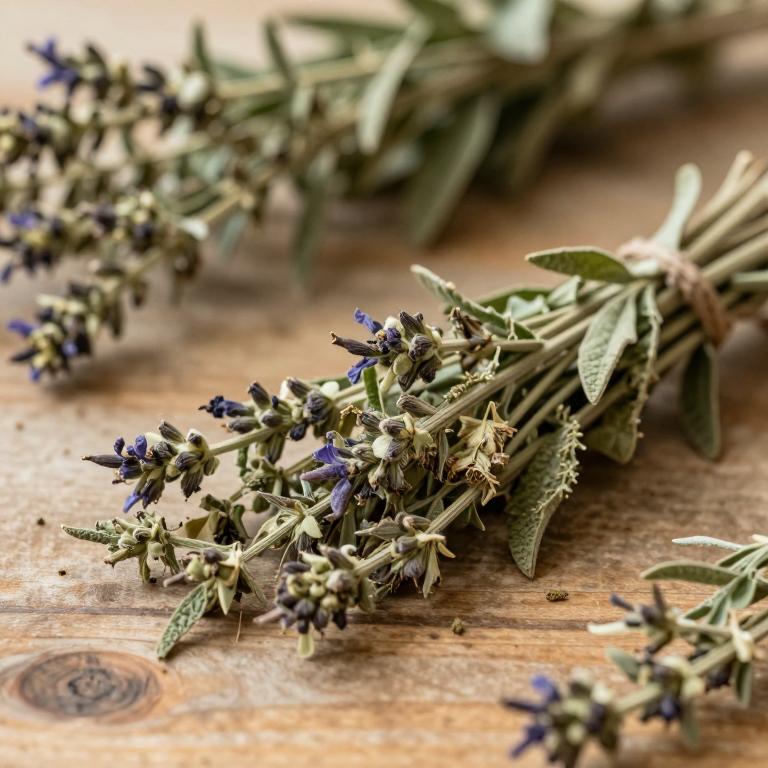
Atropatanian Sage, scientifically known as Salvia atropatana, is a rare perennial herb native to specific Mediterranean regions. Characterized by its distinctive foliage and aromatic properties, this plant holds significant interest in ethnobotany. Researchers continue to explore its unique chemical profile for potential therapeutic applications in traditional medicinal practices.
- Family
- Lamiaceae
- Native range
- Asia-Temperate
- Parts used
- Not available
- Common names
- Atropatanian Sage · Iranian Oil Sage
- Scientific synonyms
- Salvia Montbretii Var. Virescens · Salvia Bachtiarica · 6 more
Names and Synonyms
Common Names
- Atropatanian Sage
- Iranian oil sage
Scientific Names
Accepted name
Salvia atropatanaSynonyms
- Salvia montbretii var. virescens
- Salvia bachtiarica
- Salvia hypochionea
- Salvia kopetdaghensis
- Salvia kourossia
- Salvia linguifolia
- Salvia linczevskii
- Salvia lurorum
Sources: Wikidata, Catalogue of Life
Taxonomical Classification
This plant, Salvia atropatana, belongs to the kingdom Plantae within the phylum Streptophyta and the class Equisetopsida. It is further classified under the subclass Magnoliidae and the order Lamiales. Finally, it resides in the family Lamiaceae under the genus Salvia.
| Rank | Classification |
|---|---|
| Kingdom | Plantae |
| Phylum | Streptophyta |
| Class | Equisetopsida |
| Subclass | Magnoliidae |
| Order | Lamiales |
| Family | Lamiaceae |
| Genus | Salvia |
Sources: The World Checklist of Vascular Plants (WCVP)
Distribution
This plant exhibits a specific geographical range across several distinct regions of Asia. Within Central Asia, its presence is documented in the country of Turkmenistan. Moving toward Western Asia, the species can also be found throughout the territory of Iran. Its distribution continues across Western Asia to include the nation of Iraq. Finally, the plant extends its reach across Western Asia into Türkiye.
| Region | Area |
|---|---|
| Central Asia | Turkmenistan |
| Western Asia | Iran |
| Western Asia | Iraq |
| Western Asia | Türkiye |
Sources: The World Checklist of Vascular Plants (WCVP)
Botanical Identification
Ecology
The ecology of Salvia atropatana is characterized by its preference for specific high-altitude and open landscape formations. This species is primarily found inhabiting mountainous regions, where it thrives amidst the complex terrain of slopes and ridges. Within these elevated zones, it frequently colonizes shrubberies, integrating into the woody undergrowth and transitional thickets. Additionally, it is well-adapted to steppe environments, occupying the expansive, open grasslands that define these semi-arid ecosystems. These diverse habitats suggest a resilience to varying degrees of solar exposure and soil compositions typical of montane and continental landscapes.
- Habitat :
- mountains, shrubberies, steppe
Life history
The life history of Salvia atropatana is characterized by its status as a perennial organism, allowing it to persist through multiple growing seasons rather than completing its cycle within a single year. As a hemicryptophyte, its perennating buds are located at or near the soil surface, protected by leaf litter or soil during unfavorable conditions, which enables it to recover and regrow following seasonal dormancy. This life form, combined with its perennial nature, supports a stable presence within its ecological niche, where it can establish a robust root system and repeat its reproductive efforts over successive years.
- Life form :
- hemicryptophyte
- Lifecycle :
- perennial
Morphology
The morphology of Salvia atropatana is characterized by its growth form as a herb, exhibiting a non-woody structure throughout its development. The plant is self-supporting rather than a climber, maintaining an upright habit without the need for external structural assistance. It functions as an independent organism, neither acting as a parasite nor an epiphyte, as it maintains a strictly terrestrial existence. In terms of stature, the plant reaches a minimum height of 0.5 m and a maximum height of 0.8 m.
- Climber :
- self-supporting
- Epiphyte :
- terrestrial
- Growth form :
- herb
- Parasite :
- independent
- Plant height max:
- 0.8 m
- Plant height min:
- 0.5 m
- Woodiness :
- non-woody
Reproduction
The reproduction of Salvia atropatana is characterized by a specific seasonal flowering window that dictates its reproductive cycle. The flowering process is relatively concentrated, with the flowering start occurring in June. This period of floral development remains consistent through the end of the blooming cycle, which also concludes in June. Because the start and end points are synchronized within this single month, the plant exhibits a highly localized and brief flowering duration during the early summer season.
- Flowering time :
- Jun
Sources: Global Inventory of Floras and Traits (GIFT)
Chemicals
Salvia atropatana has 3 reported phytochemicals identified across 0 scientific publications and several other databases. The most consistently reported chemicals include Flavonoid, RA, rosmarinic acid.
| Chemical | Supporting sources | Consensus |
|---|---|---|
| Flavonoid | 1 supporting sources | ★☆☆☆☆ |
| RA | 1 supporting sources | ★☆☆☆☆ |
| rosmarinic acid | 1 supporting sources | ★☆☆☆☆ |
Flavonoid
- Molecules (Basel, Switzerland)
RA
- Molecules (Basel, Switzerland)
rosmarinic acid
- Molecules (Basel, Switzerland)
Conditions
Salvia atropatana has 2 reported investigations on conditions identified across 0 scientific publications and several other databases. The most consistently reported conditions include infections, wounds.
| Condition | Supporting sources | Consensus |
|---|---|---|
| Infections | 1 supporting sources | ★☆☆☆☆ |
| Wounds | 1 supporting sources | ★☆☆☆☆ |
Infections
- Molecules (Basel, Switzerland)
Wounds
- Molecules (Basel, Switzerland)