Salvia africana-caerulea (informal name)
Salvia africana · Accepted scientific name
Scientific literature: Very Sparse (3 studies) · ★☆☆☆☆
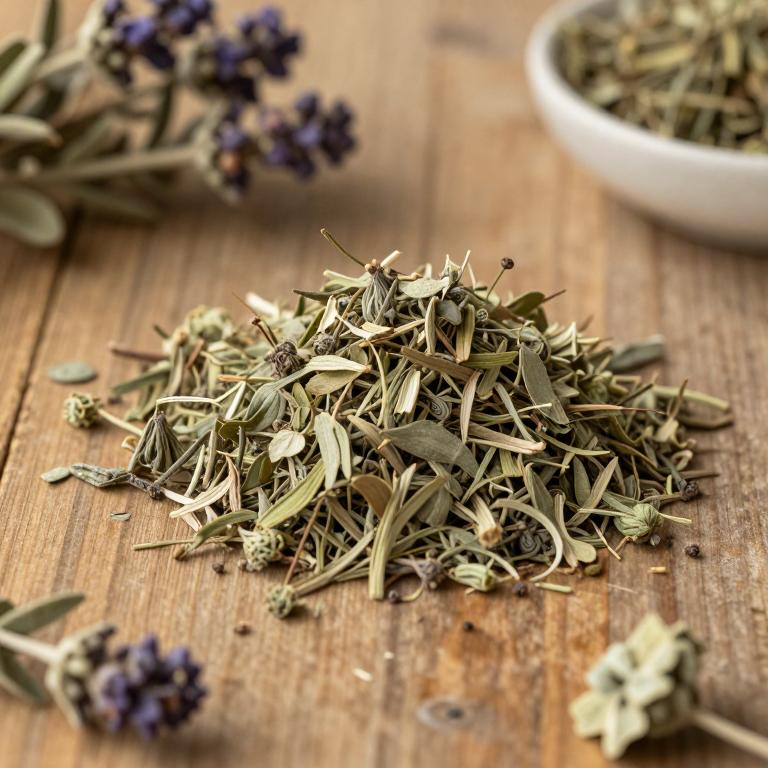
Salvia africana-caerulea (informal name), scientifically known as Salvia africana, is a remarkable perennial shrub native to Southern Africa. Renowned for its striking blue flowers and potent aromatic properties, this medicinal plant is traditionally utilized in various cultures to treat ailments ranging from digestive issues to respiratory infections and inflammation.
Names and Synonyms
Common Names
- African Blue Sage
- Aromatic Sage
- Blue Sage
- Purple sage
- Red Sage
- Wild Sage
- Wild Salvia
Scientific Names
Accepted name
Salvia africanaSynonyms
- Megyathus acetabulosum
- Stiefia molucellae
- Arischrada molucellae
- Crolocos colorata
- Salvia molucellae
- Salvia tauricola
- Salvia undulata
- Salvia integerrima
- Salvia lanuginosa
- Salvia rotundifolia
- Salvia subspathulata
- Salvia colorata
- Salvia acetabulosa
Regional and Traditional Names
Spanish:
- Salvia africana-caerulea
- Salvia africana-caerulea
German:
- Salvia africana caerulea (nom. inval.)
Sources: Wikidata, Catalogue of Life
Taxonomical Classification
This plant belongs to the kingdom Plantae and is classified under the phylum Streptophyta and the class Equisetopsida. Within the subclass Magnoliidae, it is further organized into the order Lamiales and the family Lamiaceae. Finally, it is categorized under the genus Salvia.
| Rank | Classification |
|---|---|
| Kingdom | Plantae |
| Phylum | Streptophyta |
| Class | Equisetopsida |
| Subclass | Magnoliidae |
| Order | Lamiales |
| Family | Lamiaceae |
| Genus | Salvia |
Sources: The World Checklist of Vascular Plants (WCVP)
Distribution
This plant exhibits a fragmented geographical distribution that spans across two distinct regions. In the Macaronesian islands, it can be found specifically within the Canary Islands. Moving to the African continent, its range extends significantly into the southern portion of the landmass. Specifically, it is native to the various Cape Provinces of Southern Africa. Consequently, its presence is limited to these two widely separated maritime and terrestrial locations.
| Region | Area |
|---|---|
| Macaronesia | Canary Is. |
| Southern Africa | Cape Provinces |
Sources: The World Checklist of Vascular Plants (WCVP)
Botanical Identification
Ecology
The ecology of Salvia africana is characterized by its ability to inhabit a broad altitudinal gradient, allowing it to colonize diverse topographical landscapes. It thrives across an elevational range that begins at a low altitude of 20 m AMSL and extends up to a maximum of 1097 m AMSL. This wide vertical distribution suggests a high degree of environmental plasticity, enabling the species to adapt to varying climatic conditions, temperature fluctuations, and moisture levels found between sea level and montane foothills.
- Elevational range max:
- 1097 m AMSL
- Elevational range min:
- 20 m AMSL
Life history
The life history of Salvia africana is characterized by its status as a perennial plant, allowing it to persist through multiple growing seasons. In terms of its structural growth habit and ecological positioning, it exhibits characteristics of both a phanerophyte and a nanophanerophyte, with its life form determined by the height and positioning of its persistent buds relative to the ground surface.
- Life form :
- nanophanerophyte
- Life form :
- phanerophyte
- Lifecycle :
- perennial
Morphology
The morphology of Salvia africana is characterized by a woody growth form, specifically classified as a shrub. This plant is a self-supporting species that does not function as a climber, liana, or vine, and it grows as an independent organism rather than a parasite. In terms of its ecological habitat and positioning, it is a terrestrial plant, lacking aquatic or epiphytic tendencies. The physical stature of the species varies in height, typically ranging from a minimum of 0.3 m to a maximum of 2 m.
- Aquatic :
- terrestrial
- Climber :
- self-supporting
- Epiphyte :
- terrestrial
- Growth form :
- shrub
- Parasite :
- independent
- Plant height max:
- 2 m
- Plant height min:
- 0.3 m
- Woodiness :
- woody
Physiology
The physiological profile of Salvia africana is characterized by specialized morphological adaptations designed to optimize resource acquisition and environmental resilience. A defining structural feature of its vegetative development is the leaf form, which is specifically described as obovate, a configuration that provides a broad, rounded apex tapering toward the base to maximize surface area for light interception while facilitating efficient transpiration regulation. This leaf architecture supports the plant's photosynthetic processes, allowing for robust carbon fixation within its metabolic pathways. The physiological efficiency of these obovate leaves is integral to the plant's ability to manage water potential and nutrient transport, ensuring that the structural integrity of the foliage remains intact during varying environmental stressors.
- Leaf form :
- obovate
Reproduction
The reproduction of Salvia africana is characterized by a specific flowering phenology and distinct seed morphology. The flowering period is quite extensive, typically commencing in June and continuing through to January. During this reproductive cycle, the plant produces inflorescences that can reach a maximum length of 0.3 meters, featuring flowers that are distinctly blue in color. Following pollination, the plant produces seeds with notable variations in mass; individual seeds can weigh as little as 0.00394 g, while the maximum recorded seed mass is 0.01321 g. On average, the seed mass for this species is approximately 0.0075566665 g, reflecting the specific energetic investment the plant makes into its progeny.
- Flower colour :
- blue
- Flowering time :
- Jun
- Flowering time :
- Jan
- Inflorescence length max:
- 0.3 m
- Seed mass max:
- 0.01321 g
- Seed mass mean:
- 0.0075566665 g
- Seed mass min:
- 0.00394 g
Sources: Global Inventory of Floras and Traits (GIFT)
Chemicals
Salvia africana has 2 reported phytochemicals identified across 0 scientific publications and several other databases. The most consistently reported chemicals include ACE, alpha-Amylase.
| Chemical | Supporting sources | Consensus |
|---|---|---|
| ACE | 1 supporting sources | ★☆☆☆☆ |
| alpha-Amylase | 1 supporting sources | ★☆☆☆☆ |
ACE
- Journal of ethnopharmacology
alpha-Amylase
- Journal of ethnopharmacology
Conditions
Salvia africana has 1 reported investigations on conditions identified across 0 scientific publications and several other databases. The most consistently reported conditions include E. coli.
| Condition | Supporting sources | Consensus |
|---|---|---|
| E. coli | 1 supporting sources | ★☆☆☆☆ |
E. coli
- BMC complementary and alternative medicine
Preparations
Salvia africana has 3 reported preparations identified across 0 scientific publications and several other databases. The most consistently reported preparations include methanol extracts, chloroform, n-hexane.
| Preparation | Supporting sources | Consensus |
|---|---|---|
| Methanol extracts | 2 supporting sources | ★☆☆☆☆ |
| Chloroform | 1 supporting sources | ★☆☆☆☆ |
| N-hexane | 1 supporting sources | ★☆☆☆☆ |
Methanol extracts
- Journal of ethnopharmacology
- BMC complementary and alternative medicine
Chloroform
- Journal of ethnopharmacology
N-hexane
- Journal of ethnopharmacology