Tartarian Rhubarb
Rheum tataricum · Accepted scientific name
Scientific literature: Very Sparse (9 studies) · ★☆☆☆☆
Tartarian Rhubarb, scientifically known as Rheum tataricum, is a perennial herb prized in traditional medicine for its potent therapeutic properties. Renowned for its high anthraquinone content, this plant is primarily used to support digestive health, acting as an effective natural laxative to stimulate bowel movements and relieve constipation.
- Family
- Polygonaceae
- Native range
- Europe
- Parts used
- Rhizome · Root
- Common names
- Tartarian Rhubarb
- Scientific synonyms
- Rheum Songaricum · Rheum Caspicum
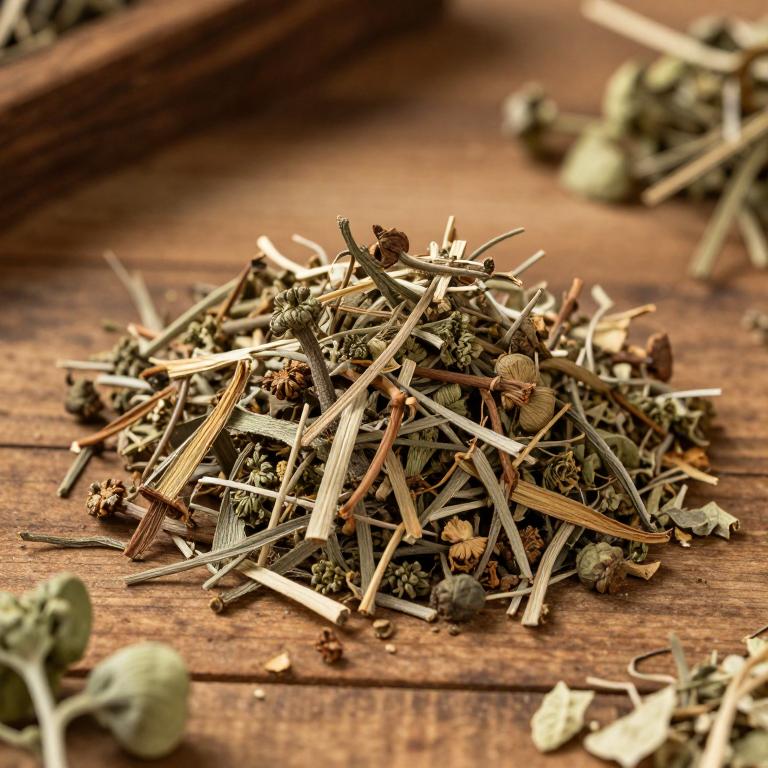
Names and Synonyms
Common Names
- Tartarian Rhubarb
Scientific Names
Accepted name
Rheum tataricumSynonyms
- Rheum songaricum
- Rheum caspicum
Sources: Wikidata, Catalogue of Life
Taxonomical Classification
This plant, Rheum tatricum, belongs to the kingdom Plantae and the phylum Streptophyta. It is classified within the class Equisetopsida and the subclass Magnoliidae, falling under the order Caryophyllales. Finally, it is a member of the family Polygonaceae and is specifically identified within the genus Rheum.
| Rank | Classification |
|---|---|
| Kingdom | Plantae |
| Phylum | Streptophyta |
| Class | Equisetopsida |
| Subclass | Magnoliidae |
| Order | Caryophyllales |
| Family | Polygonaceae |
| Genus | Rheum |
Sources: The World Checklist of Vascular Plants (WCVP)
Distribution
This plant is primarily distributed across several key regions within Eastern Europe and Central Asia. In Eastern Europe, its presence is noted throughout Ukraine and spanning across both East and South European Russia. Moving toward Central Asia, the species extends its range into the territory of Kazakhstan. Additionally, it can be found growing within the borders of Uzbekistan. Together, these locations define the specific geographical footprint of Rheum tataricum.
| Region | Area |
|---|---|
| Eastern Europe | East European Russia |
| Eastern Europe | South European Russia |
| Eastern Europe | Ukraine |
| Central Asia | Kazakhstan |
| Central Asia | Uzbekistan |
| China | Xinjiang |
Sources: The World Checklist of Vascular Plants (WCVP)
Botanical Identification
Ecology
The ecology of Rheum tataricum is characterized by its ability to colonize a diverse array of terrain, ranging from open steppe landscapes to more rugged elevated regions. It is frequently found inhabiting hills, meadows, and mountains, where it thrives in varied microclimates. Furthermore, the plant demonstrates a strong capacity for survival in stony places, indicating an adaptability to poorly developed soils and rocky substrates. This wide distribution across different topographical features allows it to establish itself in both relatively stable meadow environments and more exposed, high-altitude or rocky habitats.
- Habitat :
- hills, meadows, mountains, steppe, stony places
Life history
The life history of Rheum tatricum is characterized by its status as a perennial plant, meaning it persists through multiple growing seasons rather than completing its life cycle in a single year. As a long-lived herb typically found in alpine and subalpine environments, it undergoes a seasonal cycle of dormancy and regrowth, developing robust rhizomes that serve as energy reservoirs to survive harsh winter conditions. Each year, the plant emerges from its underground structures to produce foliage and, once mature, develops inflorescences to facilitate reproduction. This perennial nature allows the species to establish stable populations within its specific high-altitude niches, relying on its ability to regrow from its perennial root system year after year.
- Lifecycle :
- perennial
Morphology
The morphology of Rheum tatricum is characterized by its growth form as a herb, exhibiting a distinctly non-woody structure. The plant maintains a relatively low stature, with a recorded plant height ranging from a minimum of 0.35 m to a maximum of 0.5 m, resulting in an average plant height of approximately 0.425 m.
- Growth form :
- herb
- Plant height max:
- 0.5 m
- Plant height mean:
- 0.425 m
- Plant height min:
- 0.35 m
- Woodiness :
- non-woody
Reproduction
The reproduction of Rheum tatricum is characterized by a specific flowering window and the development of small, distinct fruits. The flowering period typically commences in April and concludes in May, though the timing can be variable depending on environmental conditions. Following pollination, the plant produces fruits that exhibit specific morphological dimensions. The fruit length generally ranges from a minimum of 1 cm to a maximum of 1.2 cm, with a mean length of approximately 1.1 cm. Similarly, the fruit width varies between a minimum of 0.6 cm and a maximum of 0.9 cm, maintaining an average width of 0.75 cm.
- Flowering time :
- Apr
- Flowering time :
- May
- Fruit length max:
- 1.2 cm
- Fruit length mean:
- 1.1 cm
- Fruit length min:
- 1 cm
- Fruit width max:
- 0.9 cm
- Fruit width mean:
- 0.75 cm
- Fruit width min:
- 0.6 cm
Sources: Global Inventory of Floras and Traits (GIFT)
Plant Parts
Rheum tataricum has 2 reported plant parts identified across 2 scientific publications and several other databases that are studied for medicinal purposes. The most consistently reported plant part include rhizome, root.
| Plant part | Supporting sources | Consensus |
|---|---|---|
| Rhizome | 1 supporting sources | ★☆☆☆☆ |
| Root | 1 supporting sources | ★☆☆☆☆ |
Rhizome
- Plants (Basel, Switzerland)
Root
- Plants (Basel, Switzerland)
Chemicals
Rheum tataricum has 5 reported phytochemicals identified across 2 scientific publications and several other databases. The most consistently reported chemicals include Anthraquinones, Flavonoids, Stilbenes, Tannins, resveratrol.
| Chemical | Supporting sources | Consensus |
|---|---|---|
| Anthraquinones | 1 supporting sources | ★☆☆☆☆ |
| Flavonoids | 1 supporting sources | ★☆☆☆☆ |
| Stilbenes | 1 supporting sources | ★☆☆☆☆ |
| Tannins | 1 supporting sources | ★☆☆☆☆ |
| resveratrol | 1 supporting sources | ★☆☆☆☆ |
Anthraquinones
- Plants (Basel, Switzerland)
Flavonoids
- Plants (Basel, Switzerland)
Stilbenes
- Phytochemistry
Tannins
- Plants (Basel, Switzerland)
resveratrol
- Phytochemistry