Giant Knotweed
Reynoutria sachalinensis · Accepted scientific name
Scientific literature: Very Sparse (20 studies) · ★☆☆☆☆
Giant Knotweed, scientifically known as Reynoutria sachalinensis, is a robust perennial herb valued in traditional medicine. Renowned for its bioactive compounds, particularly resveratrol and stilbenes, it offers significant antioxidant and anti-inflammatory properties. This resilient plant serves as a promising natural resource for developing modern therapeutic treatments and supplements.
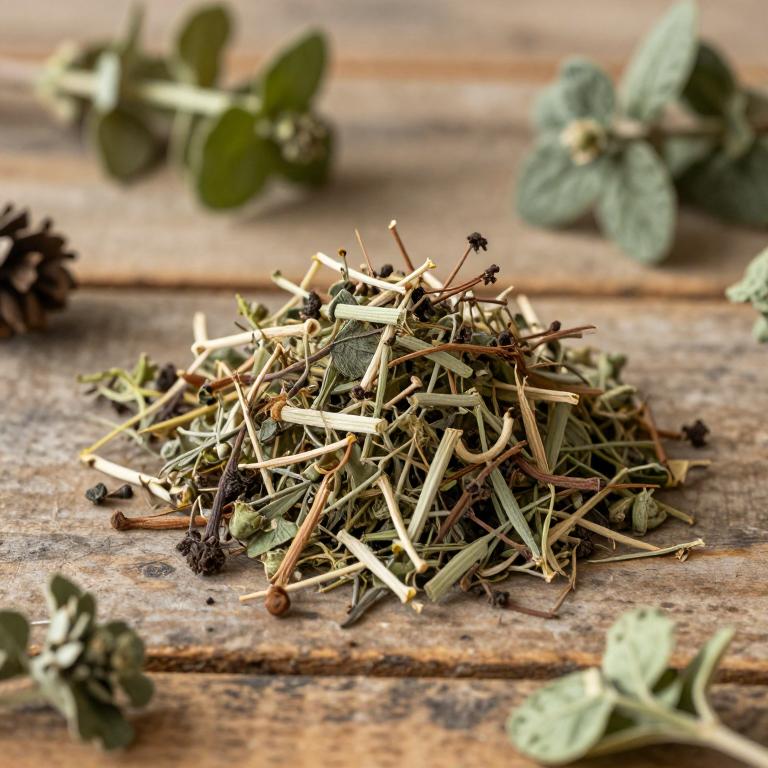
Names and Synonyms
Common Names
- Sachaline knotweed
- Sakhalin knotweed
- giant knotweed
- sacaline
Scientific Names
Accepted name
Reynoutria sachalinensisSynonyms
- Reynoutria sachalinensis var. brachyphylla
- Fallopia sachalinensis
- Polygonum sachalinense
- Tiniaria sachalinensis
- Pleuropterus sachalinensis
- Reynoutria brachyphylla
Regional and Traditional Names
Spanish:
- Hierba nudosa gigante
German:
- Sachalin-Staudenknöterich
- Sachalin-Staudenknoeterich
- Russischer Staudenknöterich
- Sachalin-Knöterich
- Sachalin-Staudenknöterich
French:
- renouée de Sakhaline
- renouée des Sakhalines
- Renouee de Sakhaline
Sources: Wikidata, Catalogue of Life
Taxonomical Classification
This plant belongs to the kingdom Plantae and the phylum Streptophyta, falling under the class Equisetopsida and subclass Magnoliidae. Within the order Caryophyllales, it is classified under the family Polygonaceae. Specifically, it is identified by the genus Reynoutria.
| Rank | Classification |
|---|---|
| Kingdom | Plantae |
| Phylum | Streptophyta |
| Class | Equisetopsida |
| Subclass | Magnoliidae |
| Order | Caryophyllales |
| Family | Polygonaceae |
| Genus | Reynoutria |
Sources: The World Checklist of Vascular Plants (WCVP)
Distribution
This plant exhibits a specific geographical distribution across various parts of Northern Europe. Its presence has been documented in the coastal and inland regions of Denmark. It is also found growing within the territories of Finland. Furthermore, the species can be located throughout Great Britain and Ireland. Finally, its range extends into the northern landscapes of Norway.
| Region | Area |
|---|---|
| Northern Europe | Denmark |
| Northern Europe | Finland |
| Northern Europe | Great Britain |
| Northern Europe | Ireland |
| Northern Europe | Norway |
| Northern Europe | Sweden |
| Middle Europe | Austria |
| Middle Europe | Belgium |
| Middle Europe | Czechia-Slovakia |
| Middle Europe | Germany |
Sources: The World Checklist of Vascular Plants (WCVP)
Botanical Identification
Ecology
The ecology of Reynoutria sachalinensis is characterized by its preference for lowland environments, where it establishes itself within diverse landscape types. It typically flourishes in disturbed sites, riparian zones, and along the margins of water bodies, where the soil provides sufficient moisture and nutrient availability. This species often functions as a pioneer or colonizing plant, capable of rapidly occupying open spaces in lowland ecosystems. Its ability to thrive in these specific habitats allows it to compete effectively for sunlight and space, often forming dense stands that can significantly influence the local community structure and soil composition in the lowlands it inhabits.
- Habitat :
- Lowland
Life history
The life history of Reynoutria sachalinensis is characterized by its status as a perennial species, allowing it to persist through multiple growing seasons. In terms of its biological structure and survival strategy, it functions as a geophyte, relying on underground organs to endure unfavorable environmental conditions. Furthermore, its classification as a cryptophyte highlights its specialized method of protecting its perennating buds beneath the soil surface, ensuring its continued regeneration and long-term survival within its habitat.
- Life form :
- geophyte
- Life form :
- cryptophyte
- Lifecycle :
- perennial
Morphology
The morphology of Reynoutria sachalinensis is characterized by its growth form as a non-woody herb and forb. This plant is a self-supporting species, lacking the climbing habits of lianas or vines, and it functions as an independent organism rather than a parasite or epiphyte. It is strictly a terrestrial plant, not possessing aquatic or semiaquatic characteristics. In terms of stature, it exhibits significant variability in height, ranging from a minimum of 1 meter to a maximum of 5 meters, with an average plant height of approximately 3 meters.
- Aquatic :
- terrestrial
- Climber :
- self-supporting
- Epiphyte :
- terrestrial
- Growth form :
- herb
- Growth form :
- forb
- Parasite :
- independent
- Plant height max:
- 5 m
- Plant height mean:
- 3 m
- Plant height min:
- 1 m
- Woodiness :
- non-woody
Physiology
The physiology of Reynoutria sachalinensis is characterized by a C3 photosynthetic pathway, indicating a carbon fixation process typical of many temperate woody and herbaceous species. The plant is non-carnivorous and does not possess the ability to function as a nitrogen fixer, relying instead on soil nutrient uptake. Its vegetative morphology is defined by significant leaf variation, with leaf lengths ranging from a minimum of 15 cm to a maximum of 40 cm. The leaf width exhibits a similar range, starting from a minimum of 7 cm and extending up to a maximum of 25 cm, resulting in a mean leaf width of 12 cm. Collectively, these dimensions contribute to a substantial mean leaf size of 512 cm².
- Carnivory :
- non-carnivorous
- Leaf length max:
- 40 cm
- Leaf length min:
- 15 cm
- Leaf size mean:
- 512 cm²
- Leaf width max:
- 25 cm
- Leaf width mean:
- 12 cm
- Leaf width min:
- 7 cm
- Nitrogen fixer :
- no
- Photosynthetic pathway :
- C3
Reproduction
The reproduction of Reynoutria sachalinensis is characterized by a sexual reproductive cycle, as asexual reproduction is noted to be absent. The flowering period typically commences in August and concludes in October. During this phase, the plant utilizes a biotic pollination syndrome, specifically relying on insects to facilitate the transfer of pollen. The reproductive process is capable of self-fertilization, ensuring seed production. The resulting fruit is classified as an achene, which is indehiscent. The seeds produced are extremely lightweight, with a mean mass of approximately 0.000282 g, though specific measurements for seed length and width are recorded as zero in the available data. These seeds employ multiple dispersal syndromes, including anemochory (wind dispersal) and anthropochory (dispersal by humans), allowing the species to spread across its environment.
- Dehiscence :
- indehiscent
- Dispersal syndrome :
- anemochorous
- Dispersal syndrome :
- anthropochorous
- Flowering time :
- Aug
- Flowering time :
- Oct
- Fruit type :
- achene
- Pollination syndrome :
- insect
- Pollination syndrome :
- biotic
- Reproduction asexual :
- absent
- Seed length mean:
- 0 mm
- Seed mass max:
- 0 g
- Seed mass mean:
- 0.000282 g
- Seed width mean:
- 0 mm
- Self fertilization :
- present
Sources: Global Inventory of Floras and Traits (GIFT)
Plant Parts
Reynoutria sachalinensis has 1 reported plant parts identified across 1 scientific publications and several other databases that are studied for medicinal purposes. The most consistently reported plant part include rhizome.
| Plant part | Supporting sources | Consensus |
|---|---|---|
| Rhizome | 1 supporting sources | ★☆☆☆☆ |
Rhizome
- Pharmaceuticals (Basel, Switzerland)
Chemicals
Reynoutria sachalinensis has 16 reported phytochemicals identified across 1 scientific publications and several other databases. The most consistently reported chemicals include Stilbenes, Anthraquinones, Epicatechin, Epicatechin gallate, Epigallocatechin gallate.
| Chemical | Supporting sources | Consensus |
|---|---|---|
| Stilbenes | 3 supporting sources | ★★☆☆☆ |
| Anthraquinones | 1 supporting sources | ★☆☆☆☆ |
| Epicatechin | 1 supporting sources | ★☆☆☆☆ |
| Epicatechin gallate | 1 supporting sources | ★☆☆☆☆ |
| Epigallocatechin gallate | 1 supporting sources | ★☆☆☆☆ |
| Piceid | 1 supporting sources | ★☆☆☆☆ |
| Proanthocyanidins | 1 supporting sources | ★☆☆☆☆ |
| Procyanidin B2 | 1 supporting sources | ★☆☆☆☆ |
| Procyanidin B2 3,3'-di-O-gallate | 1 supporting sources | ★☆☆☆☆ |
| Procyanidin C1 | 1 supporting sources | ★☆☆☆☆ |
Stilbenes
- Planta medica
- Scientific reports
- Nutrients
Anthraquinones
- Scientific reports
Epicatechin
- Pharmaceuticals (Basel, Switzerland)
Epicatechin gallate
- Pharmaceuticals (Basel, Switzerland)
Epigallocatechin gallate
- Pharmaceuticals (Basel, Switzerland)
Piceid
- Pharmaceuticals (Basel, Switzerland)
Proanthocyanidins
- Molecules (Basel, Switzerland)
Procyanidin B2
- Pharmaceuticals (Basel, Switzerland)
Procyanidin B2 3,3'-di-O-gallate
- Pharmaceuticals (Basel, Switzerland)
Procyanidin C1
- Pharmaceuticals (Basel, Switzerland)
Conditions
Reynoutria sachalinensis has 1 reported investigations on conditions identified across 1 scientific publications and several other databases. The most consistently reported conditions include diabetes mellitus.
| Condition | Supporting sources | Consensus |
|---|---|---|
| Diabetes mellitus | 1 supporting sources | ★☆☆☆☆ |
Diabetes mellitus
- Nutrients
Preparations
Reynoutria sachalinensis has 1 reported preparations identified across 1 scientific publications and several other databases. The most consistently reported preparations include extracts.
| Preparation | Supporting sources | Consensus |
|---|---|---|
| Extracts | 1 supporting sources | ★☆☆☆☆ |
Extracts
- Viruses