Rafflesia kerrii
Rafflesia kerrii · Accepted scientific name
Scientific literature: Very Sparse (2 studies) · ★☆☆☆☆
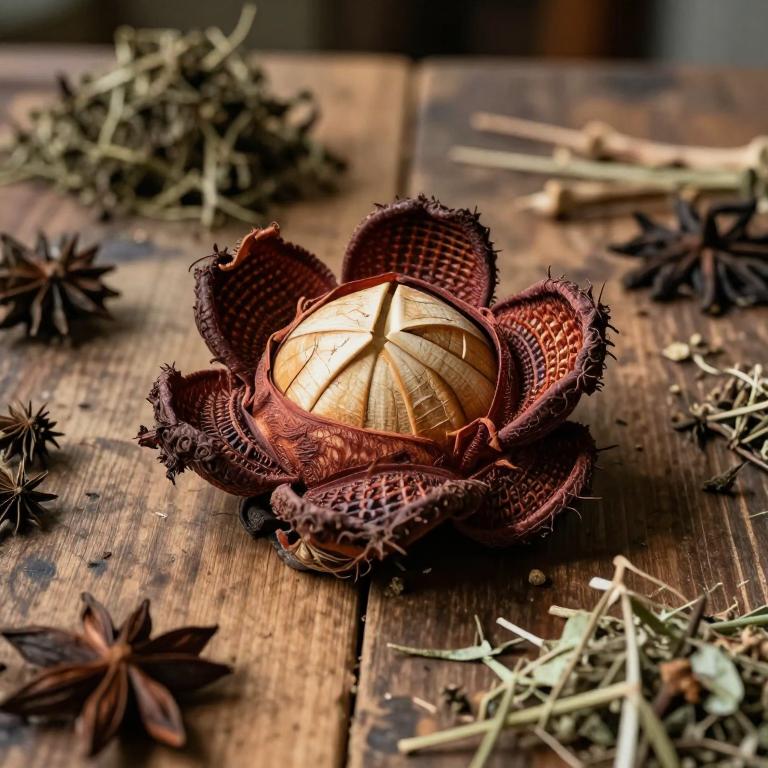
Rafflesia kerrii, scientifically known as Rafflesia kerrii, is a remarkable parasitic plant native to Southeast Asia. Renowned for producing some of the world's largest flowers, it lacks true leaves, stems, or roots. This extraordinary species relies entirely on host vines, offering unique insights into evolutionary biology and rainforest biodiversity.
- Family
- Rafflesiaceae
- Native range
- Asia-Tropical
- Parts used
- Flower
- Common names
- Not available
- Scientific synonyms
- Not available
Names and Synonyms
Scientific Names
Accepted name
Rafflesia kerriiSources: Wikidata, Catalogue of Life
Taxonomical Classification
This plant belongs to the kingdom Plantae and the phylum Streptophyta, falling under the class Equisetopsida and subclass Magnoliidae. Within the order Malpighiales, it is uniquely classified under the family Rafflesiaceae. Finally, its specific taxonomic identity is defined by the genus Rafflesia.
| Rank | Classification |
|---|---|
| Kingdom | Plantae |
| Phylum | Streptophyta |
| Class | Equisetopsida |
| Subclass | Magnoliidae |
| Order | Malpighiales |
| Family | Rafflesiaceae |
| Genus | Rafflesia |
Sources: The World Checklist of Vascular Plants (WCVP)
Distribution
This plant possesses a specific and limited range across Southeast Asia. Its presence can be traced within the Indo-China region, specifically in Thailand. Additionally, it is found within the Malesia zone, occurring in Malaya. These distinct locations represent the primary areas where the species can be identified. Consequently, its geographical distribution is tied to these particular tropical territories.
| Region | Area |
|---|---|
| Indo-China | Thailand |
| Malesia | Malaya |
Sources: The World Checklist of Vascular Plants (WCVP)
Botanical Identification
Morphology
The morphology of Rafflesia kerrii is characterized by a highly specialized and unconventional structure, as it lacks traditional vegetative organs such as true leaves, stems, or roots. While many climbing plants function as a liana, vine, or self-supporting organism, this species does not exhibit a climber habit; instead, it exists primarily as a terrestrial entity within its ecosystem. It is strictly a terrestrial organism rather than an epiphyte, lacking the capacity to function as a holoepiphyte, hemiepiphyte, or any other epiphytic form. Furthermore, its life cycle is defined by its status as an obligatory parasite, meaning it is entirely dependent on its host for survival and cannot function as an independent or facultative organism. Consequently, it does not possess the woody tissue typical of many larger plants, as it lacks a woody stem or trunk, instead manifesting only as fleshy, parasitic tissue embedded within the host's vessels and periodically erupting as massive, fleshy flowers.
- Climber :
- liana
- Climber :
- obligatory
- Epiphyte :
- terrestrial
- Parasite :
- obligatory
- Woodiness :
- woody
Sources: Global Inventory of Floras and Traits (GIFT)
Plant Parts
Rafflesia kerrii has 1 reported plant parts identified across 1 scientific publications and several other databases that are studied for medicinal purposes. The most consistently reported plant part include flower.
| Plant part | Supporting sources | Consensus |
|---|---|---|
| Flower | 1 supporting sources | ★☆☆☆☆ |
Flower
- Drug discoveries & therapeutics
Chemicals
Rafflesia kerrii has 1 reported phytochemicals identified across 1 scientific publications and several other databases. The most consistently reported chemicals include Gallic acid.
| Chemical | Supporting sources | Consensus |
|---|---|---|
| Gallic acid | 1 supporting sources | ★☆☆☆☆ |
Gallic acid
- Drug discoveries & therapeutics