post oak
Quercus stellata · Accepted scientific name
Scientific literature: Very Extensive (236 studies) · ★★★★★
Post oak, scientifically known as Quercus stellata, is a resilient deciduous tree native to North American woodlands. Renowned for its sturdy timber and unique spreading canopy, this medicinal plant offers traditional healing properties. Its bark and leaves are often utilized in herbal remedies to treat various ailments and inflammations.
- Family
- Fagaceae
- Native range
- Northern America
- Parts used
- Not available
- Common names
- Iron Oak · Post Oak
- Scientific synonyms
- Quercus Stellata F. Rufescens · Quercus Minor · 23 more
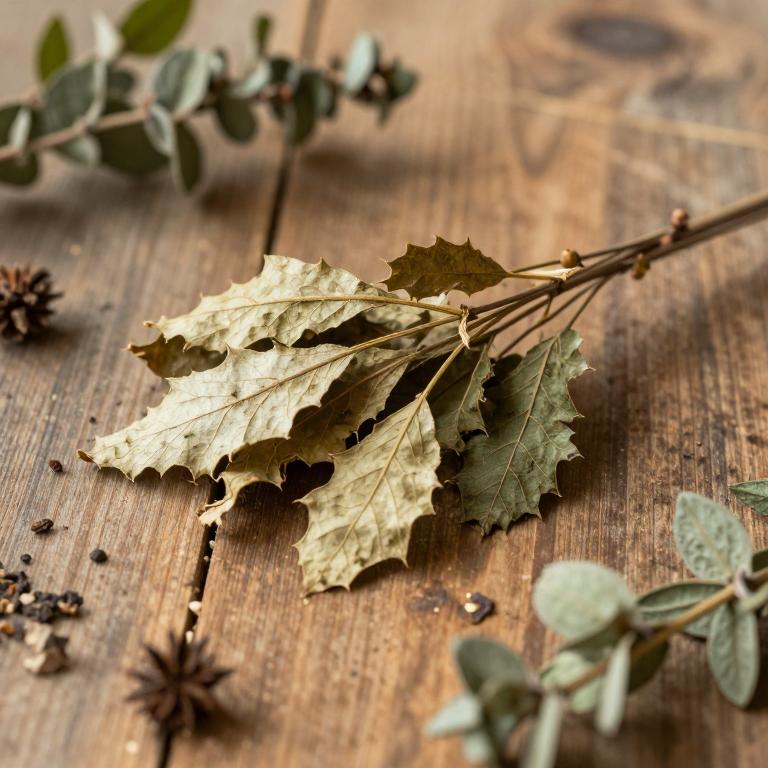
Names and Synonyms
Common Names
- Iron Oak
- Post Oak
Scientific Names
Accepted name
Quercus stellataSynonyms
- Quercus stellata f. rufescens
- Quercus minor
- Quercus stellata var. rufescens
- Quercus stellata var. palmeri
- Quercus stellata f. sterrettii
- Quercus stellata f. tonsa
- Quercus obtusiloba
- Quercus heteroloba
- Quercus lobulata
- Quercus floridana
- Quercus fusca
- Quercus gonoloba
- Quercus villosa
- Quercus alba var. minor
- Quercus stellata var. anomala
- Quercus stellata var. floridana
- Quercus stellata f. heterophylla
- Quercus stellata f. houbae
- Quercus stellata f. laevis
- Quercus stellata f. cruciformis
- Quercus stellata var. parviloba
- Quercus stellata f. quadrata
- Quercus stellata f. reducta
- Quercus stellata f. mollissima
- Quercus stellata f. oblonga
Regional and Traditional Names
Spanish:
- Quercus alba var. minor
- Roble de los postes
- Roble para postes
- Quercus minor
- Quercus gonoloba
- Roble encino
- Quercus alba var minor
- Quercus lobulata
- Quercus floridana
- Quercus villosa
- Quercus heteroloba
- Quercus obtusiloba
- Quercus fusca
- Roble de los Postes
French:
- Chêne étoilé
- Chêne étoilé
Sources: Wikidata, Catalogue of Life
Taxonomical Classification
This plant belongs to the kingdom Plantae and the phylum Streptophyta, falling under the class Equisetopsida and subclass Magnoliidae. It is further classified within the order Fagales and the family Fagaceae. Finally, its taxonomic identity is defined by the genus Quercus.
| Rank | Classification |
|---|---|
| Kingdom | Plantae |
| Phylum | Streptophyta |
| Class | Equisetopsida |
| Subclass | Magnoliidae |
| Order | Fagales |
| Family | Fagaceae |
| Genus | Quercus |
Sources: The World Checklist of Vascular Plants (WCVP)
Distribution
This plant, Quercus stellata, exhibits a specific range within the North-Central region of the United States. It can be found growing naturally across the state of Illinois. Its distribution also extends through the landscapes of Iowa. Furthermore, the species is present within the borders of Kansas. Finally, its geographical reach includes Missouri and Oklahoma.
| Region | Area |
|---|---|
| North-Central U.S.A. | Illinois |
| North-Central U.S.A. | Iowa |
| North-Central U.S.A. | Kansas |
| North-Central U.S.A. | Missouri |
| North-Central U.S.A. | Oklahoma |
| Northeastern U.S.A. | Connecticut |
| Northeastern U.S.A. | Indiana |
| Northeastern U.S.A. | Massachusetts |
| Northeastern U.S.A. | New Jersey |
| Northeastern U.S.A. | New York |
Sources: The World Checklist of Vascular Plants (WCVP)
Botanical Identification
Life history
The life history of Quercus stellata is characterized by its status as a perennial species, allowing it to establish a long-term presence within its ecosystem through successive growing seasons. As a phanerophyte, it maintains its photosynthetic organs on elevated woody stems, a life form strategy that protects its buds during unfavorable periods and enables significant vertical growth. Specifically, its development follows the phanerophyte classification, ensuring its survival through robust structural development that supports its long-term life cycle.
- Life form :
- phanerophyte
- Lifecycle :
- perennial
Morphology
The morphology of Quercus stellata is characterized by a robust, woody growth form, specifically classified as a tree. This species is a self-supporting organism that does not exhibit climbing, liana, or vine-like behaviors, nor does it function as a parasite or an epiphyte. As a terrestrial plant, it is not aquatic or semiaquatic in nature. It reaches a significant stature with a mean plant height of approximately 19.06 meters, maintaining an independent biological existence within its ecosystem.
- Aquatic :
- terrestrial
- Climber :
- self-supporting
- Epiphyte :
- terrestrial
- Growth form :
- tree
- Parasite :
- independent
- Plant height mean:
- 19.06 m
- Woodiness :
- woody
Physiology
The physiology of Quercus stellata is characterized by its utilization of the C3 photosynthetic pathway, a process wherein carbon dioxide is fixed directly into a three-carbon compound during the first stage of the Calvin cycle. This metabolic approach involves the enzyme RuBisCO, which facilitates the carboxylation of ribulose-1,5-bisphosphate, making the plant highly efficient in temperate environments where water availability is sufficient to maintain open stomata. The energy conversion process within the chloroplasts relies on light-dependent reactions to generate ATP and NADPH, which subsequently drive the light-independent reactions to synthesize carbohydrates. This physiological framework supports the plant's seasonal growth patterns and its ability to manage gas exchange and transpiration in response to varying environmental moisture levels.
- Photosynthetic pathway :
- C3
Reproduction
The reproduction of Quercus stellata is characterized by a specific seed morphology and a specialized dispersal mechanism. The seeds produced by this species exhibit a highly consistent mass, with a recorded mean of 1.19455333333333 g, ranging from a minimum of 1.19366 g to a maximum of 1.196 g. In terms of propagation strategy, the plant employs a zoochorous dispersal syndrome, indicating that its seeds are primarily distributed through interaction with animals, although its potential dispersal methods may encompass anemochorous, autochorous, hydrochorous, or unspecialized pathways.
- Dispersal syndrome :
- zoochorous
- Seed mass max:
- 1.196 g
- Seed mass mean:
- 1.19455333333333 g
- Seed mass min:
- 1.19366 g
Sources: Global Inventory of Floras and Traits (GIFT)
Chemicals
Quercus stellata has 24 reported phytochemicals identified across 0 scientific publications and several other databases. The most consistently reported chemicals include ALUMINUM, Ash, BARIUM, BORON, CADMIUM.
| Chemical | Supporting sources | Consensus |
|---|---|---|
| ALUMINUM | 1 supporting sources | ★☆☆☆☆ |
| Ash | 1 supporting sources | ★☆☆☆☆ |
| BARIUM | 1 supporting sources | ★☆☆☆☆ |
| BORON | 1 supporting sources | ★☆☆☆☆ |
| CADMIUM | 1 supporting sources | ★☆☆☆☆ |
| CALCIUM | 1 supporting sources | ★☆☆☆☆ |
| CHROMIUM | 1 supporting sources | ★☆☆☆☆ |
| COBALT | 1 supporting sources | ★☆☆☆☆ |
| COPPER | 1 supporting sources | ★☆☆☆☆ |
| FLUORINE | 1 supporting sources | ★☆☆☆☆ |
ALUMINUM
- Dr. Duke
Ash
- Dr. Duke
BARIUM
- Dr. Duke
BORON
- Dr. Duke
CADMIUM
- Dr. Duke
CALCIUM
- Dr. Duke
CHROMIUM
- Dr. Duke
COBALT
- Dr. Duke
COPPER
- Dr. Duke
FLUORINE
- Dr. Duke
Activities
Quercus stellata has 211 reported activities identified across 0 scientific publications and several other databases. The most consistently reported activities include Astringent, ACE-Inhibitor, AP-1-Inhibitor, Acnegenic, Amphiglycemic?.
| Activity | Supporting sources | Consensus |
|---|---|---|
| Astringent | 2 supporting sources | ★☆☆☆☆ |
| ACE-Inhibitor | 1 supporting sources | ★☆☆☆☆ |
| AP-1-Inhibitor | 1 supporting sources | ★☆☆☆☆ |
| Acnegenic | 1 supporting sources | ★☆☆☆☆ |
| Amphiglycemic? | 1 supporting sources | ★☆☆☆☆ |
| Analgesic | 1 supporting sources | ★☆☆☆☆ |
| Androgenic | 1 supporting sources | ★☆☆☆☆ |
| Angiotensin-Receptor-Blocker | 1 supporting sources | ★☆☆☆☆ |
| Anorexic | 1 supporting sources | ★☆☆☆☆ |
| AntiAGE | 1 supporting sources | ★☆☆☆☆ |
Astringent
- Dr. Duke
- Journal of ethnobiology and ethnomedicine
ACE-Inhibitor
- Dr. Duke
AP-1-Inhibitor
- Dr. Duke
Acnegenic
- Dr. Duke
Amphiglycemic?
- Dr. Duke
Analgesic
- Dr. Duke
Androgenic
- Dr. Duke
Angiotensin-Receptor-Blocker
- Dr. Duke
Anorexic
- Dr. Duke
AntiAGE
- Dr. Duke