blunt mountain-mint
Pycnanthemum muticum · Accepted scientific name
Scientific literature: Very Extensive (228 studies) · ★★★★★
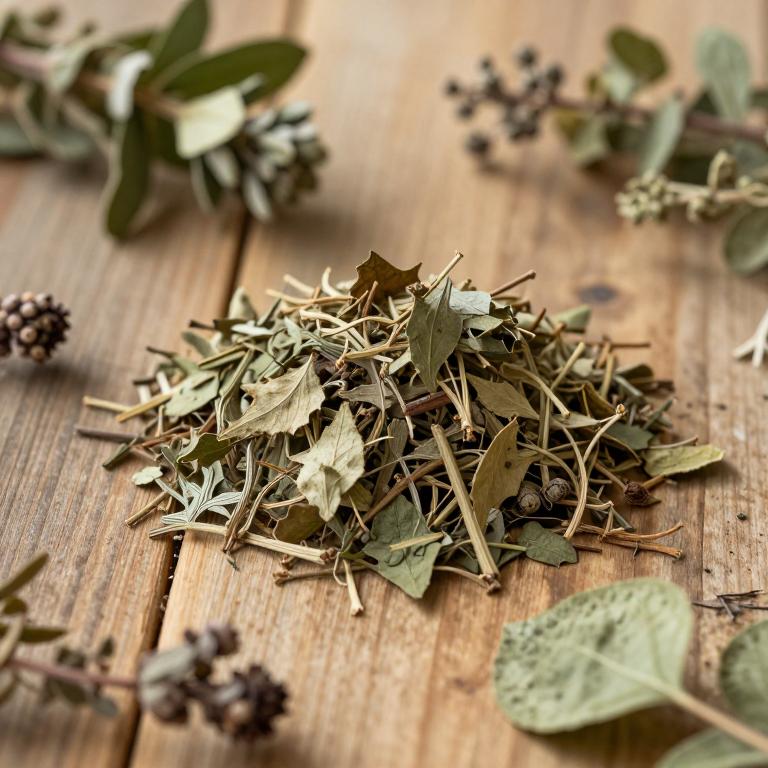
Blunt mountain-mint, scientifically known as Pycnanthemum muticum, is a versatile perennial herb native to North America. Renowned for its aromatic, serrated leaves and white flower clusters, it serves as a vital nectar source for pollinators. This hardy plant is prized in medicinal traditions and ecological landscaping for its resilience.
Names and Synonyms
Common Names
- blunt mountain-mint
- clustered mountain-mint
- blunt mountain mint
- short-toothed mountain mint
- short-toothed mountain-mint
- showy mountain mint
Scientific Names
Accepted name
Pycnanthemum muticumSynonyms
- Pycnanthemum arkansanum
- Brachystemum muticum
- Koellia mutica
- Thymus serratus
- Pycnanthemum pilosum var. leptodon
Sources: Wikidata, Catalogue of Life
Taxonomical Classification
This plant belongs to the kingdom Plantae within the phylum Streptophyta and the class Equisetopsida. It is further classified under the subclass Magnoliidae in the order Lamiales and the family Lamiaceae. Finally, it is identified by the genus Pycnanthemum.
| Rank | Classification |
|---|---|
| Kingdom | Plantae |
| Phylum | Streptophyta |
| Class | Equisetopsida |
| Subclass | Magnoliidae |
| Order | Lamiales |
| Family | Lamiaceae |
| Genus | Pycnanthemum |
Sources: The World Checklist of Vascular Plants (WCVP)
Distribution
This plant, known as bitter pycnanthemum, exhibits a specific distribution across several regions of the United States. In the North-Central region, it can be found growing in the states of Illinois and Missouri. Its range also extends into the Northeast, where it is documented in Connecticut and Massachusetts. Additionally, the species is located in the North-Central area of Michigan. Together, these locations highlight the plant's presence across diverse parts of the country.
| Region | Area |
|---|---|
| North-Central U.S.A. | Illinois |
| North-Central U.S.A. | Missouri |
| Northeastern U.S.A. | Connecticut |
| Northeastern U.S.A. | Massachusetts |
| Northeastern U.S.A. | Michigan |
| Northeastern U.S.A. | New Hampshire |
| Northeastern U.S.A. | New Jersey |
| Northeastern U.S.A. | New York |
| Northeastern U.S.A. | Ohio |
| Northeastern U.S.A. | Pennsylvania |
Sources: The World Checklist of Vascular Plants (WCVP)
Botanical Identification
Life history
The life history of Pycnanthemum muticum is characterized by its status as a perennial, meaning it persists through multiple growing seasons by utilizing stored energy in its underground structures. As a hemicryptophyte, its perennating buds are located at or just below the soil surface, protected by leaf litter or soil during unfavorable environmental conditions. This life form strategy allows the plant to re-emerge vigorously each spring, navigating seasonal changes through a robust vegetative presence that supports its long-term survival in its natural habitat.
- Life form :
- hemicryptophyte
- Lifecycle :
- perennial
Morphology
The morphology of Pycnanthemum muticum is characterized by its growth form as a non-woody herb and specifically a forb. As a self-supporting plant, it does not exhibit climber or liana characteristics, instead maintaining its structure independently. It is a terrestrial species, functioning as an independent organism rather than a parasite or an epiphyte.
- Aquatic :
- terrestrial
- Climber :
- self-supporting
- Epiphyte :
- terrestrial
- Growth form :
- herb
- Growth form :
- forb
- Parasite :
- independent
- Woodiness :
- non-woody
Reproduction
The reproduction of Pycnanthemum muticum is characterized by a specific flowering window and precise seed production parameters. The plant enters its flowering stage in July and continues its reproductive cycle through August. During this period, it produces seeds that exhibit a highly consistent mass; the seed mass is uniform across its developmental range, with a mean, maximum, and minimum value all measured at 4e-04 g.
- Flowering time :
- Jul
- Flowering time :
- Aug
- Seed mass mean:
- 4e-04 g
Sources: Global Inventory of Floras and Traits (GIFT)
Chemicals
Pycnanthemum muticum has 32 reported phytochemicals identified across 0 scientific publications and several other databases. The most consistently reported chemicals include 1,8-Cineole, MENTHONE, Pulegone, 1-OCTEN-3-OL, 1-OCTEN-3-ONE.
| Chemical | Supporting sources | Consensus |
|---|---|---|
| 1,8-Cineole | 2 supporting sources | ★☆☆☆☆ |
| MENTHONE | 2 supporting sources | ★☆☆☆☆ |
| Pulegone | 2 supporting sources | ★☆☆☆☆ |
| 1-OCTEN-3-OL | 1 supporting sources | ★☆☆☆☆ |
| 1-OCTEN-3-ONE | 1 supporting sources | ★☆☆☆☆ |
| ALPHA-PINENE | 1 supporting sources | ★☆☆☆☆ |
| BETA-PINENE | 1 supporting sources | ★☆☆☆☆ |
| Borneol | 1 supporting sources | ★☆☆☆☆ |
| CAMPHENE | 1 supporting sources | ★☆☆☆☆ |
| Caryophyllene | 1 supporting sources | ★☆☆☆☆ |
1,8-Cineole
- Dr. Duke
- Journal of agricultural and food chemistry
MENTHONE
- Dr. Duke
- Journal of agricultural and food chemistry
Pulegone
- Dr. Duke
- Journal of agricultural and food chemistry
1-OCTEN-3-OL
- Dr. Duke
1-OCTEN-3-ONE
- Journal of agricultural and food chemistry
ALPHA-PINENE
- Dr. Duke
BETA-PINENE
- Dr. Duke
Borneol
- Dr. Duke
CAMPHENE
- Dr. Duke
Caryophyllene
- Dr. Duke
Activities
Pycnanthemum muticum has 193 reported activities identified across 0 scientific publications and several other databases. The most consistently reported activities include (-)-Chronotropic, (-)-Inotropic, ACE-Inhibitor, AChE-Inhibitor, Acaricide.
| Activity | Supporting sources | Consensus |
|---|---|---|
| (-)-Chronotropic | 1 supporting sources | ★☆☆☆☆ |
| (-)-Inotropic | 1 supporting sources | ★☆☆☆☆ |
| ACE-Inhibitor | 1 supporting sources | ★☆☆☆☆ |
| AChE-Inhibitor | 1 supporting sources | ★☆☆☆☆ |
| Acaricide | 1 supporting sources | ★☆☆☆☆ |
| Aldose-Reductase-Inhibitor | 1 supporting sources | ★☆☆☆☆ |
| Allelochemic | 1 supporting sources | ★☆☆☆☆ |
| Allelopathic | 1 supporting sources | ★☆☆☆☆ |
| Allergenic | 1 supporting sources | ★☆☆☆☆ |
| Analgesic | 1 supporting sources | ★☆☆☆☆ |
(-)-Chronotropic
- Dr. Duke
(-)-Inotropic
- Dr. Duke
ACE-Inhibitor
- Dr. Duke
AChE-Inhibitor
- Dr. Duke
Acaricide
- Dr. Duke
Aldose-Reductase-Inhibitor
- Dr. Duke
Allelochemic
- Dr. Duke
Allelopathic
- Dr. Duke
Allergenic
- Dr. Duke
Analgesic
- Dr. Duke