Kudu Berry
Pseudolachnostylis maprouneifolia · Accepted scientific name
Scientific literature: Very Sparse (23 studies) · ★☆☆☆☆
Kudu Berry, scientifically known as Pseudolachnostylis maprouneifolia, is a versatile medicinal plant native to Southern Africa. Renowned for its diverse therapeutic properties, various parts of the tree are utilized in traditional medicine to treat ailments ranging from skin irritations to digestive issues, offering significant potential for modern pharmacological research.
- Family
- Phyllanthaceae
- Native range
- Africa
- Parts used
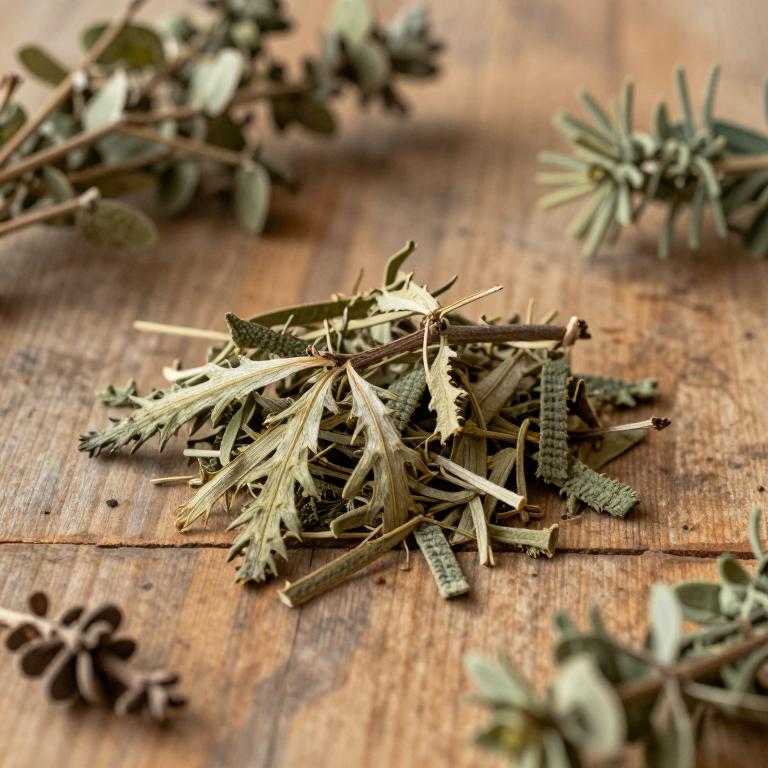
- Leaf
- Common names
- Kudu Berry
- Scientific synonyms
- Not available
Names and Synonyms
Common Names
- Kudu Berry
Scientific Names
Accepted name
Pseudolachnostylis maprouneifoliaSources: Wikidata, Catalogue of Life
Taxonomical Classification
This plant belongs to the kingdom Plantae and the phylum Streptophyta, falling under the class Equisetopsida and subclass Magnoliidae. Within the order Malpighiales, it is classified under the family Phyllanthaceae. It is specifically identified by the genus Pseudolachnostylis, which includes the species Pseudolachnostylis maprouneiifolia.
| Rank | Classification |
|---|---|
| Kingdom | Plantae |
| Phylum | Streptophyta |
| Class | Equisetopsida |
| Subclass | Magnoliidae |
| Order | Malpighiales |
| Family | Phyllanthaceae |
| Genus | Pseudolachnostylis |
Sources: The World Checklist of Vascular Plants (WCVP)
Distribution
This plant is geographically distributed across several distinct regions of the African continent. Within West-Central Tropical Africa, its presence is noted in both Burundi and the DR Congo. Moving toward the eastern part of the continent, it can also be found in Tanzania. In the southern reaches of the continent, the species extends into Angola. Finally, its distribution in South Tropical Africa includes the country of Malawi.
| Region | Area |
|---|---|
| West-Central Tropical Africa | Burundi |
| West-Central Tropical Africa | DR Congo |
| East Tropical Africa | Tanzania |
| South Tropical Africa | Angola |
| South Tropical Africa | Malawi |
| South Tropical Africa | Mozambique |
| South Tropical Africa | Zambia |
| South Tropical Africa | Zimbabwe |
| Southern Africa | Botswana |
| Southern Africa | Caprivi Strip |
Sources: The World Checklist of Vascular Plants (WCVP)
Botanical Identification
Ecology
The ecology of Pseudolachnostylis maprouneiifolia is characterized by its preference for forest habitats, where it plays a role in the complex structure of its native ecosystems. This species demonstrates a significant vertical distribution across varying landscapes, occupying an elevational range that begins at 109 m AMSL and extends up to a maximum altitude of 1495 m AMSL. This wide altitudinal breadth suggests an ability to adapt to diverse microclimates and varying topographical conditions within forest environments.
- Elevational range max:
- 1495 m AMSL
- Elevational range min:
- 109 m AMSL
- Habitat :
- forest
Life history
The life history of Pseudolachnostylis maprounei is characterized by a perennial lifecycle, allowing the plant to persist through multiple growing seasons. As a phanerophyte, it maintains its buds well above the ground level, often reaching significant heights, though it can also exhibit traits consistent with a nanophanerophyte in certain developmental stages or environments. The plant follows a deciduous growth pattern, shedding its foliage periodically as part of its seasonal biological rhythm.
- Deciduousness :
- deciduous
- Life form :
- nanophanerophyte
- Life form :
- phanerophyte
- Lifecycle :
- perennial
Morphology
The morphology of Pseudolachnostylis maprouneiifolia is characterized by a woody growth form, specifically functioning as a self-supporting tree. This terrestrial species displays a significant range in stature, with plant heights varying from a minimum of 1.05 m to a maximum of 13.71 m, resulting in an average height of approximately 8 m. As an independent organism, it does not exhibit parasitic or epiphytic behavior, maintaining a stable, self-supporting structure rather than acting as a climber, liana, or vine.
- Aquatic :
- terrestrial
- Climber :
- self-supporting
- Epiphyte :
- terrestrial
- Growth form :
- tree
- Parasite :
- independent
- Plant height max:
- 13.71 m
- Plant height mean:
- 8 m
- Plant height min:
- 1.05 m
- Woodiness :
- woody
Physiology
The physiology of Pseudolachnostylis maprouneiifolia is characterized by a C3 photosynthetic pathway, which dictates its carbon fixation processes and metabolic efficiency in its natural habitat. Unlike plants that utilize C4 or CAM mechanisms to minimize photorespiration, this species relies on the standard Calvin cycle for converting atmospheric carbon dioxide into organic compounds. Furthermore, the plant does not function as a nitrogen fixer, meaning it lacks the symbiotic relationship with nitrogen-fixing bacteria necessary to convert atmospheric nitrogen into a usable biological form, and instead depends on the availability of nitrogenous compounds within the soil for its nutritional requirements.
- Nitrogen fixer :
- no
- Photosynthetic pathway :
- C3
Reproduction
The reproduction of Pseudolachnostylis maprouneiifolia is characterized by a biotic pollination strategy that relies on animal vectors rather than abiotic factors. Specifically, the plant utilizes an insect-based pollination syndrome, with bees acting as key pollinators to facilitate the transfer of pollen. The species exhibits a lack of self-fertilization, indicating that it is an obligate outcrosser, which promotes genetic diversity within the population. Regarding its progeny, the seeds produced are highly uniform in size; the seed mass is consistent across all recorded measurements, with a minimum, maximum, and mean mass all strictly valued at 0.09154 g.
- Pollination syndrome :
- insect
- Pollination syndrome :
- bee
- Pollination syndrome :
- biotic
- Seed mass mean:
- 0.09154 g
- Self fertilization :
- absent
Sources: Global Inventory of Floras and Traits (GIFT)
Plant Parts
Pseudolachnostylis maprouneifolia has 1 reported plant parts identified across 2 scientific publications and several other databases that are studied for medicinal purposes. The most consistently reported plant part include leaf.
| Plant part | Supporting sources | Consensus |
|---|---|---|
| Leaf | 2 supporting sources | ★☆☆☆☆ |
Leaf
- Journal of ethnopharmacology
- Molecules (Basel, Switzerland)
Chemicals
Pseudolachnostylis maprouneifolia has 11 reported phytochemicals identified across 2 scientific publications and several other databases. The most consistently reported chemicals include Alcohols, Coumarins, Flavonoids, Glycosides, Phenols.
| Chemical | Supporting sources | Consensus |
|---|---|---|
| Alcohols | 1 supporting sources | ★☆☆☆☆ |
| Coumarins | 1 supporting sources | ★☆☆☆☆ |
| Flavonoids | 1 supporting sources | ★☆☆☆☆ |
| Glycosides | 1 supporting sources | ★☆☆☆☆ |
| Phenols | 1 supporting sources | ★☆☆☆☆ |
| Saponins | 1 supporting sources | ★☆☆☆☆ |
| Steroids | 1 supporting sources | ★☆☆☆☆ |
| Tannins | 1 supporting sources | ★☆☆☆☆ |
| Terpenoids | 1 supporting sources | ★☆☆☆☆ |
| ketones | 1 supporting sources | ★☆☆☆☆ |
Alcohols
- Pakistan journal of biological sciences : PJBS
Coumarins
- Pakistan journal of biological sciences : PJBS
Flavonoids
- Pakistan journal of biological sciences : PJBS
Glycosides
- Pakistan journal of biological sciences : PJBS
Phenols
- Pakistan journal of biological sciences : PJBS
Saponins
- Pakistan journal of biological sciences : PJBS
Steroids
- Pakistan journal of biological sciences : PJBS
Tannins
- Pakistan journal of biological sciences : PJBS
Terpenoids
- Pakistan journal of biological sciences : PJBS
ketones
- Pakistan journal of biological sciences : PJBS
Activities
Pseudolachnostylis maprouneifolia has 3 reported activities identified across 2 scientific publications and several other databases. The most consistently reported activities include Antifungal, Antioxidant, Aphrodisiac.
| Activity | Supporting sources | Consensus |
|---|---|---|
| Antifungal | 1 supporting sources | ★☆☆☆☆ |
| Antioxidant | 1 supporting sources | ★☆☆☆☆ |
| Aphrodisiac | 1 supporting sources | ★☆☆☆☆ |
Antifungal
- Pakistan journal of biological sciences : PJBS
Antioxidant
- Pakistan journal of biological sciences : PJBS
Aphrodisiac
- Pakistan journal of biological sciences : PJBS
Conditions
Pseudolachnostylis maprouneifolia has 7 reported investigations on conditions identified across 2 scientific publications and several other databases. The most consistently reported conditions include cancer, cough, fever, pneumonia, schistosomiasis.
| Condition | Supporting sources | Consensus |
|---|---|---|
| Cancer | 1 supporting sources | ★☆☆☆☆ |
| Cough | 1 supporting sources | ★☆☆☆☆ |
| Fever | 1 supporting sources | ★☆☆☆☆ |
| Pneumonia | 1 supporting sources | ★☆☆☆☆ |
| Schistosomiasis | 1 supporting sources | ★☆☆☆☆ |
| Urogenital schistosomiasis | 1 supporting sources | ★☆☆☆☆ |
| Wounds | 1 supporting sources | ★☆☆☆☆ |
Cancer
- Pakistan journal of biological sciences : PJBS
Cough
- Pakistan journal of biological sciences : PJBS
Fever
- Pakistan journal of biological sciences : PJBS
Pneumonia
- Pakistan journal of biological sciences : PJBS
Schistosomiasis
- Journal of ethnopharmacology
Urogenital schistosomiasis
- Journal of ethnopharmacology
Wounds
- Pakistan journal of biological sciences : PJBS
Preparations
Pseudolachnostylis maprouneifolia has 1 reported preparations identified across 2 scientific publications and several other databases. The most consistently reported preparations include crude extracts.
| Preparation | Supporting sources | Consensus |
|---|---|---|
| Crude extracts | 1 supporting sources | ★☆☆☆☆ |
Crude extracts
- Pakistan journal of biological sciences : PJBS