Sticky knob-bush
Pseudoconyza viscosa · Accepted scientific name
Scientific literature: Very Sparse (4 studies) · ★☆☆☆☆
Sticky knob-bush, scientifically known as Pseudoconyza viscosa, is a resilient, aromatic shrub native to South Africa. Characterized by its distinctive sticky texture and small, clustered flowers, this medicinal plant is traditionally used in various cultures to treat skin ailments, digestive issues, and inflammatory conditions through its potent phytochemical properties.
- Family
- Asteraceae
- Native range
- Africa
- Parts used
- Leaf
- Common names
- Sticky Knob-Bush · Clammy False Oxtongue
- Scientific synonyms
- Conyza Viscosa · Blumea Senegalensis · 28 more
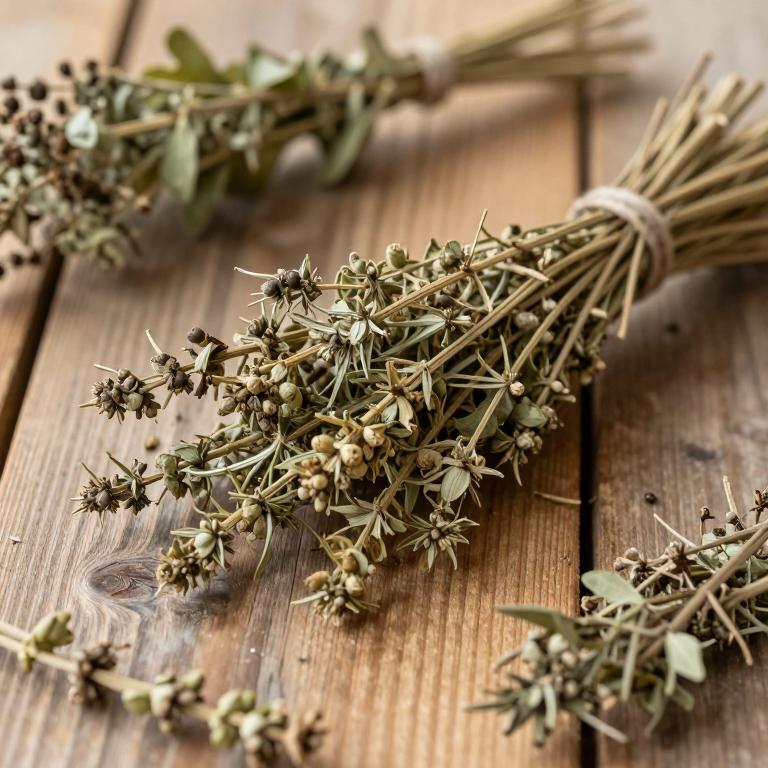
Names and Synonyms
Common Names
- Sticky knob-bush
- clammy false oxtongue
Scientific Names
Accepted name
Pseudoconyza viscosaSynonyms
- Conyza viscosa
- Blumea senegalensis
- Erigeron stipulatus
- Eschenbachia lyrata
- Laggera viscosa
- Marsea viscosa
- Pluchea kotschyi
- Blumea viscosa
- Conyza aurita
- Blumea obliqua var. aurita
- Blumea guineensis
- Blumea aurita
- Blumea bojeri
- Laggera aurita
- Eupatorium lyratum
- Blumea lyrata
- Blumea microphylla
- Blumea viscosa var. lyrata
- Laggera lyrata
- Marsea lyrata
- Pseudoconyza lyrata
- Conyza argentea
- Conyza chiapensis
- Conyza guineensis
- Conyza lyrata
- Conyza lyrata var. pilosa
- Conyza rudis
- Conyza senegalensis
- Pseudoconyza viscosa var. lyrata
- Blumea glutinosa
Regional and Traditional Names
Spanish:
- Yepantzoctle
Sources: Wikidata, Catalogue of Life
Taxonomical Classification
This plant belongs to the kingdom Plantae and is classified under the phylum Streptophyta and class Equisetopsida. Within the subclass Magnoliidae, it falls under the order Asterales and the family Asteraceae. Finally, its specific taxonomic designation is placed within the genus Pseudoconyza.
| Rank | Classification |
|---|---|
| Kingdom | Plantae |
| Phylum | Streptophyta |
| Class | Equisetopsida |
| Subclass | Magnoliidae |
| Order | Asterales |
| Family | Asteraceae |
| Genus | Pseudoconyza |
Sources: The World Checklist of Vascular Plants (WCVP)
Distribution
This plant exhibits a diverse geographical distribution spanning across several distinct regions. In Northern Africa, its presence is specifically noted within the country of Egypt. Moving toward the Atlantic, it can be found in the Macaronesian archipelago of Cape Verde. The species also extends into West Tropical Africa, where it inhabits the nations of Benin and Burkina. Furthermore, its range continues through West Tropical Africa to include Guinea-Bissau.
| Region | Area |
|---|---|
| Northern Africa | Egypt |
| Macaronesia | Cape Verde |
| West Tropical Africa | Benin |
| West Tropical Africa | Burkina |
| West Tropical Africa | Guinea-Bissau |
| West Tropical Africa | Guinea |
| West Tropical Africa | Ivory Coast |
| West Tropical Africa | Mali |
| West Tropical Africa | Mauritania |
| West Tropical Africa | Senegal |
Sources: The World Checklist of Vascular Plants (WCVP)
Botanical Identification
Ecology
The ecology of Pseudoconyza viscosa is characterized by its adaptability to a diverse range of altitudinal gradients, allowing it to inhabit varied topographical landscapes. This species is found across an elevational range spanning from sea level up to a maximum of 1000 m AMSL. Such a distribution suggests that the plant is capable of thriving in both lowland coastal or riparian environments and slightly higher sub-montane terrains. Its presence within this specific vertical range indicates a tolerance for varying atmospheric pressures and temperature fluctuations associated with shifting elevations, enabling it to occupy diverse ecological niches within its native habitat.
- Elevational range max:
- 1000 m AMSL
- Elevational range min:
- 0 m AMSL
Life history
The life history of Pseudoconyza viscosa is characterized by an annual lifecycle, meaning it completes its entire biological development from germination to seed production within a single growing season. As a therophyte, its life form is defined by its strategy of surviving unfavorable environmental conditions as ephemeral seeds, with the adult plant typically dying off after the reproductive phase is complete. This life form classification indicates that the plant lacks persistent underground organs or woody structures, instead relying on a rapid growth cycle to exploit seasonal resources before returning to a dormant seed state.
- Life form :
- therophyte
- Lifecycle :
- annual
Morphology
The morphology of Pseudoconyza viscosa is characterized by its growth form as a non-woody herb and forb. It is a self-supporting plant that does not exhibit climbing or parasitic behavior, functioning as an independent organism. The species is strictly terrestrial, neither aquatic nor epiphytic. In terms of stature, the plant typically reaches a height ranging from a minimum of 0.3 m to a maximum of 1 m, with an average plant height of approximately 0.75 m.
- Aquatic :
- terrestrial
- Climber :
- self-supporting
- Epiphyte :
- terrestrial
- Growth form :
- herb
- Growth form :
- forb
- Parasite :
- independent
- Plant height max:
- 1 m
- Plant height mean:
- 0.75 m
- Plant height min:
- 0.3 m
- Woodiness :
- non-woody
Physiology
The physiology of Pseudoconyza viscosa is characterized by its metabolic adaptations to arid or semi-arid environments, where it manages water retention and nutrient uptake through specialized cellular mechanisms. Its growth patterns are driven by efficient photosynthetic pathways optimized for high-light intensity, allowing it to maintain biomass production under thermal stress. Regarding its nutritional physiology, the plant does not possess the specialized symbiotic relationship with diazotrophic bacteria required to function as a nitrogen fixer; therefore, it relies entirely on the assimilation of inorganic nitrogen, such as nitrates and ammonium, from the surrounding soil substrate. This lack of biological nitrogen fixation (trait_1: nitrogen fixer; trait_2: nitrogen_fix_1; trait_value: no) necessitates a robust root system capable of scavenging available nitrogenous compounds to support its physiological development and reproductive cycles.
- Nitrogen fixer :
- no
Reproduction
The reproduction of Pseudoonyza viscosa is characterized by the production of small seeds that exhibit specific variations in mass. The seed mass for this species follows a narrow range, with a calculated mean mass of 4e-05 g. Within the population, individual seed weights fluctuate between a minimum value of 2e-05 g and a maximum value of 5e-05 g.
- Seed mass max:
- 5e-05 g
- Seed mass mean:
- 4e-05 g
- Seed mass min:
- 2e-05 g
Sources: Global Inventory of Floras and Traits (GIFT)
Plant Parts
Pseudoconyza viscosa has 1 reported plant parts identified across 1 scientific publications and several other databases that are studied for medicinal purposes. The most consistently reported plant part include leaf.
| Plant part | Supporting sources | Consensus |
|---|---|---|
| Leaf | 1 supporting sources | ★☆☆☆☆ |
Leaf
- Journal of ethnopharmacology
Chemicals
Pseudoconyza viscosa has 2 reported phytochemicals identified across 1 scientific publications and several other databases. The most consistently reported chemicals include Dicaffeoylquinic acid, Flavonoid.
| Chemical | Supporting sources | Consensus |
|---|---|---|
| Dicaffeoylquinic acid | 1 supporting sources | ★☆☆☆☆ |
| Flavonoid | 1 supporting sources | ★☆☆☆☆ |
Dicaffeoylquinic acid
- Frontiers in plant science
Flavonoid
- Frontiers in plant science
Activities
Pseudoconyza viscosa has 1 reported activities identified across 1 scientific publications and several other databases. The most consistently reported activities include Anticonvulsant.
| Activity | Supporting sources | Consensus |
|---|---|---|
| Anticonvulsant | 1 supporting sources | ★☆☆☆☆ |
Anticonvulsant
- Journal of ethnopharmacology
Preparations
Pseudoconyza viscosa has 2 reported preparations identified across 1 scientific publications and several other databases. The most consistently reported preparations include Essential Oils, methanol leaf extract.
| Preparation | Supporting sources | Consensus |
|---|---|---|
| Essential oils | 1 supporting sources | ★☆☆☆☆ |
| Methanol leaf extract | 1 supporting sources | ★☆☆☆☆ |
Essential oils
- Infection and drug resistance
Methanol leaf extract
- Journal of ethnopharmacology