St. Lucie cherry
Prunus mahaleb · Accepted scientific name
Scientific literature: Sparse (90 studies) · ★★☆☆☆
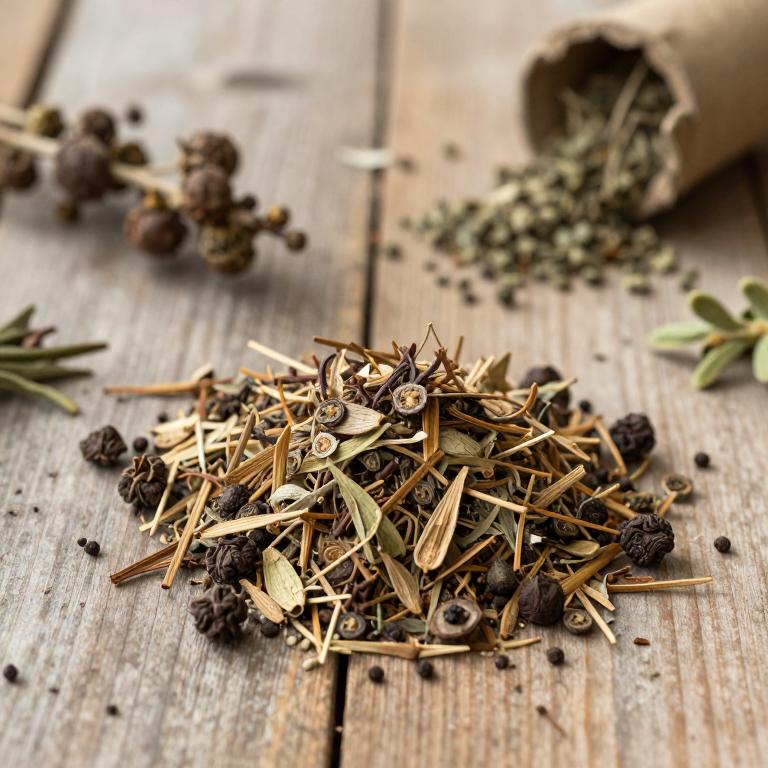
St. Lucie cherry, scientifically known as Pruunus mahaleb, is a versatile deciduous shrub prized for its medicinal and culinary properties. Renowned for its antioxidant-rich fruits, it is traditionally utilized to support digestive health and reduce inflammation. This hardy species remains a significant component in herbal medicine and botanical studies.
Names and Synonyms
Common Names
- St. Lucie cherry
- mahaleb cherry
- perfumed cherry
- rock cherry
- St Lucie Cherry
- St. Lucie's Cherry
- Gandhi cherry
- Mahlab Cherry
- Mahleb Cherry
- Saint Lucie Cherry
Scientific Names
Accepted name
Prunus mahalebSynonyms
- Padus mahaleb
- Padellus mahaleb
- Mahaleb vulgaris
- Cerasus mahaleb
Regional and Traditional Names
Spanish:
- Abanera
- Cerezo de santa Lucía
- Ollarán
- Cerasus mahaleb
- Cerezo de puerto
- Pudriera
- Mahaleb
- Cerezo de Mahoma
- Prunus odorata
- Druparia mahaleb
- Padellus mahaleb
- Maleino
- Guinda silvestre
- Arto cutio
- Árbol de Santa Lucía
- Cerezo de santa Lucia
- Ollaran
- Arbol de Santa Lucia
- Cerezo de Santa Lucía
German:
- Steinweichsel
- Stein-Weichsel
- Felsenkirsche
- Felsen-Kirsche
- bois de sainte lucie
- Steinweichsel
- Stein-Weichsel
- Weichselkirsche
French:
- Cerisier de sainte Lucie
- Cerisier De Sainte-Lucie
- Faux-merisier
- Quénot
- Bois de sainte Lucie
- Qneu
- Faux merisier
- bois de Sainte-Lucie
- cerisier de Sainte-Lucie
- cerisier mahaleb
- mahaleb
- Amarel
- Bois-de-Sainte-Lucie
- Merisier odorant
- Faux merisier
- Prunier de Sainte-Lucie
- Prunier mahaleb
- Bois de sainte Lucie
Sources: Wikidata, Catalogue of Life
Taxonomical Classification
This plant belongs to the kingdom Plantae within the phylum Streptophyta and the class Equisetopsida. It is further classified under the subclass Magnoliidae and the order Rosales, falling within the family Rosaceae. Finally, its taxonomic identity is established under the genus Prunus.
| Rank | Classification |
|---|---|
| Kingdom | Plantae |
| Phylum | Streptophyta |
| Class | Equisetopsida |
| Subclass | Magnoliidae |
| Order | Rosales |
| Family | Rosaceae |
| Genus | Prunus |
Sources: The World Checklist of Vascular Plants (WCVP)
Distribution
This plant exhibits a specific geographical distribution across several regions of Europe. In Northern Europe, its presence can be found in Denmark and Great Britain. The species also extends further north into the territories of Norway and Sweden. Additionally, its range reaches into Middle Europe, specifically within Austria. Together, these locations define the documented habitats for Prunus mahaleb in these areas.
| Region | Area |
|---|---|
| Northern Europe | Denmark |
| Northern Europe | Great Britain |
| Northern Europe | Norway |
| Northern Europe | Sweden |
| Middle Europe | Austria |
| Middle Europe | Belgium |
| Middle Europe | Czechia-Slovakia |
| Middle Europe | Germany |
| Middle Europe | Hungary |
| Middle Europe | Netherlands |
Sources: The World Checklist of Vascular Plants (WCVP)
Botanical Identification
Ecology
The ecology of Prunus mahaleb is characterized by its preference for diverse montane environments, where it thrives across a varied landscape of forests, mountain slopes, shrubberies, and stony places. This species occupies a specific altitudinal niche, with an elevational range that extends from a minimum of 500 m AMSL to a maximum of 1000 m AMSL, maintaining a mean elevation of approximately 1378 m AMSL. Its ability to colonize rocky and disturbed terrain within these mountainous habitats suggests a robust adaptability to different soil compositions and microclimates found within these ecological zones.
- Elevational range max:
- 1000 m AMSL
- Elevational range mean:
- 1378 m AMSL
- Elevational range min:
- 500 m AMSL
- Habitat :
- forest, mountains, shrubberies, stony places
Life history
The life history of Prunus mahaleb is characterized by its existence as a perennial species, allowing it to persist through multiple growing seasons. As a phanerophyte, its reproductive buds are elevated above the ground level, typically manifesting as a woody shrub or small tree. The plant follows a deciduous growth pattern, shedding its foliage annually in response to seasonal changes. Within the classification of life forms, it is strictly identified as a phanerophyte, ensuring its structural longevity and ability to withstand varying environmental conditions over its lifespan.
- Deciduousness :
- deciduous
- Life form :
- phanerophyte
- Lifecycle :
- perennial
Morphology
The morphology of Prunus mahaleb is characterized by a woody growth form that can manifest as both a shrub and a tree. As a terrestrial and independent species, it does not function as a parasite or an epiphyte, nor does it require climbing support, being entirely self-supporting in its natural habitat. The plant exhibits significant variation in stature, with heights ranging from a minimum of 1.2 m to a maximum of 13 m, maintaining an average plant height of approximately 7 m.
- Aquatic :
- terrestrial
- Climber :
- self-supporting
- Epiphyte :
- terrestrial
- Growth form :
- tree
- Growth form :
- shrub
- Parasite :
- independent
- Plant height max:
- 13 m
- Plant height mean:
- 7 m
- Plant height min:
- 1.2 m
- Woodiness :
- woody
Physiology
The physiology of Prunus mahaleb is characterized by a C3 photosynthetic pathway, which dictates its carbon fixation processes and environmental adaptations. As a non-carnivorous species, it relies entirely on soil-based nutrient uptake rather than specialized leaf structures for prey capture. The leaf morphology exhibits specific dimensional variations, with an average leaf length of 4.25 cm (ranging from a minimum of 1.5 cm to a maximum of 5 cm) and an average leaf width of 2.65 cm (ranging from 1 cm to 4 cm), resulting in a mean leaf size of 7.534 cm². Furthermore, the plant maintains a mean Specific Leaf Area (SLA) of 168.62 cm²/g, reflecting its leaf mass per area and its physiological strategy for balancing light interception with resource conservation.
- Carnivory :
- non-carnivorous
- Leaf length max:
- 5 cm
- Leaf length mean:
- 4.25 cm
- Leaf length min:
- 1.5 cm
- Leaf size mean:
- 7.534 cm²
- Leaf width max:
- 4 cm
- Leaf width mean:
- 2.65 cm
- Leaf width min:
- 1 cm
- Photosynthetic pathway :
- C3
- Specific Leaf Area (SLA) mean:
- 168.62 cm²/g
Reproduction
The reproduction of Prunus mahaleb is characterized by a biotic pollination strategy, specifically relying on insects to facilitate the transfer of pollen. The flowering period typically begins in July and concludes in August. A notable aspect of its reproductive biology is that self-fertilization is absent, necessitating cross-pollination. Following successful fertilization, the plant produces fleshy, indehiscent fruits classified as drupes. These fruits are relatively small, with an average length of 0.75 cm (ranging from 0.7 to 0.8 cm) and an average width of approximately 0.73 cm (ranging from 0.7 to 0.8 cm). The dispersal of these fruits follows a zoochorous syndrome, meaning they are spread by animals. Within the fruit, the seeds exhibit a mean mass of approximately 0.084 g, with values ranging from 0.0472 g to 0.1125 g, and a consistent seed volume of 84 mm³. Asexual reproduction is absent in this species, making sexual reproduction through seed production the primary means of propagation.
- Dehiscence :
- indehiscent
- Dispersal syndrome :
- zoochorous
- Flowering time :
- Jul
- Flowering time :
- Aug
- Fruit dryness :
- fleshy
- Fruit length max:
- 0.8 cm
- Fruit length mean:
- 0.75 cm
- Fruit length min:
- 0.7 cm
- Fruit type :
- drupe
- Fruit width max:
- 0.8 cm
- Fruit width mean:
- 0.726666666666667 cm
- Fruit width min:
- 0.7 cm
- Pollination syndrome :
- insect
- Pollination syndrome :
- biotic
- Reproduction asexual :
- absent
- Seed mass max:
- 0.1125 g
- Seed mass mean:
- 0.08435333325 g
- Seed mass min:
- 0.0472 g
- Seed volume max:
- 84 mm³
- Self fertilization :
- absent
Sources: Global Inventory of Floras and Traits (GIFT)
Plant Parts
Prunus mahaleb has 3 reported plant parts identified across 3 scientific publications and several other databases that are studied for medicinal purposes. The most consistently reported plant part include fruit, leaf, seed.
| Plant part | Supporting sources | Consensus |
|---|---|---|
| Fruit | 1 supporting sources | ★☆☆☆☆ |
| Leaf | 1 supporting sources | ★☆☆☆☆ |
| Seed | 1 supporting sources | ★☆☆☆☆ |
Fruit
- Food science & nutrition
Leaf
- Food science & nutrition
Seed
- Plants (Basel, Switzerland)
Chemicals
Prunus mahaleb has 12 reported phytochemicals identified across 3 scientific publications and several other databases. The most consistently reported chemicals include Herniarin, ferulic acid, Flavonoids, Isoleucine, Nonamide.
| Chemical | Supporting sources | Consensus |
|---|---|---|
| Herniarin | 2 supporting sources | ★☆☆☆☆ |
| ferulic acid | 2 supporting sources | ★☆☆☆☆ |
| Flavonoids | 1 supporting sources | ★☆☆☆☆ |
| Isoleucine | 1 supporting sources | ★☆☆☆☆ |
| Nonamide | 1 supporting sources | ★☆☆☆☆ |
| Pyroglutamic acid | 1 supporting sources | ★☆☆☆☆ |
| choline | 1 supporting sources | ★☆☆☆☆ |
| citric acid | 1 supporting sources | ★☆☆☆☆ |
| coumarin | 1 supporting sources | ★☆☆☆☆ |
| genistein | 1 supporting sources | ★☆☆☆☆ |
Herniarin
- PeerJ
- Food science & nutrition
ferulic acid
- PeerJ
- Food science & nutrition
Flavonoids
- Food science & nutrition
Isoleucine
- PeerJ
Nonamide
- PeerJ
Pyroglutamic acid
- PeerJ
choline
- PeerJ
citric acid
- PeerJ
coumarin
- PeerJ
genistein
- Dr. Duke
Activities
Prunus mahaleb has 72 reported activities identified across 3 scientific publications and several other databases. The most consistently reported activities include Abortifacient, Aldose-Reductase-Inhibitor, Alpha-Reductase-Inhibitor, Antiaggregant, Antiangiogenic.
| Activity | Supporting sources | Consensus |
|---|---|---|
| Abortifacient | 1 supporting sources | ★☆☆☆☆ |
| Aldose-Reductase-Inhibitor | 1 supporting sources | ★☆☆☆☆ |
| Alpha-Reductase-Inhibitor | 1 supporting sources | ★☆☆☆☆ |
| Antiaggregant | 1 supporting sources | ★☆☆☆☆ |
| Antiangiogenic | 1 supporting sources | ★☆☆☆☆ |
| Antiatherosclerotic | 1 supporting sources | ★☆☆☆☆ |
| Anticancer (Breast) | 1 supporting sources | ★☆☆☆☆ |
| Anticarcinomic (Breast) | 1 supporting sources | ★☆☆☆☆ |
| Anticlimacteric | 1 supporting sources | ★☆☆☆☆ |
| Antiendoccytotic | 1 supporting sources | ★☆☆☆☆ |
Abortifacient
- Dr. Duke
Aldose-Reductase-Inhibitor
- Dr. Duke
Alpha-Reductase-Inhibitor
- Dr. Duke
Antiaggregant
- Dr. Duke
Antiangiogenic
- Dr. Duke
Antiatherosclerotic
- Dr. Duke
Anticancer (Breast)
- Dr. Duke
Anticarcinomic (Breast)
- Dr. Duke
Anticlimacteric
- Dr. Duke
Antiendoccytotic
- Dr. Duke
Preparations
Prunus mahaleb has 4 reported preparations identified across 3 scientific publications and several other databases. The most consistently reported preparations include chloroform, methanol, seeds, water.
| Preparation | Supporting sources | Consensus |
|---|---|---|
| Chloroform | 1 supporting sources | ★☆☆☆☆ |
| Methanol | 1 supporting sources | ★☆☆☆☆ |
| Seeds | 1 supporting sources | ★☆☆☆☆ |
| Water | 1 supporting sources | ★☆☆☆☆ |
Chloroform
- Turkish journal of medical sciences
Methanol
- Turkish journal of medical sciences
Seeds
- Plants (Basel, Switzerland)
Water
- Turkish journal of medical sciences