Porophyllum obscurum
Porophyllum obscurum · Accepted scientific name
Scientific literature: Very Sparse (1 studies) · ★☆☆☆☆
Porophyllum obscurum, scientifically known as Porophyllum obscurum, is a versatile medicinal herb widely utilized in traditional folk medicine. Primarily found in tropical regions, this plant is celebrated for its potent antimicrobial, anti-inflammatory, and antioxidant properties, offering significant therapeutic potential for treating various ailments through its bioactive chemical compounds.
- Family
- Asteraceae
- Native range
- Southern America
- Parts used
- Not available
- Common names
- Not available
- Scientific synonyms
- Porophyllum Lineare F. Latifolia · Kleinia Linifolia · 3 more
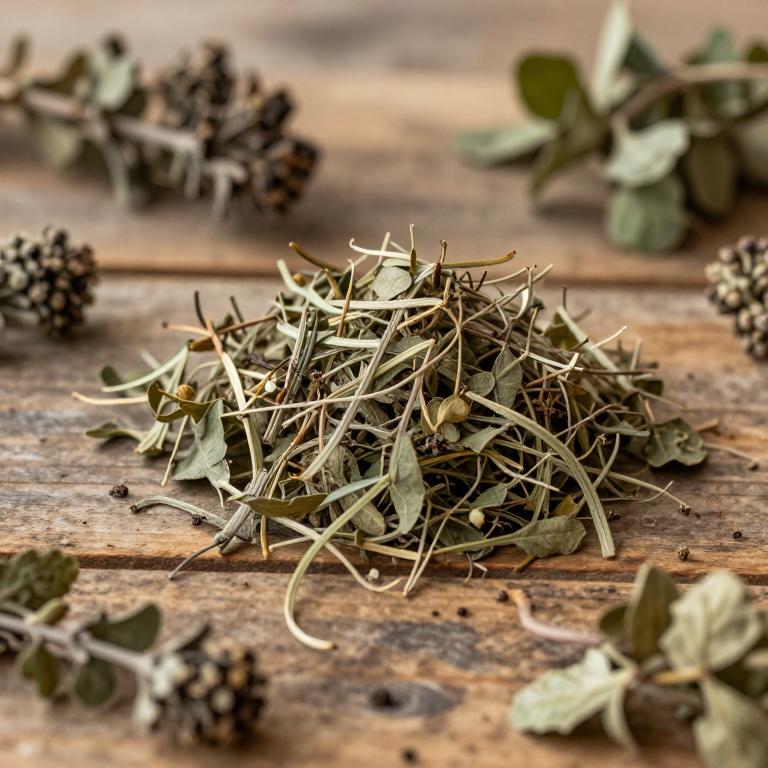
Names and Synonyms
Scientific Names
Accepted name
Porophyllum obscurumSynonyms
- Porophyllum lineare f. latifolia
- Kleinia linifolia
- Kleinia obscura
- Porophyllum eremophilum
- Porophyllum haenkei
Sources: Wikidata, Catalogue of Life
Taxonomical Classification
This plant belongs to the kingdom Plantae and the phylum Streptophyta, falling under the class Equisetopsida and subclass Magnoliidae. Within the order Asterales, it is classified under the family Asteraceae. Finally, it is identified by the genus Porophyllum and the species name obscurum.
| Rank | Classification |
|---|---|
| Kingdom | Plantae |
| Phylum | Streptophyta |
| Class | Equisetopsida |
| Subclass | Magnoliidae |
| Order | Asterales |
| Family | Asteraceae |
| Genus | Porophyllum |
Sources: The World Checklist of Vascular Plants (WCVP)
Distribution
This plant is distributed across several distinct regions within Western South America and Brazil. In the western portion of the continent, it can be found specifically within Bolivia. Its presence in Brazil is quite widespread, spanning across the West-Central territories. Additionally, the species is documented in the Northeast region of Brazil. Finally, its geographical range extends into the Southeast and South regions of the country.
| Region | Area |
|---|---|
| Western South America | Bolivia |
| Brazil | Brazil West-Central |
| Brazil | Brazil Northeast |
| Brazil | Brazil Southeast |
| Brazil | Brazil South |
| Southern South America | Argentina Northeast |
| Southern South America | Argentina Northwest |
| Southern South America | Paraguay |
| Southern South America | Uruguay |
Sources: The World Checklist of Vascular Plants (WCVP)
Botanical Identification
Ecology
The ecology of Porophyllum obscurum is characterized by its presence in specific Brazilian biomes, primarily inhabiting the Campo Rupestre and Cerrado (latu sensu) ecosystems. This species exhibits a broad vertical distribution across diverse landscapes, occupying an elevational range that begins at sea level (0 m AMSL) and extends up to a maximum altitude of 2000 m AMSL. Such a wide altitudinal gradient suggests an adaptability to varying thermal regimes and atmospheric pressures within its preferred habitats.
- Elevational range max:
- 2000 m AMSL
- Elevational range min:
- 0 m AMSL
- Habitat :
- Campo Rupestre, Cerrado (lato sensu)
Life history
The life history of Porophyllum obscurum is characterized by its status as a perennial species, meaning it persists through multiple growing seasons rather than completing its cycle in a single year. As a perennial, the plant establishes a robust root system that allows it to survive dormant periods and re-emerge to support continued vegetative growth and subsequent reproductive cycles. Throughout its lifespan, it undergoes various developmental stages, transitioning from seedling establishment to mature flowering, where it produces inflorescences to facilitate seed dispersal. This long-term survival strategy enables the plant to maintain a presence within its ecological niche, often fluctuating in vigor based on seasonal environmental conditions and resource availability.
- Lifecycle :
- perennial
Morphology
The morphology of Porophyllum obscurum is characterized by its growth form as a herb, exhibiting a non-woody structure throughout its development. This plant is primarily terrestrial in its habitat, showing no aquatic or semiaquatic tendencies, and it functions as an independent organism rather than a parasite. It is a self-supporting species that does not exhibit climbing or epiphytic behavior, maintaining a terrestrial life cycle without the need for host support or specialized epiphytic adaptations.
- Aquatic :
- terrestrial
- Climber :
- self-supporting
- Epiphyte :
- terrestrial
- Growth form :
- herb
- Parasite :
- independent
- Woodiness :
- non-woody
Sources: Global Inventory of Floras and Traits (GIFT)
Chemicals
Porophyllum obscurum has 1 reported phytochemicals identified across 0 scientific publications and several other databases. The most consistently reported chemicals include 5-(3-Buten-1-ynyl)-2,2'-bithiophene.
| Chemical | Supporting sources | Consensus |
|---|---|---|
| 5-(3-Buten-1-ynyl)-2,2'-bithiophene | 1 supporting sources | ★☆☆☆☆ |
5-(3-Buten-1-ynyl)-2,2'-bithiophene
- Photodiagnosis and photodynamic therapy
Preparations
Porophyllum obscurum has 1 reported preparations identified across 0 scientific publications and several other databases. The most consistently reported preparations include hexane extract.
| Preparation | Supporting sources | Consensus |
|---|---|---|
| Hexane extract | 1 supporting sources | ★☆☆☆☆ |
Hexane extract
- Photodiagnosis and photodynamic therapy