Terebinth
Pistacia terebinthus · Accepted scientific name
Scientific literature: Very Sparse (16 studies) · ★☆☆☆☆
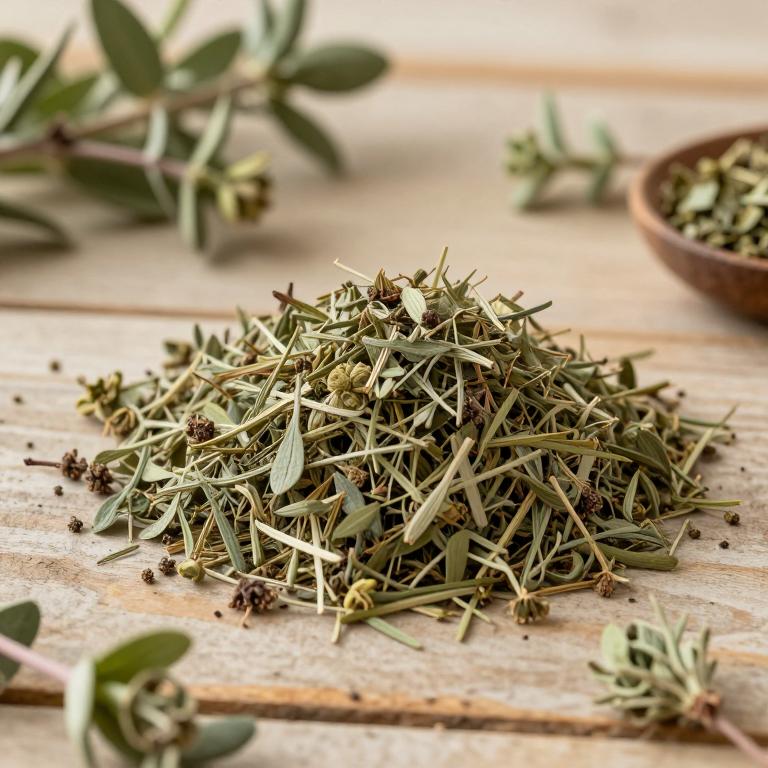
Terebinth, scientifically known as Pistacia terebinthus, is a resilient evergreen shrub native to the Mediterranean region. Renowned for its aromatic resin and nutrient-rich fruits, it has been used throughout history in traditional medicine to treat inflammation, digestive issues, and skin conditions, serving as a vital botanical resource.
Names and Synonyms
Common Names
- Cyprus Turpentine
- Eastern Turpentine Tree
- Terebinth
- Turpentine tree
- Cyprus-turpentine
- turpentine-tree
Scientific Names
Accepted name
Pistacia terebinthusSynonyms
- Pistacia terebinthus subsp. palaestina
- Lentiscus terebinthus
- Terebinthus vulgaris
- Terebinthus communis
- Pistacia palaestina
- Pistacia terebinthus var. heterophylla
- Pistacia terebinthus var. angustifolia
- Pistacia terebinthus var. macrocarpa
- Pistacia terebinthus var. oxycarpa
Regional and Traditional Names
Spanish:
- Albotín
- Higuera silvestre
- Trementina de Kios
- Cabricuerno
- Charneta
- Noguerola
- Charnera
- Cornicabre
- Granillo cornicabra
- Árbol de Nuestra Señora
- Cornicabro
- Albotin
- Valvarija
- Arbol trementino
- Lentisco albar
- Quemaculo
- Tornalobo
- Escuernicabra
- Colneta
- Cabracoja
- Cabra coja
- Arbol de Nuestra Senora
- Cornita
- Caricuerno
- Arbol de Nuestra Señora
- Jedisco
- Árbol de Nuestra Senora
- Descornacabras
- Árbol trementino
- Cabracorna
- terebinto
- Cornicabra
- Cornicabra
- cornicabra terebinto
German:
- Terpentin-Pistazie
- Terpentinpistazie
- Terpentinpistazien
- Terebinthe
- Terpentin-Pistazie
French:
- Pistachier térébinthe
- Térébinthe
- Pistachier terebinthe
- pistachier térébinthe
- térébinthe
Sources: Wikidata, Catalogue of Life
Taxonomical Classification
This plant belongs to the kingdom Plantae within the phylum Streptophyta and the class Equisetopsida. It is further classified under the subclass Magnoliidae and the order Sapindaales, falling into the family Anacardiaceae. Ultimately, its taxonomic identity is defined by its membership in the genus Pistacia.
| Rank | Classification |
|---|---|
| Kingdom | Plantae |
| Phylum | Streptophyta |
| Class | Equisetopsida |
| Subclass | Magnoliidae |
| Order | Sapindales |
| Family | Anacardiaceae |
| Genus | Pistacia |
Sources: The World Checklist of Vascular Plants (WCVP)
Distribution
This plant exhibits a specific geographical distribution across several regions of Southwestern Europe. It can be found growing in the Balearic Islands, which are part of the Baleares archipelago. Additionally, its presence is noted in the territories of Corsica and Sardegna. The species also inhabits various parts of mainland France. Finally, its range extends further west into the country of Portugal.
| Region | Area |
|---|---|
| Southwestern Europe | Baleares |
| Southwestern Europe | Corse |
| Southwestern Europe | France |
| Southwestern Europe | Portugal |
| Southwestern Europe | Sardegna |
| Southwestern Europe | Spain |
| Southeastern Europe | Albania |
| Southeastern Europe | Bulgaria |
| Southeastern Europe | Greece |
| Southeastern Europe | Italy |
Sources: The World Checklist of Vascular Plants (WCVP)
Botanical Identification
Ecology
The ecology of Pistacia terebinthus is characterized by its adaptation to Mediterranean-type ecosystems, where it typically thrives in maquis, garrigue, and open woodland habitats. It occupies a diverse range of topographic positions, often favoring rocky, well-drained soils and limestone substrates within semi-arid landscapes. The species exhibits a specific vertical distribution within its habitat, maintaining an elevational range that centers around a mean of 976 m AMSL. This positioning allows the plant to navigate varying microclimates, ranging from coastal lowlands to mid-altitude mountainous regions, where it must withstand seasonal drought and high solar radiation. Its presence is often indicative of successional stages in Mediterranean shrublands, where it plays a vital role in soil stabilization and providing structure within the plant community.
- Elevational range mean:
- 976 m AMSL
Life history
The life history of Pistacia terebinthus is characterized by its nature as a perennial species, allowing it to persist in its environment over many years. As a phanerophyte, its regenerative buds are located high above the ground on woody stems, a structural adaptation that supports its growth as a shrub or small tree. Furthermore, the plant exhibits a deciduous habit, shedding its foliage seasonally as part of its physiological cycle.
- Deciduousness :
- deciduous
- Life form :
- phanerophyte
- Lifecycle :
- perennial
Morphology
The morphology of Pistacia terebinthus is characterized by its woody structure and a growth form primarily classified as a shrub. As a terrestrial species, it does not exhibit aquatic or semiaquatic tendencies and functions as an independent organism rather than a parasite or epiphyte. The plant is self-supporting, lacking any climbing habits, and reaches a significant stature with a plant height ranging from a minimum of 2 meters to a maximum of 8 meters.
- Aquatic :
- terrestrial
- Climber :
- self-supporting
- Epiphyte :
- terrestrial
- Growth form :
- shrub
- Parasite :
- independent
- Plant height max:
- 8 m
- Plant height min:
- 2 m
- Woodiness :
- woody
Physiology
The physiology of Pistacia terebinthus is characterized by its specialized metabolic processes and structural adaptations suited for Mediterranean climates. Primarily, the plant utilizes a C3 photosynthetic pathway, which involves the direct fixation of atmospheric carbon dioxide by the enzyme RuBisCO during the Calvin cycle. This metabolic strategy, while requiring careful regulation of stomatal conductance to balance gas exchange with transpirational water loss, allows the species to optimize biomass production under temperate conditions. Furthermore, its physiological framework includes robust secondary metabolism, notably the biosynthesis of various terpenoids and phenolic compounds, which serve as chemical defenses and contribute to its adaptive resilience. The plant's water relations and nutrient uptake mechanisms are finely tuned to handle seasonal fluctuations in moisture availability, ensuring efficient carbon assimilation through its C3 mechanism even during periods of moderate environmental stress.
- Photosynthetic pathway :
- C3
Reproduction
The reproduction of Pistacia terebinthus is characterized by the production of fleshy, indehiscent fruits classified as drupes. These fruits possess a mean length of 0.64 cm and a mean width of 0.58 cm, serving as the primary vessel for seed protection and dispersal. The seeds contained within these drupes exhibit a mean mass of approximately 0.044587 g, with individual seed weights ranging from a minimum of 0.0141 g to a maximum of 0.05917 g. Consistent seed volume measurements indicate a uniform volume of 51 mm³. Due to the fleshy nature of the fruit, the plant utilizes a zoochorous dispersal syndrome, relying on animals to facilitate the spread of its seeds.
- Dehiscence :
- indehiscent
- Dispersal syndrome :
- zoochorous
- Fruit dryness :
- fleshy
- Fruit length mean:
- 0.64 cm
- Fruit type :
- drupe
- Fruit width mean:
- 0.58 cm
- Seed mass max:
- 0.05917 g
- Seed mass mean:
- 0.0445866666666667 g
- Seed mass min:
- 0.0141 g
- Seed volume max:
- 51 mm³
Sources: Global Inventory of Floras and Traits (GIFT)
Plant Parts
Pistacia terebinthus has 1 reported plant parts identified across 1 scientific publications and several other databases that are studied for medicinal purposes. The most consistently reported plant part include fruit.
| Plant part | Supporting sources | Consensus |
|---|---|---|
| Fruit | 1 supporting sources | ★☆☆☆☆ |
Fruit
- Journal of ethnopharmacology
Chemicals
Pistacia terebinthus has 7 reported phytochemicals identified across 1 scientific publications and several other databases. The most consistently reported chemicals include (E)-Ocimene, (z)-ocimene, ALPHA-PINENE, LIMONENE, MYRCENE.
| Chemical | Supporting sources | Consensus |
|---|---|---|
| (E)-Ocimene | 1 supporting sources | ★☆☆☆☆ |
| (z)-ocimene | 1 supporting sources | ★☆☆☆☆ |
| ALPHA-PINENE | 1 supporting sources | ★☆☆☆☆ |
| LIMONENE | 1 supporting sources | ★☆☆☆☆ |
| MYRCENE | 1 supporting sources | ★☆☆☆☆ |
| Monoterpenes | 1 supporting sources | ★☆☆☆☆ |
| Sesquiterpenes | 1 supporting sources | ★☆☆☆☆ |
(E)-Ocimene
- Journal of agricultural and food chemistry
(z)-ocimene
- Journal of agricultural and food chemistry
ALPHA-PINENE
- Journal of agricultural and food chemistry
LIMONENE
- Journal of agricultural and food chemistry
MYRCENE
- Journal of agricultural and food chemistry
Monoterpenes
- Journal of agricultural and food chemistry
Sesquiterpenes
- Journal of agricultural and food chemistry
Activities
Pistacia terebinthus has 2 reported activities identified across 1 scientific publications and several other databases. The most consistently reported activities include Antibacterial, Antioxidant.
| Activity | Supporting sources | Consensus |
|---|---|---|
| Antibacterial | 1 supporting sources | ★☆☆☆☆ |
| Antioxidant | 1 supporting sources | ★☆☆☆☆ |
Antibacterial
- Biochemical and biophysical research communications
Antioxidant
- Biochemical and biophysical research communications
Conditions
Pistacia terebinthus has 1 reported investigations on conditions identified across 1 scientific publications and several other databases. The most consistently reported conditions include antioxidant.
| Condition | Supporting sources | Consensus |
|---|---|---|
| Antioxidant | 1 supporting sources | ★☆☆☆☆ |
Antioxidant
- Biochemical and biophysical research communications
Preparations
Pistacia terebinthus has 4 reported preparations identified across 1 scientific publications and several other databases. The most consistently reported preparations include extract, extracts, fruits, water-soluble powder extracts.
| Preparation | Supporting sources | Consensus |
|---|---|---|
| Extract | 1 supporting sources | ★☆☆☆☆ |
| Extracts | 1 supporting sources | ★☆☆☆☆ |
| Fruits | 1 supporting sources | ★☆☆☆☆ |
| Water-soluble powder extracts | 1 supporting sources | ★☆☆☆☆ |
Extract
- Biochemical and biophysical research communications
Extracts
- Evidence-based complementary and alternative medicine : eCAM
Fruits
- Journal of ethnopharmacology
Water-soluble powder extracts
- Evidence-based complementary and alternative medicine : eCAM