Strawberry groundcherry
Physalis pruinosa · Accepted scientific name
Scientific literature: Very Sparse (2 studies) · ★☆☆☆☆
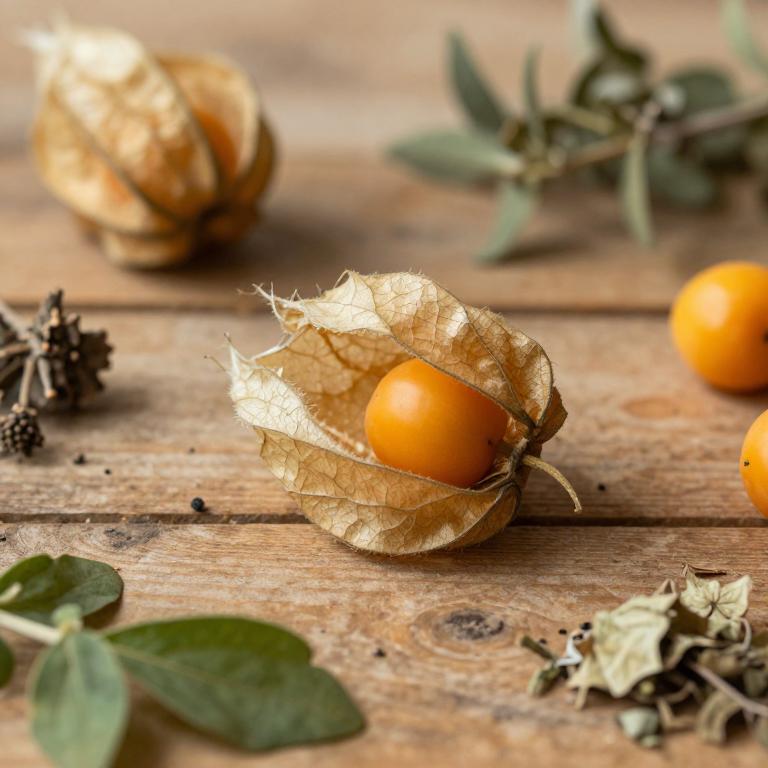
Strawberry groundcherry, scientifically known as Physalis pruinosa, is a versatile perennial herb prized for its sweet, golden berries. Native to the Americas, this plant offers significant nutritional benefits and traditional medicinal uses. Its unique papery husks protect delicate fruits, making it a fascinating subject for both gardeners and herbalists.
- Family
- Solanaceae
- Native range
- Asia-Temperate
- Parts used
- Leaf
- Common names
- Husk Tomato · Strawberry Tomato
- Scientific synonyms
- Not available
Names and Synonyms
Common Names
- husk tomato
- strawberry tomato
Scientific Names
Accepted name
Physalis pruinosaRegional and Traditional Names
Spanish:
- Physalis cordifolia
- Physalis maxima
- Physalis nicandroides var. attenuata
- tomate de culebra
German:
- Ananaskirsche
- Ananasbeere
French:
- Cerise de terre
Sources: Wikidata, Catalogue of Life
Taxonomical Classification
This plant belongs to the kingdom Plantae and is classified under the phylum Streptophyta and the class Equisetopsida. Within the subclass Magnoliidae, it is ordered as Solanales and placed in the family Solanaceae. Finally, its specific taxonomic identity is established under the genus Physalis.
| Rank | Classification |
|---|---|
| Kingdom | Plantae |
| Phylum | Streptophyta |
| Class | Equisetopsida |
| Subclass | Magnoliidae |
| Order | Solanales |
| Family | Solanaceae |
| Genus | Physalis |
Sources: The World Checklist of Vascular Plants (WCVP)
Distribution
This plant exhibits a diverse geographical distribution that spans across several distinct regions. In Eastern Asia, its presence can be noted specifically within the Ogasawara-shoto islands. Moving toward the Indian Subcontinent, it is documented to grow within India. The species also has a significant footprint in Mexico, where it is found throughout Mexico Central. Finally, its range extends further into the Mexican landscape, covering both the Northeast and the Gulf regions.
| Region | Area |
|---|---|
| Eastern Asia | Ogasawara-shoto |
| Indian Subcontinent | India |
| Mexico | Mexico Central |
| Mexico | Mexico Northeast |
| Mexico | Mexico Gulf |
| Mexico | Mexico Northwest |
| Mexico | Mexico Southwest |
| Mexico | Mexico Southeast |
| Central America | Costa Rica |
| Central America | El Salvador |
Sources: The World Checklist of Vascular Plants (WCVP)
Botanical Identification
Ecology
The ecology of Physalis pruinosa is characterized by its adaptation to specific environmental conditions within the Caatinga (stricto sensu) biome. This species thrives across a broad altitudinal gradient, occupying diverse landscapes that range from sea level up to a maximum elevation of 1450 m AMSL. Its presence within the semi-arid Caatinga indicates a specialized capacity to endure the unique climatic stresses and soil compositions inherent to this xeric shrubland ecosystem.
- Elevational range max:
- 1450 m AMSL
- Elevational range min:
- 0 m AMSL
- Habitat :
- Caatinga (stricto sensu)
Life history
The life history of Physalis pruinosa is characterized by an annual lifecycle, meaning it completes its entire developmental process from germination to seed production within a single growing season. As a therophyte, the plant functions by producing seeds that remain dormant during unfavorable conditions, allowing the species to persist in the environment despite the absence of a living vegetative structure between seasons. This life form ensures that the plant can rapidly exploit favorable environmental windows, growing from a seedling to a mature reproductive stage before the onset of senescence at the end of its yearly cycle.
- Life form :
- therophyte
- Lifecycle :
- annual
Morphology
The morphology of Physalis pruinosa is characterized by its growth form as a non-woody herb, typically manifesting as a forb or subshrub. It is a terrestrial plant, neither aquatic nor semiaquatic, and functions as an independent organism without any parasitic tendencies. Although it possesses a spreading habit, it is classified as a self-supporting plant rather than an obligatory or facultative climber, liana, or vine. Furthermore, it lacks epiphytic characteristics, maintaining a strictly terrestrial existence rather than growing as a holoepiphyte, hemiepiphyte, or any other epiphytic form.
- Aquatic :
- terrestrial
- Climber :
- self-supporting
- Epiphyte :
- terrestrial
- Growth form :
- herb
- Parasite :
- independent
- Woodiness :
- non-woody
Physiology
The physiology of Physalis pruinosa is characterized by a metabolic framework centered around a C3 photosynthetic pathway, which governs its carbon fixation processes and energy production. Under this pathway, the plant utilizes the enzyme RuBisCO to facilitate the initial fixation of atmospheric carbon dioxide into three-carbon organic compounds during the Calvin cycle. This metabolic strategy necessitates efficient transpiration and stomatal regulation to balance the intake of CO2 with the prevention of excessive water loss, a common physiological challenge for C3 species. The plant's internal resource management involves the conversion of light energy into chemical energy through specialized chloroplast structures, driving the synthesis of carbohydrates that support its vegetative growth and the development of its characteristic fruit. Additionally, its physiological processes include active nutrient uptake and osmotic regulation to maintain cellular turgor and support the structural integrity of its herbaceous tissues.
- Photosynthetic pathway :
- C3
Reproduction
The reproduction of Physalis pruinosa is characterized by the production of numerous small seeds contained within a protective, papery bladder-like calyx that develops from the flower. The reproductive success of the species is closely tied to the specific physical dimensions of its progeny, which exhibit a highly consistent seed mass. Quantitatively, the seeds possess a mean mass of 0.00085725 g, with individual seed weights ranging from a minimum of 0.00081 g to a maximum of 0.00089 g. This narrow range in seed mass suggests a stabilized reproductive strategy aimed at maintaining uniform germination potential and resource allocation within the fruit.
- Seed mass max:
- 0.00089 g
- Seed mass mean:
- 0.00085725 g
- Seed mass min:
- 0.00081 g
Sources: Global Inventory of Floras and Traits (GIFT)
Plant Parts
Physalis pruinosa has 1 reported plant parts identified across 1 scientific publications and several other databases that are studied for medicinal purposes. The most consistently reported plant part include leaf.
| Plant part | Supporting sources | Consensus |
|---|---|---|
| Leaf | 1 supporting sources | ★☆☆☆☆ |
Leaf
- BMC complementary medicine and therapies
Chemicals
Physalis pruinosa has 1 reported phytochemicals identified across 1 scientific publications and several other databases. The most consistently reported chemicals include withanolide.
| Chemical | Supporting sources | Consensus |
|---|---|---|
| withanolide | 1 supporting sources | ★☆☆☆☆ |
withanolide
- Nature communications