long-leaved ground-cherry
Physalis longifolia · Accepted scientific name
Scientific literature: Very Sparse (9 studies) · ★☆☆☆☆
Long-leaved ground-cherry, scientifically known as Physalis longifolia, is a versatile perennial herb native to parts of Asia and Australia. Renowned for its edible, lantern-like fruit, this plant offers significant medicinal potential. It is traditionally utilized for its antioxidant properties and its ability to support various healing processes.
- Family
- Solanaceae
- Native range
- Europe
- Parts used
- Not available
- Common names
- Long-Leaved Ground-Cherry · Common Ground-Cherry · 4 more
- Scientific synonyms
- Physalis Lanceolata Var. Longifolia
Names and Synonyms
Common Names
- long-leaved ground-cherry
- common ground-cherry
- longleaf ground-cherry
- common groundcherry
- long-leaved groundcherry
- narrow-leaf ground-cherry
Scientific Names
Accepted name
Physalis longifoliaSynonyms
- Physalis lanceolata var. longifolia
Regional and Traditional Names
French:
- coqueret à feuilles longues
Sources: Wikidata, Catalogue of Life
Taxonomical Classification
This plant belongs to the kingdom Plantae within the phylum Streptophyta and the class Equisetopsida. It is further classified under the subclass Magnoliidae, the order Solanales, and the family Solanaceae. Finally, its specific taxonomic placement is within the genus Physalis.
| Rank | Classification |
|---|---|
| Kingdom | Plantae |
| Phylum | Streptophyta |
| Class | Equisetopsida |
| Subclass | Magnoliidae |
| Order | Solanales |
| Family | Solanaceae |
| Genus | Physalis |
Sources: The World Checklist of Vascular Plants (WCVP)
Distribution
This plant exhibits a diverse geographical distribution that spans multiple continents. In Europe, its presence is specifically noted within the country of Italy. Moving toward Eastern Asia, the species can also be found growing in Korea. Its reach extends significantly into Australia, where it inhabits several distinct regions. Specifically, it is documented across New South Wales, Queensland, and the Northern Territory.
| Region | Area |
|---|---|
| Southeastern Europe | Italy |
| Eastern Asia | Korea |
| Australia | New South Wales |
| Australia | Northern Territory |
| Australia | Queensland |
| Australia | South Australia |
| Australia | Victoria |
| Western Canada | British Columbia |
| Eastern Canada | Ontario |
| Northwestern U.S.A. | Colorado |
Sources: The World Checklist of Vascular Plants (WCVP)
Botanical Identification
Life history
The life history of Physalis longifolia is characterized by its status as a perennial species, though its growth patterns can be considered variable depending on environmental conditions and resource availability. As a perennial, the plant is capable of surviving through multiple growing seasons, often establishing a robust presence through a spreading root system that allows for regrowth after periods of dormancy. While its primary lifecycle is perennial, the plant exhibits significant adaptability, occasionally displaying characteristics that align with annual or biennial growth cycles if environmental stressors dictate a shorter lifespan or a rapid shift from vegetative to reproductive stages. This variability in its lifecycle ensures its persistence in diverse habitats, allowing it to manage seasonal changes by cycling through periods of active growth, flowering, and seed production.
- Lifecycle :
- perennial
Morphology
The morphology of Physalis longifolia is characterized by its growth form as a non-woody herb, specifically categorized as a forb. This plant functions as an independent organism, lacking any parasitic or epiphytic tendencies, and maintains a strictly terrestrial existence rather than being aquatic or semiaquatic. Although it possesses qualities often found in climbing structures, it is described as a self-supporting plant rather than an obligatory or facultative vine or liana. In terms of physical stature, it is a relatively low-growing species, with a maximum plant height reaching approximately 0.5 m.
- Aquatic :
- terrestrial
- Climber :
- self-supporting
- Epiphyte :
- terrestrial
- Growth form :
- herb
- Growth form :
- forb
- Parasite :
- independent
- Plant height max:
- 0.5 m
- Woodiness :
- non-woody
Physiology
The physiology of Physalis longifolia is characterized by its metabolic processes and specific morphological adaptations, most notably its utilization of the C3 photosynthetic pathway. This carbon fixation method involves the direct carboxylation of ribulose-1,5-bisphosphate by the enzyme RuBisCO, a process typical of many temperate vegetation species. In terms of vegetative morphology, the plant exhibits specific leaf dimensions, with a measured leaf length that reaches a maximum of 3 cm. This compact leaf size influences the plant's surface-area-to-volume ratio, playing a critical role in regulating transpiration rates and gas exchange efficiency during its growth cycles.
- Leaf length max:
- 3 cm
- Photosynthetic pathway :
- C3
Reproduction
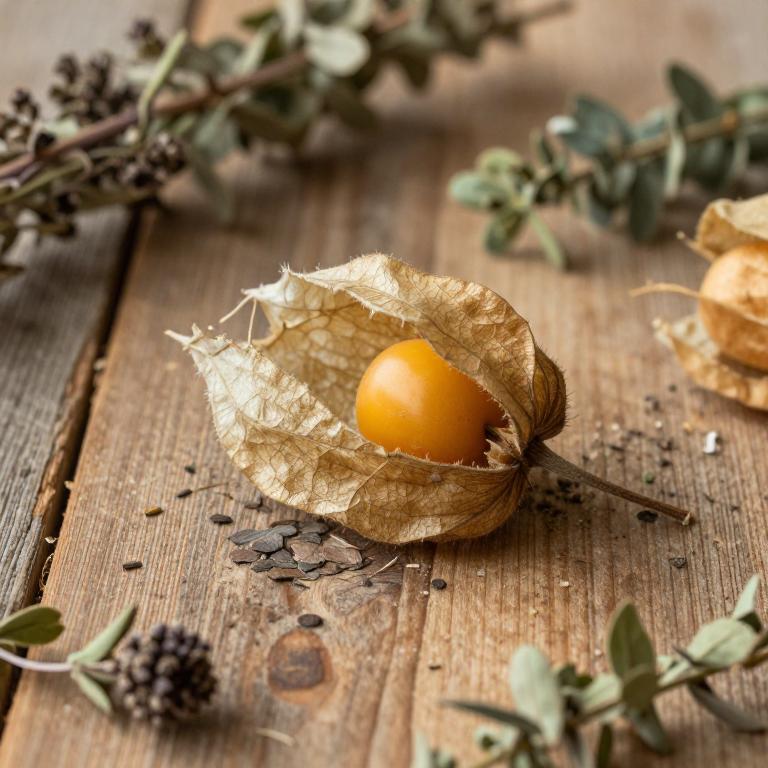
The reproduction of Physalis longifolia is characterized by the development of a fruit classified as a berry, which is contained within a distinctive inflated calyx. This fruit remains indehiscent, meaning it does not spontaneously split open at maturity to release its contents, instead relying on the eventual decay or physical breakdown of the protective structure. The dispersal of the seeds is primarily anemochorous, utilizing wind as a mechanism to transport the reproductive units away from the parent plant.
- Dehiscence :
- indehiscent
- Dispersal syndrome :
- anemochorous
- Fruit type :
- berry
Sources: Global Inventory of Floras and Traits (GIFT)
Chemicals
Physalis longifolia has 9 reported phytochemicals identified across 0 scientific publications and several other databases. The most consistently reported chemicals include Withaferin A, Withalongolide A, Withalongolide B, Withalongolide C, Withalongolide D.
| Chemical | Supporting sources | Consensus |
|---|---|---|
| Withaferin A | 1 supporting sources | ★☆☆☆☆ |
| Withalongolide A | 1 supporting sources | ★☆☆☆☆ |
| Withalongolide B | 1 supporting sources | ★☆☆☆☆ |
| Withalongolide C | 1 supporting sources | ★☆☆☆☆ |
| Withalongolide D | 1 supporting sources | ★☆☆☆☆ |
| Withalongolide E | 1 supporting sources | ★☆☆☆☆ |
| Withalongolide G | 1 supporting sources | ★☆☆☆☆ |
| Withalongolide H | 1 supporting sources | ★☆☆☆☆ |
| Withanolides | 1 supporting sources | ★☆☆☆☆ |
Withaferin A
- Pure and applied chemistry. Chimie pure et appliquee
Withalongolide A
- Pure and applied chemistry. Chimie pure et appliquee
Withalongolide B
- Pure and applied chemistry. Chimie pure et appliquee
Withalongolide C
- Pure and applied chemistry. Chimie pure et appliquee
Withalongolide D
- Pure and applied chemistry. Chimie pure et appliquee
Withalongolide E
- Pure and applied chemistry. Chimie pure et appliquee
Withalongolide G
- Pure and applied chemistry. Chimie pure et appliquee
Withalongolide H
- Pure and applied chemistry. Chimie pure et appliquee
Withanolides
- Pure and applied chemistry. Chimie pure et appliquee