Physalis halicacabum
Physalis halicacabum · Accepted scientific name
Scientific literature: Very Sparse (1 studies) · ★☆☆☆☆
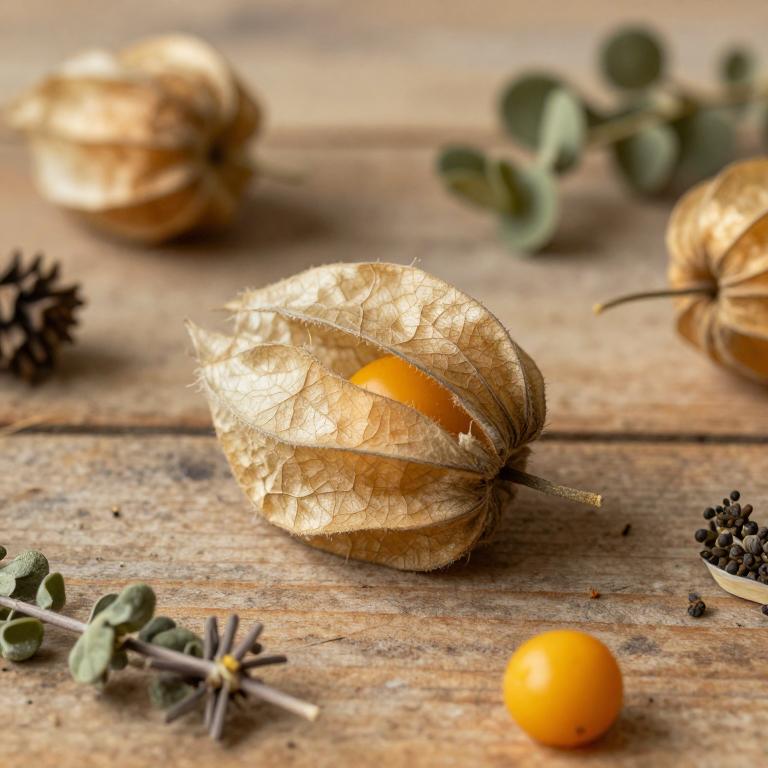
, scientifically known as Physalis haliacabum, is a versatile medicinal plant belonging to the Solanaceae family. Often referred to as bladder cherry, it grows in various habitats. Renowned in traditional medicine, its leaves and fruits possess significant antioxidant, anti-inflammatory, and diuretic properties, offering valuable therapeutic potential for holistic healing.
- Family
- Solanaceae
- Native range
- Asia-Temperate
- Parts used
- Not available
- Common names
- Not available
- Scientific synonyms
- Physalis Divaricata · Physalis Alvarisii · 7 more
Names and Synonyms
Scientific Names
Accepted name
Physalis halicacabumSynonyms
- Physalis divaricata
- Physalis alvarisii
- Physalis indica
- Physalis joe-diasii
- Physalis kansuensis
- Physalis minima var. indica
- Nicandra indica
- Physalis indica var. microcarpa
- Physalis alkekengi var. orientalis
Taxonomical Classification
This plant belongs to the kingdom Plantae within the phylum Streptophyta and the class Equisetopsida. It is further classified under the subclass Magnoliidae, the order Solanales, and the family Solanaceae. Finally, it is categorized under the genus Physalis.
| Rank | Classification |
|---|---|
| Kingdom | Plantae |
| Phylum | Streptophyta |
| Class | Equisetopsida |
| Subclass | Magnoliidae |
| Order | Solanales |
| Family | Solanaceae |
| Genus | Physalis |
Sources: The World Checklist of Vascular Plants (WCVP)
Distribution
This plant exhibits a widespread geographical distribution across several key regions of Asia. In Western Asia, its presence is noted within the country of Afghanistan. Its range extends into China, specifically throughout the North-Central territories. Within the Indian Subcontinent, it can be found in the state of Assam and across the East Himalaya region. Finally, the species is also commonly distributed throughout India.
| Region | Area |
|---|---|
| Western Asia | Afghanistan |
| China | China North-Central |
| Indian Subcontinent | Assam |
| Indian Subcontinent | East Himalaya |
| Indian Subcontinent | India |
| Indian Subcontinent | Nepal |
| Indian Subcontinent | Pakistan |
Sources: The World Checklist of Vascular Plants (WCVP)
Botanical Identification
Ecology
The ecology of Physalis haliacabum is characterized by its adaptation to diverse montane and sub-montane landscapes, where it thrives within a specific altitudinal gradient. This species is predominantly found at elevations ranging from a minimum of 400 m AMSL to a maximum of 1200 m AMSL. Within this vertical range, the plant occupies various microhabitats, often favoring disturbed soils, forest edges, or open meadows where sunlight availability is sufficient to support its growth cycle. The environmental conditions within this 800-meter elevational span dictate its distribution, as the plant must navigate varying temperature regimes and moisture levels typical of these middle-altitude zones.
- Elevational range max:
- 1200 m AMSL
- Elevational range min:
- 400 m AMSL
Morphology
The morphology of Physalis haliacabum is characterized by its growth form as a herb, exhibiting a non-woody structure throughout its vegetative organs. It functions as a self-supporting climber, utilizing its herbaceous stems to ascend or spread without the requirement of external structural support.
- Climber :
- self-supporting
- Growth form :
- herb
- Woodiness :
- non-woody
Sources: Global Inventory of Floras and Traits (GIFT)
Chemicals
Physalis halicacabum has 1 reported phytochemicals identified across 0 scientific publications and several other databases. The most consistently reported chemicals include ergosta-5,24(28)-dien-3beta,25-diol.
| Chemical | Supporting sources | Consensus |
|---|---|---|
| ergosta-5,24(28)-dien-3beta,25-diol | 1 supporting sources | ★☆☆☆☆ |
ergosta-5,24(28)-dien-3beta,25-diol
- Planta medica