grey ground-cherry
Physalis grisea · Accepted scientific name
Scientific literature: Very Sparse (11 studies) · ★☆☆☆☆
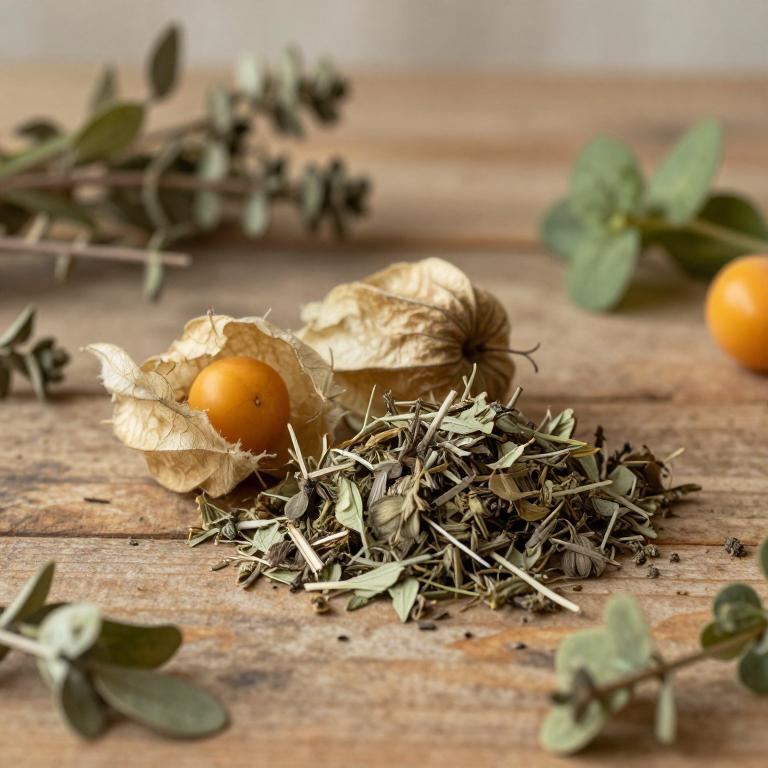
Grey ground-cherry, scientifically known as Physalis grisea, is a versatile medicinal herb native to various tropical regions. Renowned for its unique bladder-like fruit, this plant offers significant therapeutic potential. It is traditionally utilized in folk medicine to address inflammatory conditions, digestive issues, and various ailments, showcasing its remarkable botanical importance.
- Family
- Solanaceae
- Native range
- Europe
- Parts used
- Not available
- Common names
- Grey Ground-Cherry · Dwarf Cape-Gooseberry · 2 more
- Scientific synonyms
- Physalis Pubescens Var. Grisea
Names and Synonyms
Common Names
- grey ground-cherry
- dwarf Cape-gooseberry
- hairy ground-cherry
- Strawberry Groundcherry
Scientific Names
Accepted name
Physalis griseaSynonyms
- Physalis pubescens var. grisea
Regional and Traditional Names
Spanish:
- muyaca
- uvilla
German:
- Erdkirsche
French:
- coqueret gris
Sources: Wikidata, Catalogue of Life
Taxonomical Classification
This plant belongs to the kingdom Plantae and the phylum Streptophyta, falling under the class Equisetopsida and subclass Magnoliidae. It is further classified within the order Solanales and the family Solanaceae. Finally, it is categorized under the genus Physalis.
| Rank | Classification |
|---|---|
| Kingdom | Plantae |
| Phylum | Streptophyta |
| Class | Equisetopsida |
| Subclass | Magnoliidae |
| Order | Solanales |
| Family | Solanaceae |
| Genus | Physalis |
Sources: The World Checklist of Vascular Plants (WCVP)
Distribution
This plant exhibits a wide geographical distribution across both Europe and North America. In Middle Europe, its presence is documented in countries such as Austria, Belgium, and Germany. Moving across the Atlantic, the species can also be found in the diverse landscapes of Canada. Within Western Canada, it is specifically located in the province of British Columbia. Finally, its range extends to Eastern Canada, where it is known to grow in Ontario.
| Region | Area |
|---|---|
| Middle Europe | Austria |
| Middle Europe | Belgium |
| Middle Europe | Germany |
| Western Canada | British Columbia |
| Eastern Canada | Ontario |
| Northwestern U.S.A. | Washington |
| North-Central U.S.A. | Illinois |
| North-Central U.S.A. | Iowa |
| North-Central U.S.A. | Minnesota |
| North-Central U.S.A. | Missouri |
Sources: The World Checklist of Vascular Plants (WCVP)
Botanical Identification
Life history
The life history of Physalis grisea is characterized by its status as an annual plant, meaning it completes its entire developmental cycle—from germination to seed production—within a single growing season. Following the germination of seeds in favorable soil conditions, the plant undergoes a rapid vegetative growth phase, establishing a root system and developing foliage to support its increasing biomass. As the season progresses, the plant transitions into its reproductive stage, producing flowers that are subsequently encased in characteristic bladder-like calyxes. Once fertilization occurs, the plant directs its metabolic energy toward the maturation of fruits and the production of viable seeds. Upon the completion of seed dispersal, the individual plant reaches the end of its biological life cycle, leaving the next generation to emerge from the soil at the onset of the subsequent growing season.
- Lifecycle :
- annual
Morphology
The morphology of Physalis grisea is characterized by its growth form as a non-woody herb, specifically categorized as a forb. It functions as an independent organism, neither acting as a parasite nor an epiphyte, maintaining a terrestrial existence rather than an aquatic or semiaquatic one. Structurally, the plant is self-supporting, lacking the characteristics of a liana, vine, or any other form of obligate or facultative climber.
- Aquatic :
- terrestrial
- Climber :
- self-supporting
- Epiphyte :
- terrestrial
- Growth form :
- herb
- Growth form :
- forb
- Parasite :
- independent
- Woodiness :
- non-woody
Sources: Global Inventory of Floras and Traits (GIFT)
Chemicals
Physalis grisea has 9 reported phytochemicals identified across 0 scientific publications and several other databases. The most consistently reported chemicals include ANTHOCYANIN, CHI, CHS, Malondialdehyde, apigenin.
| Chemical | Supporting sources | Consensus |
|---|---|---|
| ANTHOCYANIN | 1 supporting sources | ★☆☆☆☆ |
| CHI | 1 supporting sources | ★☆☆☆☆ |
| CHS | 1 supporting sources | ★☆☆☆☆ |
| Malondialdehyde | 1 supporting sources | ★☆☆☆☆ |
| apigenin | 1 supporting sources | ★☆☆☆☆ |
| dihydrokaempferol | 1 supporting sources | ★☆☆☆☆ |
| luteolin | 1 supporting sources | ★☆☆☆☆ |
| proline | 1 supporting sources | ★☆☆☆☆ |
| quercetin | 1 supporting sources | ★☆☆☆☆ |
ANTHOCYANIN
- Plant physiology and biochemistry : PPB
CHI
- Plant physiology and biochemistry : PPB
CHS
- Plant physiology and biochemistry : PPB
Malondialdehyde
- Physiologia plantarum
apigenin
- Physiologia plantarum
dihydrokaempferol
- Physiologia plantarum
luteolin
- Physiologia plantarum
proline
- Physiologia plantarum
quercetin
- Physiologia plantarum
Conditions
Physalis grisea has 2 reported investigations on conditions identified across 0 scientific publications and several other databases. The most consistently reported conditions include drought resistance, drought tolerance.
| Condition | Supporting sources | Consensus |
|---|---|---|
| Drought resistance | 1 supporting sources | ★☆☆☆☆ |
| Drought tolerance | 1 supporting sources | ★☆☆☆☆ |
Drought resistance
- Plant physiology and biochemistry : PPB
Drought tolerance
- Plant physiology and biochemistry : PPB