brown ivory
Phyllogeiton discolor · Accepted scientific name
Scientific literature: Very Sparse (14 studies) · ★☆☆☆☆
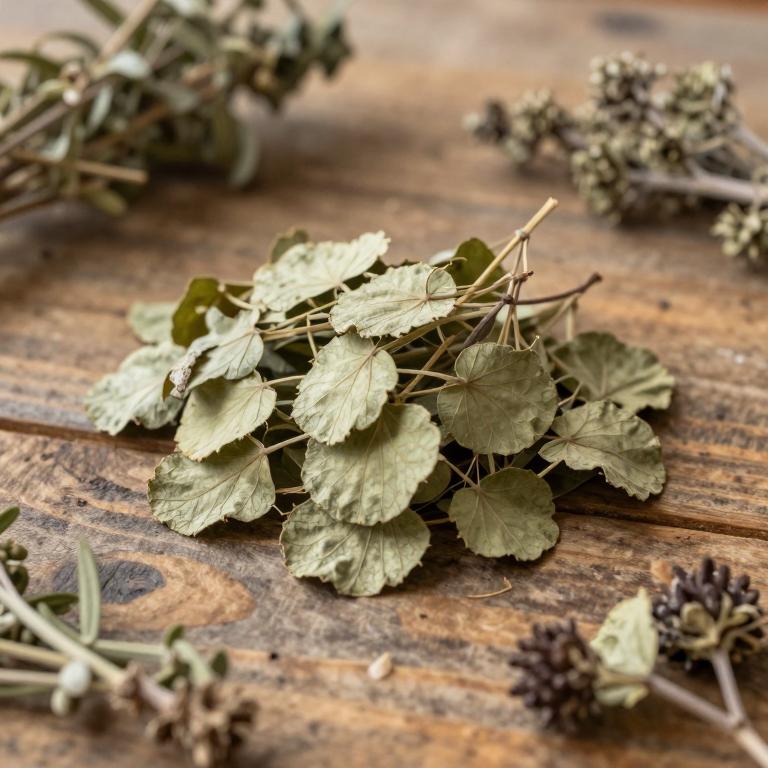
Brown ivory, scientifically known as Phyllogeiton discolor, is a distinctive medicinal plant valued for its unique therapeutic properties. Renowned for its striking foliage, this species offers significant botanical interest. It is widely utilized in traditional healing practices to address various ailments, showcasing the profound intersection of nature and wellness.
Names and Synonyms
Common Names
- Mountain Date
- Mountain-Date
- Wild Date
- Wild-Almond
Scientific Names
Accepted name
Phyllogeiton discolorSynonyms
- Adolia discolor
- Berchemia discolor
- Araliorhamnus punctulata
- Araliorhamnus vaginata
- Scutia discolor
Regional and Traditional Names
German:
- Braunes Elfenbeinholz
- Wilde Dattel
Sources: Wikidata, Catalogue of Life
Taxonomical Classification
This plant belongs to the kingdom Plantae and is classified under the phylum Streptophyta within the class Equisetopsida. It is further categorized under the subclass Magnoliidae and the order Rosales. Finally, it is a member of the family Rhamnaceae and is specifically identified by the genus Phyllogeiton.
| Rank | Classification |
|---|---|
| Kingdom | Plantae |
| Phylum | Streptophyta |
| Class | Equisetopsida |
| Subclass | Magnoliidae |
| Order | Rosales |
| Family | Rhamnaceae |
| Genus | Phyllogeiton |
Sources: The World Checklist of Vascular Plants (WCVP)
Distribution
This plant exhibits a specific geographical distribution spanning several key regions across the African continent. In West-Central Tropical Africa, it can be found within the Democratic Republic of the Congo. Its presence extends significantly into Northeast Tropical Africa, where it inhabits Ethiopia and Eritrea. Additionally, the species is located in Somalia and covers the areas of Sudan and South Sudan. These diverse locations highlight the plant's range across both central and northeastern tropical landscapes.
| Region | Area |
|---|---|
| West-Central Tropical Africa | DR Congo |
| Northeast Tropical Africa | Eritrea |
| Northeast Tropical Africa | Ethiopia |
| Northeast Tropical Africa | Somalia |
| Northeast Tropical Africa | Sudan-South Sudan |
| East Tropical Africa | Kenya |
| East Tropical Africa | Tanzania |
| East Tropical Africa | Uganda |
| South Tropical Africa | Angola |
| South Tropical Africa | Malawi |
Sources: The World Checklist of Vascular Plants (WCVP)
Botanical Identification
Ecology
The ecology of Phyllogeiton discolor is characterized by its adaptability across diverse terrains, ranging from low-lying areas to higher altitudes. It thrives within a significant elevational gradient, beginning at a minimum of 30 m AMSL and reaching a maximum elevation of 1465 m AMSL. Its preferred habitats are widespread, as it is commonly found inhabiting thicket environments and wooded grasslands, where it can integrate into the complex structure of these semi-open vegetative communities.
- Elevational range max:
- 1465 m AMSL
- Elevational range min:
- 30 m AMSL
- Habitat :
- widespread in thicket, wooded grassland
Life history
The life history of Phyllogeiton discolor is characterized by its classification as a perennial species, allowing the plant to persist through multiple growing seasons. As a perennial, it avoids the rapid, single-season completion of life seen in annuals, instead focusing on establishing a robust presence within its ecological niche. This extended lifecycle enables the plant to invest resources into long-term survival and repeated reproductive efforts over several years, rather than relying on a single, terminal flowering event. Through this perennial strategy, the plant can adapt to environmental fluctuations and maintain stability within its habitat over time.
- Lifecycle :
- perennial
Morphology
The morphology of Phyllogeiton discolor is characterized by a woody growth form, specifically developing as a tree. It is a terrestrial species that functions as an independent organism rather than a parasite or an epiphyte. In terms of stature, the plant exhibits significant vertical development, with a height that typically ranges from a minimum of 3 m to a maximum of 20 m, maintaining an average plant height of approximately 12 m. Although it possesses a sturdy, self-supporting structure rather than acting as a vine or liana, its physical presence is defined by its substantial woody architecture.
- Aquatic :
- terrestrial
- Climber :
- self-supporting
- Epiphyte :
- terrestrial
- Growth form :
- tree
- Parasite :
- independent
- Plant height max:
- 20 m
- Plant height mean:
- 12 m
- Plant height min:
- 3 m
- Woodiness :
- woody
Physiology
The physiology of Phyllogeiton discolor is characterized by a specific metabolic framework and nutrient acquisition strategy. It utilizes the C3 photosynthetic pathway, a common mechanism in many temperate and Mediterranean-climate flora, where carbon dioxide fixation occurs through the Calvin cycle without the specialized spatial or temporal separation found in C4 or CAM plants. Furthermore, this species does not function as a nitrogen fixer; it lacks the symbiotic relationship with diazotrophic bacteria required to convert atmospheric nitrogen into usable forms, meaning it relies instead on the uptake of nitrogenous compounds directly from the soil substrate.
- Nitrogen fixer :
- no
- Photosynthetic pathway :
- C3
Reproduction
The reproduction of Phyllogeiton discolor is characterized by a biotic pollination syndrome, primarily relying on biological vectors to facilitate fertilization. Within this biotic framework, the plant specifically utilizes insects, with a noted specialization toward bees as key pollinators. The resulting reproductive output yields seeds with significant morphological characteristics; the seed volume is highly consistent, measured at a mean, minimum, and maximum of 470 mm³. Furthermore, the seeds exhibit a notable range in mass, with a minimum weight of 0.1 g and a maximum weight of 0.59424 g, resulting in an average seed mass of approximately 0.302554286 g.
- Pollination syndrome :
- insect
- Pollination syndrome :
- bee
- Pollination syndrome :
- biotic
- Seed mass max:
- 0.59424 g
- Seed mass mean:
- 0.302554286 g
- Seed mass min:
- 0.1 g
- Seed volume max:
- 470 mm³
Sources: Global Inventory of Floras and Traits (GIFT)
Plant Parts
Phyllogeiton discolor has 2 reported plant parts identified across 3 scientific publications and several other databases that are studied for medicinal purposes. The most consistently reported plant part include leaf, root.
| Plant part | Supporting sources | Consensus |
|---|---|---|
| Leaf | 2 supporting sources | ★☆☆☆☆ |
| Root | 1 supporting sources | ★☆☆☆☆ |
Leaf
- The Central African journal of medicine
- Molecules (Basel, Switzerland)
Root
- Journal of natural products
Chemicals
Phyllogeiton discolor has 9 reported phytochemicals identified across 3 scientific publications and several other databases. The most consistently reported chemicals include Amorphigenin, Compound-4, Flavonoids, Nitidulin, Phenols.
| Chemical | Supporting sources | Consensus |
|---|---|---|
| Amorphigenin | 1 supporting sources | ★☆☆☆☆ |
| Compound-4 | 1 supporting sources | ★☆☆☆☆ |
| Flavonoids | 1 supporting sources | ★☆☆☆☆ |
| Nitidulin | 1 supporting sources | ★☆☆☆☆ |
| Phenols | 1 supporting sources | ★☆☆☆☆ |
| Saponins | 1 supporting sources | ★☆☆☆☆ |
| Tannins | 1 supporting sources | ★☆☆☆☆ |
| Terpenoids | 1 supporting sources | ★☆☆☆☆ |
| dabinol | 1 supporting sources | ★☆☆☆☆ |
Amorphigenin
- Journal of natural products
Compound-4
- Journal of natural products
Flavonoids
- Molecules (Basel, Switzerland)
Nitidulin
- Journal of natural products
Phenols
- Molecules (Basel, Switzerland)
Saponins
- Molecules (Basel, Switzerland)
Tannins
- Molecules (Basel, Switzerland)
Terpenoids
- Molecules (Basel, Switzerland)
dabinol
- Journal of natural products
Activities
Phyllogeiton discolor has 1 reported activities identified across 3 scientific publications and several other databases. The most consistently reported activities include Antimicrobial.
| Activity | Supporting sources | Consensus |
|---|---|---|
| Antimicrobial | 1 supporting sources | ★☆☆☆☆ |
Antimicrobial
- The Central African journal of medicine
Preparations
Phyllogeiton discolor has 2 reported preparations identified across 3 scientific publications and several other databases. The most consistently reported preparations include methanol and distilled water extracts, root bark.
| Preparation | Supporting sources | Consensus |
|---|---|---|
| Methanol and distilled water extracts | 1 supporting sources | ★☆☆☆☆ |
| Root bark | 1 supporting sources | ★☆☆☆☆ |
Methanol and distilled water extracts
- Molecules (Basel, Switzerland)
Root bark
- Journal of natural products