Tepary bean
Phaseolus acutifolius · Accepted scientific name
Scientific literature: Very Extensive (338 studies) · ★★★★★
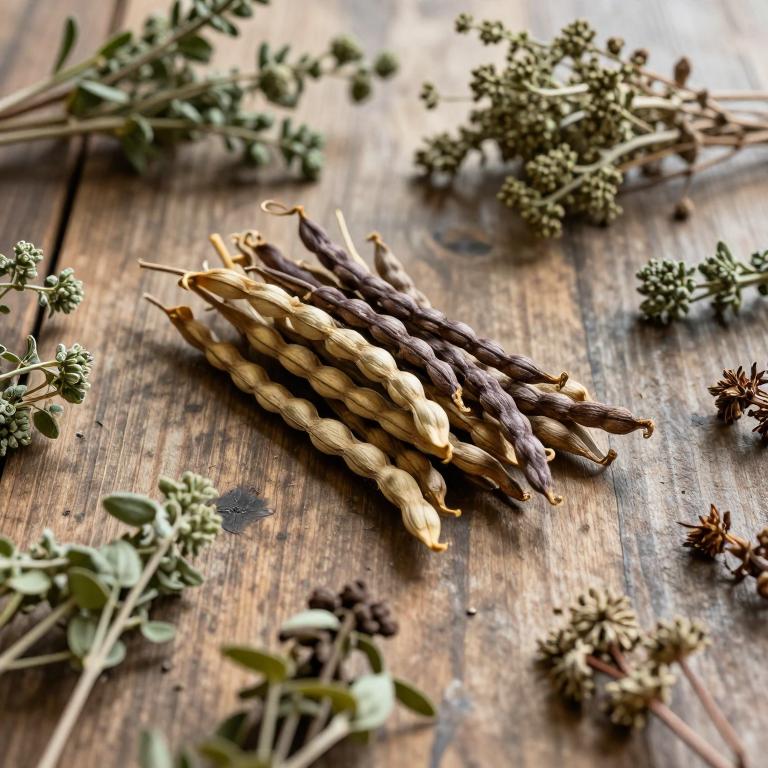
Tepary bean, scientifically known as Phaseolus acutifolius, is a resilient legume native to the Sonoran Desert. Highly adapted to extreme heat and drought, this nutritious plant offers significant dietary benefits. Traditionally valued in indigenous cultures, it serves as a vital, sustainable food source in arid and warming climates.
- Family
- Fabaceae
- Native range
- Europe
- Parts used
- Not available
- Common names
- Tepary Bean · Tepary-Beans · 1 more
- Scientific synonyms
- Not available
Names and Synonyms
Common Names
- Tepary bean
- tepary-beans
- tepary bean
Scientific Names
Accepted name
Phaseolus acutifoliusRegional and Traditional Names
Spanish:
- escumite
- frijol tépari
- Escomite
- Frijol tepario
German:
- Teparybohne
French:
- Haricot tépari
Sources: Wikidata, Catalogue of Life
Taxonomical Classification
This plant belongs to the kingdom Plantae and the phylum Streptophyta, falling under the class Equisetopsida and subclass Magnoliidae. Within the order Fabales, it is a member of the family Fabaceae and is classified under the genus Phaseolus.
| Rank | Classification |
|---|---|
| Kingdom | Plantae |
| Phylum | Streptophyta |
| Class | Equisetopsida |
| Subclass | Magnoliidae |
| Order | Fabales |
| Family | Fabaceae |
| Genus | Phaseolus |
Sources: The World Checklist of Vascular Plants (WCVP)
Distribution
This plant exhibits a diverse geographical distribution spanning across multiple regions of Europe and the Atlantic islands. Within Eastern Europe, its presence is documented in Krym and throughout Ukraine. It also inhabits significant portions of the Russian landscape, specifically in Central European Russia and South European Russia. Beyond the mainland, its range extends to the Macaronesia region, specifically reaching the Canary Is. Consequently, the species maintains a wide ecological footprint across these distinct territories.
| Region | Area |
|---|---|
| Eastern Europe | Krym |
| Eastern Europe | Central European Russia |
| Eastern Europe | South European Russia |
| Eastern Europe | Ukraine |
| Macaronesia | Canary Is. |
| West Tropical Africa | Mali |
| Central Asia | Kazakhstan |
| Central Asia | Kirgizstan |
| Indian Subcontinent | India |
| Southwestern U.S.A. | Arizona |
Sources: The World Checklist of Vascular Plants (WCVP)
Botanical Identification
Ecology
The ecology of Phaseolus acutifolius is fundamentally defined by its adaptation to the steppe biome, where it thrives in open, semi-arid landscapes characterized by low precipitation and high solar exposure. Within these steppe environments, the species occupies niches that demand high tolerance for seasonal moisture fluctuations and intense temperature variations. The plant's survival strategy is closely tied to the specific soil compositions found in these grasslands, often favoring well-drained substrates that prevent waterlogging while allowing for deep root penetration to access subterranean moisture. By inhabiting these expansive, wind-swept habitats, Phaseolus acutifolius participates in a specialized ecological community where it must compete for limited nutrients and water among various perennial grasses and ephemeral herbs.
- Habitat :
- steppe
Life history
The life history of Phaseolus acuifolius is characterized by an annual lifecycle, meaning the plant completes its entire biological development—from seed germination and vegetative growth to flowering and seed production—within a single growing season. As an annual species, it relies on the rapid production of seeds to ensure the survival of the next generation before the onset of unfavorable environmental conditions. The cycle begins with the germination of seeds in suitable soil, followed by a period of rapid vegetative expansion where the plant establishes its structural framework. This is succeeded by a reproductive phase involving the development of flowers and the subsequent formation of pods containing seeds. Once the seeds reach maturity, the parent plant typically withers and dies, leaving the dormant seeds in the soil to await the next favorable seasonal cycle to begin the process anew.
- Lifecycle :
- annual
Morphology
The morphology of Phaseolus acuifolius is characterized by its growth form as a non-woody herb and forb. It functions as an obligatory climber, specifically exhibiting a vine habit, with a shoot orientation that is described as prostrate. The plant is terrestrial in its habitat, functioning as an independent organism rather than a parasite or epiphyte. In terms of stature, it reaches a maximum plant height of 2 m, with a mean height of 2 m and a minimum height of 0.5 m.
- Aquatic :
- terrestrial
- Climber :
- vine
- Climber :
- obligatory
- Epiphyte :
- terrestrial
- Growth form :
- herb
- Growth form :
- forb
- Parasite :
- independent
- Plant height mean:
- 2 m
- Plant height min:
- 0.5 m
- Shoot orientation :
- prostrate
- Woodiness :
- non-woody
Physiology
The physiology of Phaseolus acuifolius is characterized by a C3 photosynthetic pathway, which dictates its metabolic processes for carbon fixation and energy production. In terms of nutrient acquisition and symbiotic relationships, the plant is not a nitrogen fixer, meaning it lacks the specialized ability to convert atmospheric nitrogen into usable forms through symbiotic associations with nitrogen-fixing bacteria.
- Nitrogen fixer :
- no
- Photosynthetic pathway :
- C3
Reproduction
The reproduction of Phaseolus acuifolius is characterized by a biotic pollination syndrome, specifically relying on insects to facilitate the transfer of pollen. The plant is capable of self-fertilization, ensuring reproductive success through both autonomous mechanisms and insect-mediated biotic interactions. The resulting seeds are highly uniform in size, with a recorded seed mass that remains constant at a mean, minimum, and maximum value of 0.1034 g.
- Pollination syndrome :
- insect
- Pollination syndrome :
- biotic
- Seed mass mean:
- 0.1034 g
- Self fertilization :
- present
Sources: Global Inventory of Floras and Traits (GIFT)
Chemicals
Phaseolus acutifolius has 37 reported phytochemicals identified across 0 scientific publications and several other databases. The most consistently reported chemicals include Ash, CALCIUM, CHROMIUM, COBALT, COPPER.
| Chemical | Supporting sources | Consensus |
|---|---|---|
| Ash | 1 supporting sources | ★☆☆☆☆ |
| CALCIUM | 1 supporting sources | ★☆☆☆☆ |
| CHROMIUM | 1 supporting sources | ★☆☆☆☆ |
| COBALT | 1 supporting sources | ★☆☆☆☆ |
| COPPER | 1 supporting sources | ★☆☆☆☆ |
| FAT | 1 supporting sources | ★☆☆☆☆ |
| IRON | 1 supporting sources | ★☆☆☆☆ |
| Isoleucine | 1 supporting sources | ★☆☆☆☆ |
| LIGNIN | 1 supporting sources | ★☆☆☆☆ |
| Lectin | 1 supporting sources | ★☆☆☆☆ |
Ash
- Dr. Duke
CALCIUM
- Dr. Duke
CHROMIUM
- Dr. Duke
COBALT
- Dr. Duke
COPPER
- Dr. Duke
FAT
- Dr. Duke
IRON
- Dr. Duke
Isoleucine
- Dr. Duke
LIGNIN
- Dr. Duke
Lectin
- The British journal of nutrition
Activities
Phaseolus acutifolius has 292 reported activities identified across 0 scientific publications and several other databases. The most consistently reported activities include ACE-Inhibitor, Acidulant, Aggregant, Aldose-Reductase-Inhibitor, Allergenic.
| Activity | Supporting sources | Consensus |
|---|---|---|
| ACE-Inhibitor | 1 supporting sources | ★☆☆☆☆ |
| Acidulant | 1 supporting sources | ★☆☆☆☆ |
| Aggregant | 1 supporting sources | ★☆☆☆☆ |
| Aldose-Reductase-Inhibitor | 1 supporting sources | ★☆☆☆☆ |
| Allergenic | 1 supporting sources | ★☆☆☆☆ |
| Amphiglycemic? | 1 supporting sources | ★☆☆☆☆ |
| Analgesic | 1 supporting sources | ★☆☆☆☆ |
| Angiotensin-Receptor-Blocker | 1 supporting sources | ★☆☆☆☆ |
| AntiADD | 1 supporting sources | ★☆☆☆☆ |
| AntiAGE | 1 supporting sources | ★☆☆☆☆ |
ACE-Inhibitor
- Dr. Duke
Acidulant
- Dr. Duke
Aggregant
- Dr. Duke
Aldose-Reductase-Inhibitor
- Dr. Duke
Allergenic
- Dr. Duke
Amphiglycemic?
- Dr. Duke
Analgesic
- Dr. Duke
Angiotensin-Receptor-Blocker
- Dr. Duke
AntiADD
- Dr. Duke
AntiAGE
- Dr. Duke
Conditions
Phaseolus acutifolius has 2 reported investigations on conditions identified across 0 scientific publications and several other databases. The most consistently reported conditions include drought, weight gain.
| Condition | Supporting sources | Consensus |
|---|---|---|
| Drought | 1 supporting sources | ★☆☆☆☆ |
| Weight gain | 1 supporting sources | ★☆☆☆☆ |
Drought
- Plant foods for human nutrition (Dordrecht, Netherlands)
Weight gain
- International journal of obesity and related metabolic disorders : journal of the International Association for the Study of Obesity