Moth orchids
Phalaenopsis · Accepted scientific name
Scientific literature: Very Sparse (4 studies) · ★☆☆☆☆
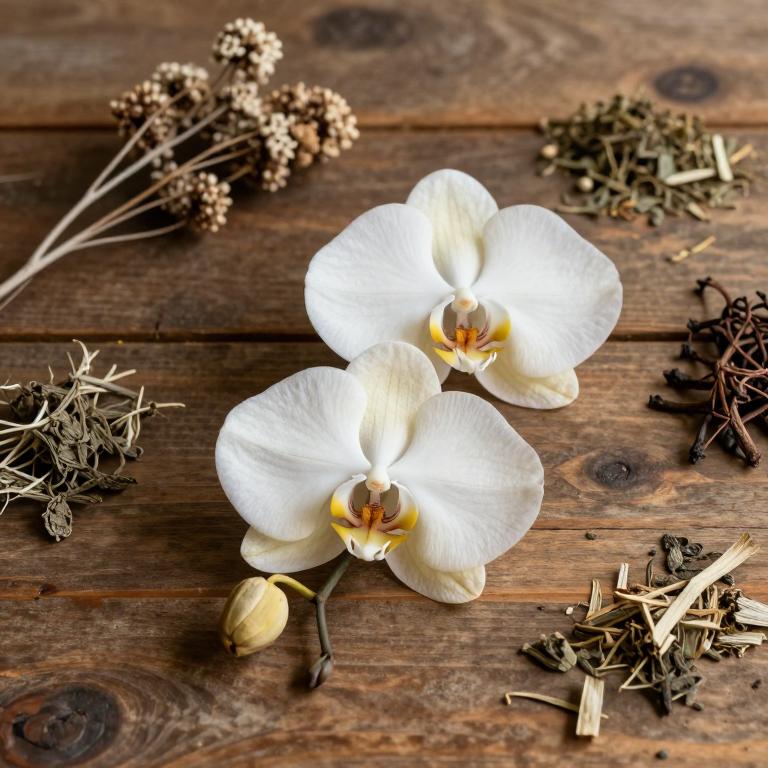
Moth orchids, scientifically known as Phalaenopsis, is a popular genus celebrated for its stunning, long-lasting blooms. While primarily ornamental, these resilient epiphytes are studied for their unique bioactive compounds. Integrating beauty with potential therapeutic properties, they remain a fascinating subject in both botanical aesthetics and traditional medicinal research.
- Family
- Orchidaceae
- Native range
- Asia-Temperate
- Parts used
- Not available
- Common names
- Moth Orchids · Phals
- Scientific synonyms
- Lesliea · Synadena · 11 more
Names and Synonyms
Common Names
- Moth orchids
- Phals
Scientific Names
Accepted name
PhalaenopsisSynonyms
- Lesliea
- Synadena
- Polychilos
- Sedirea
- Nothodoritis
- Kingidium
- Hygrochilus
- Doritis
- Stauritis
- Ornithochilus
- Polystylus
- Stauroglottis
- Grussia
Regional and Traditional Names
Spanish:
- Orquídea alevilla
- Orquídeas asiáticas mariposa
German:
- Malaienblume
French:
- Orchidée papillon
Sources: Wikidata, Catalogue of Life
Taxonomical Classification
This plant belongs to the kingdom Plantae and the phylum Streptophyta, falling under the class Equisetopsida and subclass Magnoliidae. Within the order Asparagales, it is classified under the family Orchidaceae. It is specifically identified by the genus Phalaenopsis.
| Rank | Classification |
|---|---|
| Kingdom | Plantae |
| Phylum | Streptophyta |
| Class | Equisetopsida |
| Subclass | Magnoliidae |
| Order | Asparagales |
| Family | Orchidaceae |
| Genus | Phalaenopsis |
Sources: The World Checklist of Vascular Plants (WCVP)
Distribution
This plant exhibits a diverse geographical distribution across several specific regions within China. It can be found growing in the areas of China South-Central and China North-Central. Furthermore, its habitat extends to the tropical environment of Hainan. The species is also present in the lush landscapes of China Southeast. Finally, its range reaches the high-altitude terrains of Tibet.
| Region | Area |
|---|---|
| China | China South-Central |
| China | Hainan |
| China | China North-Central |
| China | China Southeast |
| China | Tibet |
| Eastern Asia | Japan |
| Eastern Asia | Korea |
| Eastern Asia | Nansei-shoto |
| Eastern Asia | Taiwan |
| Indian Subcontinent | Assam |
Sources: The World Checklist of Vascular Plants (WCVP)
Chemicals
Phalaenopsis has 4 reported phytochemicals identified across 0 scientific publications and several other databases. The most consistently reported chemicals include IPR, TDZ, cZR, tZR.
| Chemical | Supporting sources | Consensus |
|---|---|---|
| IPR | 1 supporting sources | ★☆☆☆☆ |
| TDZ | 1 supporting sources | ★☆☆☆☆ |
| cZR | 1 supporting sources | ★☆☆☆☆ |
| tZR | 1 supporting sources | ★☆☆☆☆ |
IPR
- International journal of molecular sciences
TDZ
- International journal of molecular sciences
cZR
- International journal of molecular sciences
tZR
- International journal of molecular sciences