bitter-gourd-shaped passion fruit
Passiflora · Accepted scientific name
Scientific literature: Very Sparse (47 studies) · ★☆☆☆☆
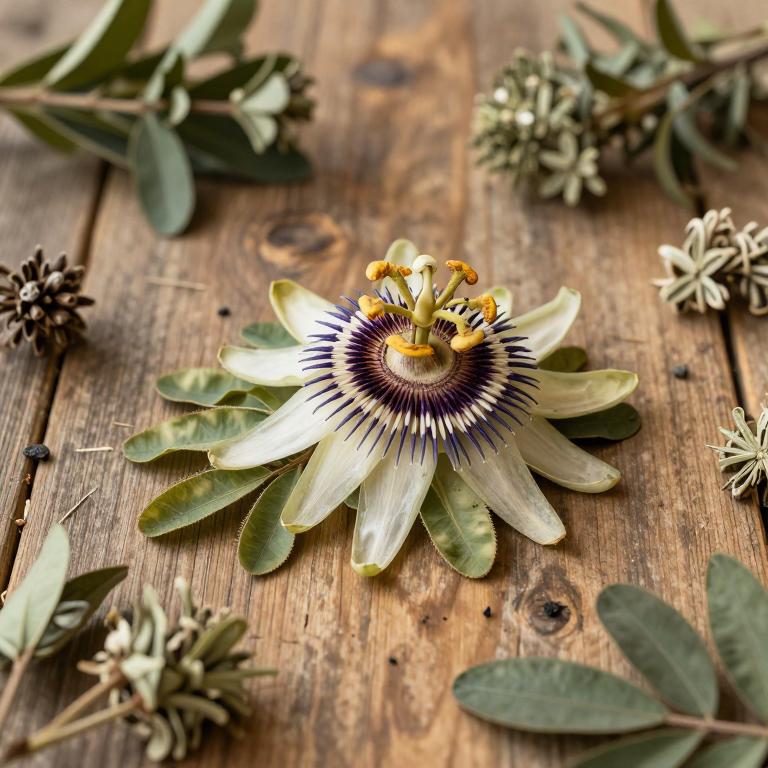
Bitter-gourd-shaped passion fruit, scientifically known as Passiflora, is a versatile climbing vine celebrated for its exotic fruit and therapeutic properties. Renowned in herbal medicine for its calming effects, it is frequently used to alleviate anxiety, promote restful sleep, and soothe the nervous system through its potent bioactive compounds.
- Family
- Passifloraceae
- Native range
- Europe
- Parts used
- Leaf
- Common names
- Passionflower · Passionflowers
- Scientific synonyms
- Decaloba · Pericodia · 29 more
Names and Synonyms
Common Names
- passionflower
- Passionflowers
Scientific Names
Accepted name
PassifloraSynonyms
- Decaloba
- Pericodia
- Senapea
- Poggendorffia
- Psilanthus
- Murucuia
- Hollrungia
- Macrophora
- Distephia
- Distephana
- Tacsonia
- Dysosmia
- Astephananthes
- Asephananthes
- Disemma
- Anthactinia
- Xerogona
- Synactila
- Peremis
- Pentaria
- Granadilla
- Rathea
- Meioperis
- Monactineirma
- Tetrastylis
- Tetrapathaea
- Tripsilina
- Cieca
- Baldwinia
- Astrophea
- Lortetia
Regional and Traditional Names
Spanish:
- Flor de la pasion
- Flor de la pasión
- Flores de la pasión
- Pasionarias
German:
- Passionsblumen
- Passionsfrüchte
- Parchita
- Grenadille
- Granadille
- Passionsblume
- Grenadilla
- Passionsblumen
French:
- passiflore
- Passiflore
- passiflores
Sources: Wikidata, Catalogue of Life
Taxonomical Classification
This plant belongs to the kingdom Plantae within the phylum Streptophyta and the class Equisetopsida. It is further classified under the subclass Magnoliidae and the order Malpighiales. Finally, it is a member of the family Passifloraceae and is identified by the genus Passiflora.
| Rank | Classification |
|---|---|
| Kingdom | Plantae |
| Phylum | Streptophyta |
| Class | Equisetopsida |
| Subclass | Magnoliidae |
| Order | Malpighiales |
| Family | Passifloraceae |
| Genus | Passiflora |
Sources: The World Checklist of Vascular Plants (WCVP)
Distribution
This plant exhibits a diverse geographical distribution across several regions of the European continent. In Northern Europe, its presence can be documented in both Great Britain and Ireland. Moving toward Middle Europe, the species is also found within the borders of Germany. The distribution extends into Southwestern Europe, where it inhabits the landscapes of Spain. Finally, its range reaches into Southeastern Europe, specifically within the country of Albania.
| Region | Area |
|---|---|
| Northern Europe | Great Britain |
| Northern Europe | Ireland |
| Middle Europe | Germany |
| Southwestern Europe | Spain |
| Southeastern Europe | Albania |
| Southeastern Europe | Italy |
| Southeastern Europe | Sicilia |
| Northern Africa | Morocco |
| Macaronesia | Azores |
| Macaronesia | Canary Is. |
Sources: The World Checklist of Vascular Plants (WCVP)
Plant Parts
Passiflora has 1 reported plant parts identified across 3 scientific publications and several other databases that are studied for medicinal purposes. The most consistently reported plant part include leaf.
| Plant part | Supporting sources | Consensus |
|---|---|---|
| Leaf | 3 supporting sources | ★★☆☆☆ |
Leaf
- Medical hypotheses
- Molecules (Basel, Switzerland)
- Phytochemical analysis : PCA
Chemicals
Passiflora has 8 reported phytochemicals identified across 3 scientific publications and several other databases. The most consistently reported chemicals include Isoorientin, Isovitexin, Orientin, Schaftoside, HARMINE.
| Chemical | Supporting sources | Consensus |
|---|---|---|
| Isoorientin | 3 supporting sources | ★★☆☆☆ |
| Isovitexin | 2 supporting sources | ★☆☆☆☆ |
| Orientin | 2 supporting sources | ★☆☆☆☆ |
| Schaftoside | 2 supporting sources | ★☆☆☆☆ |
| HARMINE | 1 supporting sources | ★☆☆☆☆ |
| Saponarin | 1 supporting sources | ★☆☆☆☆ |
| Vitexin | 1 supporting sources | ★☆☆☆☆ |
| luteolin | 1 supporting sources | ★☆☆☆☆ |
Isoorientin
- Analytical and bioanalytical chemistry
- Journal of molecular structure
- Phytochemical analysis : PCA
Isovitexin
- Analytical and bioanalytical chemistry
- Phytochemical analysis : PCA
Orientin
- Natural product research
- Phytochemical analysis : PCA
Schaftoside
- Analytical and bioanalytical chemistry
- Journal of molecular structure
HARMINE
- Medical hypotheses
Saponarin
- Journal of molecular structure
Vitexin
- Phytochemical analysis : PCA
luteolin
- Journal of molecular structure
Activities
Passiflora has 11 reported activities identified across 3 scientific publications and several other databases. The most consistently reported activities include Antibacterial, Antidiabetic, Antifungal, Antiallergic, Anticancer.
| Activity | Supporting sources | Consensus |
|---|---|---|
| Antibacterial | 2 supporting sources | ★☆☆☆☆ |
| Antidiabetic | 2 supporting sources | ★☆☆☆☆ |
| Antifungal | 2 supporting sources | ★☆☆☆☆ |
| Antiallergic | 1 supporting sources | ★☆☆☆☆ |
| Anticancer | 1 supporting sources | ★☆☆☆☆ |
| Antioxidant | 1 supporting sources | ★☆☆☆☆ |
| Antipyretic | 1 supporting sources | ★☆☆☆☆ |
| Cardioprotective | 1 supporting sources | ★☆☆☆☆ |
| Hepatoprotective | 1 supporting sources | ★☆☆☆☆ |
| Nephroprotective | 1 supporting sources | ★☆☆☆☆ |
Antibacterial
- Antimicrobial agents and chemotherapy
- Plants (Basel, Switzerland)
Antidiabetic
- Plants (Basel, Switzerland)
- Complementary therapies in medicine
Antifungal
- Antimicrobial agents and chemotherapy
- Plants (Basel, Switzerland)
Antiallergic
- Natural product research
Anticancer
- Natural product research
Antioxidant
- Natural product research
Antipyretic
- Plants (Basel, Switzerland)
Cardioprotective
- Natural product research
Hepatoprotective
- Plants (Basel, Switzerland)
Nephroprotective
- Plants (Basel, Switzerland)
Conditions
Passiflora has 13 reported investigations on conditions identified across 3 scientific publications and several other databases. The most consistently reported conditions include COVID-19, actinomycete, bacteria, depression, fever.
| Condition | Supporting sources | Consensus |
|---|---|---|
| Covid-19 | 1 supporting sources | ★☆☆☆☆ |
| Actinomycete | 1 supporting sources | ★☆☆☆☆ |
| Bacteria | 1 supporting sources | ★☆☆☆☆ |
| Depression | 1 supporting sources | ★☆☆☆☆ |
| Fever | 1 supporting sources | ★☆☆☆☆ |
| Fungi | 1 supporting sources | ★☆☆☆☆ |
| Hysteria | 1 supporting sources | ★☆☆☆☆ |
| Inflammation | 1 supporting sources | ★☆☆☆☆ |
| Insomnia | 1 supporting sources | ★☆☆☆☆ |
| Presbyopia | 1 supporting sources | ★☆☆☆☆ |
Covid-19
- Journal of molecular structure
Actinomycete
- Antimicrobial agents and chemotherapy
Bacteria
- Plants (Basel, Switzerland)
Depression
- Plants (Basel, Switzerland)
Fever
- Plants (Basel, Switzerland)
Fungi
- Plants (Basel, Switzerland)
Hysteria
- Medical science monitor : international medical journal of experimental and clinical research
Inflammation
- Plants (Basel, Switzerland)
Insomnia
- Medical science monitor : international medical journal of experimental and clinical research
Presbyopia
- Medical hypotheses
Preparations
Passiflora has 5 reported preparations identified across 3 scientific publications and several other databases. The most consistently reported preparations include Gentle bathing of the cut rinds of Passiflora in water in the presence of air and ethylene, extracts, flowers, leaves, peels.
| Preparation | Supporting sources | Consensus |
|---|---|---|
| Gentle bathing of the cut rinds of passiflora in water in the presence of air and ethylene | 1 supporting sources | ★☆☆☆☆ |
| Extracts | 1 supporting sources | ★☆☆☆☆ |
| Flowers | 1 supporting sources | ★☆☆☆☆ |
| Leaves | 1 supporting sources | ★☆☆☆☆ |
| Peels | 1 supporting sources | ★☆☆☆☆ |
Gentle bathing of the cut rinds of passiflora in water in the presence of air and ethylene
- Antimicrobial agents and chemotherapy
Extracts
- Die Pharmazie
Flowers
- The Journal of nutritional biochemistry
Leaves
- The Journal of nutritional biochemistry
Peels
- The Journal of nutritional biochemistry