Corkystem Passionflower
Passiflora suberosa · Accepted scientific name
Scientific literature: Very Sparse (13 studies) · ★☆☆☆☆
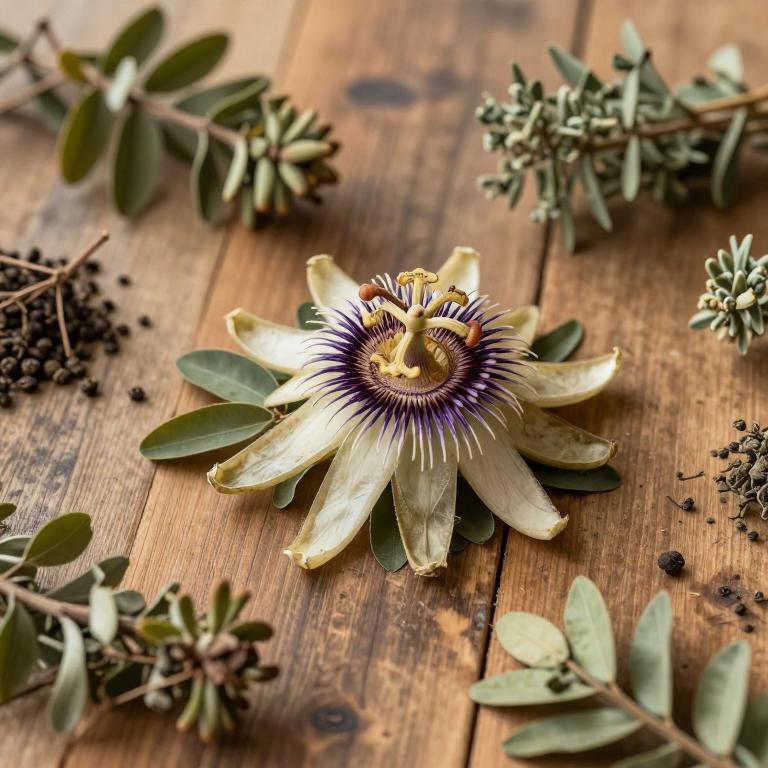
Corkystem Passionflower, scientifically known as Passiflora suberosa, is a woody climbing vine native to South America. Renowned for its distinctive cork-like stems and intricate blooms, this medicinal plant is traditionally utilized in herbal medicine for its calming, sedative, and anti-anxiety properties, offering a natural approach to managing stress.
Names and Synonyms
Common Names
- Corkystem Passionflower
- cork passionflower
- cork passionvine
- devil's-pumpkin
- indigo-berry
- small passionflower
- small passionfruit
- Devil's Pumpkin
- Indigo Berry
- corky passionfruit
- triangular passionflower
Scientific Names
Accepted name
Passiflora suberosaSynonyms
- Meioperis suberosa
- Granadilla suberosa
- Monactineirma suberosa
- Cieca suberosa
Regional and Traditional Names
Spanish:
- Granadilla roja
- granadita de ratón
French:
- Grain d'encre
Sources: Wikidata, Catalogue of Life
Taxonomical Classification
This plant belongs to the kingdom Plantae and the phylum Streptophyta, falling under the class Equisetopsida and subclass Magnoliidae. It is classified within the order Malpighiales and the family Passifloraceae. Finally, its specific taxonomic identity is found within the genus Passiflora.
| Rank | Classification |
|---|---|
| Kingdom | Plantae |
| Phylum | Streptophyta |
| Class | Equisetopsida |
| Subclass | Magnoliidae |
| Order | Malpighiales |
| Family | Passifloraceae |
| Genus | Passiflora |
Sources: The World Checklist of Vascular Plants (WCVP)
Distribution
This plant exhibits a wide-ranging geographical distribution that spans multiple continents and diverse climates. In the Atlantic, it can be found within the Macaronesia region, specifically on the Canary Islands. Its presence extends across East Tropical Africa, where it is documented in Kenya, Tanzania, and Uganda. Moving further south, the species is also located in the KwaZulu-Natal province of Southern Africa. Consequently, this medicinal plant occupies a vast ecological range from island habitats to the African mainland.
| Region | Area |
|---|---|
| Macaronesia | Canary Is. |
| East Tropical Africa | Kenya |
| East Tropical Africa | Tanzania |
| East Tropical Africa | Uganda |
| Southern Africa | KwaZulu-Natal |
| Middle Atlantic Ocean | Ascension |
| Western Indian Ocean | Comoros |
| Western Indian Ocean | Mauritius |
| Western Indian Ocean | Réunion |
| Western Indian Ocean | Rodrigues |
Sources: The World Checklist of Vascular Plants (WCVP)
Botanical Identification
Ecology
The ecology of Passiflora suberosa is characterized by its remarkable adaptability to diverse environmental conditions and a wide altitudinal distribution. This species can be found across a broad elevational gradient, ranging from sea level (0 m AMSL) up to a maximum altitude of 2500 m AMSL. Its habitat preferences are highly varied, allowing it to thrive in several distinct ecosystems, including Caatinga (strictu sensu), Campo Rupestre, and Restinga. Furthermore, it inhabits various forest types, such as Floresta Ombrófila (Pluvial), Floresta Estacional Decidual, Floresta Estacional Semi-decidual, and Floresta Ciliar or Galeria. In addition to these natural biomes, the plant also demonstrates its ecological plasticity by colonizing Áreas Antrópicas, showing resilience in human-modified landscapes.
- Elevational range max:
- 2500 m AMSL
- Elevational range min:
- 0 m AMSL
- Habitat :
- Área Antrópica, Caatinga (stricto sensu), Campo Rupestre, Floresta Ciliar ou Galeria, Floresta Estacional Decidual, Floresta Estacional Semidecidual, Floresta Ombrófila (= Floresta Pluvial), Restinga
Genetics
The genetics of Passiflora suberosa are characterized by a complex karyotype that exhibits significant variation in ploidy levels. The species displays multiple chromosome numbers, specifically recorded as 12, 18, 24, and 36. This variation suggests a high degree of chromosomal plasticity and polyploidization within the lineage, where different cytotypes may coexist or arise through genome doubling events. Such genomic diversity is a defining genetic feature of this plant, contributing to its evolutionary adaptability and complex inheritance patterns.
- Chromosome number :
- 12, 18, 24, 36
Life history
The life history of Passiflora suberosa is characterized by its status as a perennial organism, allowing it to persist in its environment through multiple growing seasons. As a perennial species, it does not complete its life cycle in a single year or two but instead establishes a long-term presence, often developing extensive climbing structures to navigate its habitat. Its developmental trajectory involves a continuous cycle of vegetative growth, flowering, and seed production, which enables the plant to sustain itself and colonize surrounding areas over an extended lifespan. This enduring lifecycle supports its ability to withstand seasonal fluctuations and contribute to the stability of its ecological niche through repeated reproductive efforts.
- Lifecycle :
- perennial
Morphology
The morphology of Passiflora suberosa is characterized by its growth form as a non-woody herb and forb, specifically functioning as an obligatory climbing vine. This scandent plant typically exhibits a terrestrial life habit, operating as an independent organism rather than a parasite or an epiphyte. In terms of its vertical dimension, the plant displays a significant growth range, with a minimum height of 1 m, a mean height of approximately 5 m, and a maximum height reaching up to 6 m.
- Aquatic :
- terrestrial
- Climber :
- vine
- Climber :
- obligatory
- Epiphyte :
- terrestrial
- Growth form :
- herb
- Growth form :
- forb
- Parasite :
- independent
- Plant height max:
- 6 m
- Plant height mean:
- 5 m
- Plant height min:
- 1 m
- Shoot orientation :
- scandent
- Woodiness :
- non-woody
Physiology
The physiology of Passiflora suberosa is characterized by a C3 photosynthetic pathway, which governs its carbon fixation processes and energy production. The plant's vegetative structure features lobed leaves that vary significantly in size, with leaf lengths ranging from a minimum of 2.8 cm to a maximum of 10.7 cm. Correspondingly, the leaf width fluctuates between a minimum of 1.4 cm and a maximum of 6 cm. In terms of nutrient cycling, this species does not function as a nitrogen fixer, relying instead on the availability of nitrogen within the soil substrate to support its metabolic requirements and growth.
- Leaf form :
- lobed
- Leaf length max:
- 10.7 cm
- Leaf length min:
- 2.8 cm
- Leaf width max:
- 6 cm
- Leaf width min:
- 1.4 cm
- Nitrogen fixer :
- no
- Photosynthetic pathway :
- C3
Reproduction
The reproductive cycle of Passiflora suberosa begins with the emergence of green flowers, which typically measure between 1.5 cm and 2.5 cm in width. The flowering period is concentrated in the mid-year months, specifically starting in April and concluding in June. Following successful pollination, the plant produces fleshy, indehiscent fruit categorized as a berry. These berries are characterized by a black coloration and reach a width ranging from 1 cm to 1.2 cm. Within these fruits, the seeds possess a consistent volume of approximately 10 mm³. The dispersal of the species is primarily zoochorous, specifically utilizing an endozoochorous syndrome, where animals consume the fleshy fruit and disperse the seeds through their digestive tracts.
- Dehiscence :
- indehiscent
- Dispersal syndrome :
- zoochorous
- Dispersal syndrome :
- endozoochorous
- Flower colour :
- green
- Flower width max:
- 2.5 cm
- Flower width min:
- 1.5 cm
- Flowering time :
- Apr
- Flowering time :
- Jun
- Fruit colour :
- black
- Fruit dryness :
- fleshy
- Fruit type :
- berry
- Fruit width max:
- 1.2 cm
- Fruit width min:
- 1 cm
- Seed volume max:
- 10 mm³
Sources: Global Inventory of Floras and Traits (GIFT)
Chemicals
Passiflora suberosa has 7 reported phytochemicals identified across 0 scientific publications and several other databases. The most consistently reported chemicals include Anthraquinones, Flavonoids, Passiflorine, Proanthocyanidins, Saponins.
| Chemical | Supporting sources | Consensus |
|---|---|---|
| Anthraquinones | 1 supporting sources | ★☆☆☆☆ |
| Flavonoids | 1 supporting sources | ★☆☆☆☆ |
| Passiflorine | 1 supporting sources | ★☆☆☆☆ |
| Proanthocyanidins | 1 supporting sources | ★☆☆☆☆ |
| Saponins | 1 supporting sources | ★☆☆☆☆ |
| Tannins | 1 supporting sources | ★☆☆☆☆ |
| Triterpenes | 1 supporting sources | ★☆☆☆☆ |
Anthraquinones
- PeerJ
Flavonoids
- PeerJ
Passiflorine
- Dr. Duke
Proanthocyanidins
- PeerJ
Saponins
- PeerJ
Tannins
- PeerJ
Triterpenes
- PeerJ
Activities
Passiflora suberosa has 4 reported activities identified across 0 scientific publications and several other databases. The most consistently reported activities include Antibacterial, Antimicrobial, Antioxidant, Toxic.
| Activity | Supporting sources | Consensus |
|---|---|---|
| Antibacterial | 1 supporting sources | ★☆☆☆☆ |
| Antimicrobial | 1 supporting sources | ★☆☆☆☆ |
| Antioxidant | 1 supporting sources | ★☆☆☆☆ |
| Toxic | 1 supporting sources | ★☆☆☆☆ |
Antibacterial
- PeerJ
Antimicrobial
- PeerJ
Antioxidant
- PeerJ
Toxic
- PeerJ
Conditions
Passiflora suberosa has 2 reported investigations on conditions identified across 0 scientific publications and several other databases. The most consistently reported conditions include hypertension, skin diseases.
| Condition | Supporting sources | Consensus |
|---|---|---|
| Hypertension | 1 supporting sources | ★☆☆☆☆ |
| Skin diseases | 1 supporting sources | ★☆☆☆☆ |
Hypertension
- PeerJ
Skin diseases
- PeerJ