bell-apple
Passiflora nitida · Accepted scientific name
Scientific literature: Very Sparse (2 studies) · ★☆☆☆☆
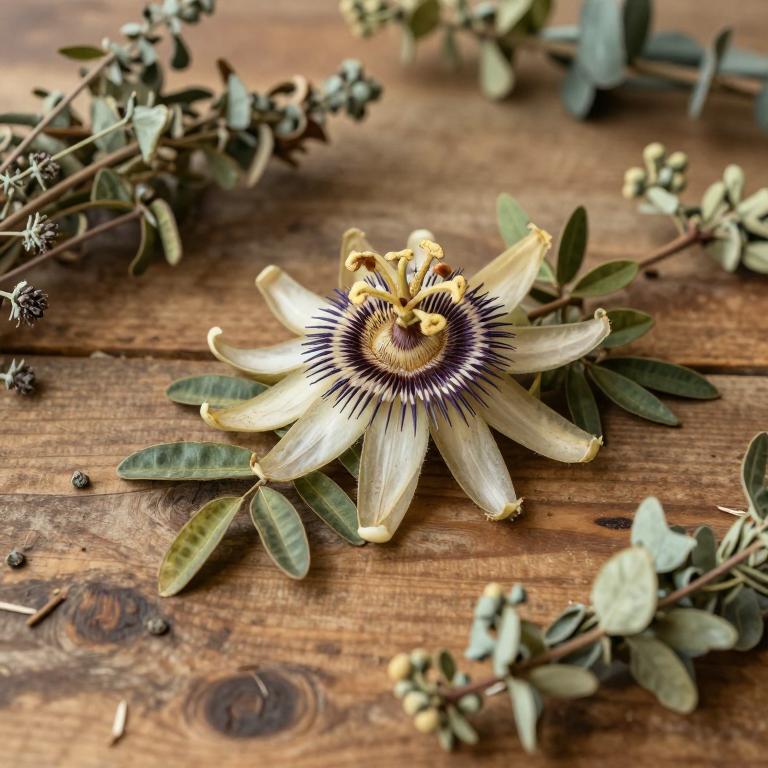
Bell-apple, scientifically known as Passiflora nitida, is a captivating tropical climber celebrated for its striking, exotic blooms. Beyond its ornamental beauty, this passionflower species holds significant medicinal potential. Renowned for its calming properties, it is traditionally utilized to alleviate anxiety, promote restful sleep, and support overall neurological wellness.
- Family
- Passifloraceae
- Native range
- Southern America
- Parts used
- Not available
- Common names
- Bell-Apple · Bell Apple
- Scientific synonyms
- Passiflora Nymphaeoides
Names and Synonyms
Common Names
- bell-apple
- bell apple
Scientific Names
Accepted name
Passiflora nitidaSynonyms
- Passiflora nymphaeoides
Regional and Traditional Names
Spanish:
- semito
- Granadilla de olor
French:
- khouzou
Sources: Wikidata, Catalogue of Life
Taxonomical Classification
This plant belongs to the kingdom Plantae within the phylum Streptophyta and is classified under the class Equisetopsida. Following the subclass Magnoliidae, it is organized under the order Malpighiales and the family Passifloraceae. Finally, Passiflora nitida is situated within the genus Passiflora.
| Rank | Classification |
|---|---|
| Kingdom | Plantae |
| Phylum | Streptophyta |
| Class | Equisetopsida |
| Subclass | Magnoliidae |
| Order | Malpighiales |
| Family | Passifloraceae |
| Genus | Passiflora |
Sources: The World Checklist of Vascular Plants (WCVP)
Distribution
This plant exhibits a specific geographical range that spans across parts of Central and South America. In Central America, its presence is documented within the countries of Costa Rica and Panamá. Moving into Northern South America, the species can be found throughout the territory of French Guiana. It is also distributed across the nation of Guyana. Finally, its habitat extends to include the region of Suriname.
| Region | Area |
|---|---|
| Central America | Costa Rica |
| Central America | Panamá |
| Northern South America | French Guiana |
| Northern South America | Guyana |
| Northern South America | Suriname |
| Northern South America | Venezuela |
| Western South America | Bolivia |
| Western South America | Colombia |
| Western South America | Peru |
| Brazil | Brazil West-Central |
Sources: The World Checklist of Vascular Plants (WCVP)
Botanical Identification
Ecology
The ecology of Passiflora nitida is characterized by a versatile distribution across diverse landscape types, including Anthropic Areas, Cerrado (latu sensu), Terra Firme Forests, and Ombrophilous (Rainforest) environments. This species demonstrates significant adaptability to various ecosystems, ranging from open scrublands to dense, humid tropical forests. Its vertical distribution is found within an elevational range spanning from sea level (0 m AMSL) up to a maximum altitude of 1000 m AMSL, allowing it to occupy both lowland and montane ecological niches.
- Elevational range max:
- 1000 m AMSL
- Elevational range min:
- 0 m AMSL
- Habitat :
- Área Antrópica, Cerrado (lato sensu), Floresta de Terra Firme, Floresta Ombrófila (= Floresta Pluvial)
Life history
The life history of Passiflora nitida is characterized by its status as a perennial organism, allowing it to persist in its environment through multiple growing seasons. As a perennial climber, it establishes a robust root system that supports continuous vegetative growth and the development of its intricate climbing structures. Throughout its lifecycle, the plant undergoes seasonal cycles of foliage production and flowering, often utilizing tendrils to anchor itself to surrounding vegetation to reach sunlight. The longevity inherent in its perennial nature enables it to invest significant energy into complex reproductive structures, eventually producing specialized flowers and fruit that facilitate seed dispersal, ensuring the continuation of the species across successive years.
- Lifecycle :
- perennial
Morphology
The morphology of Passiflora nitida is characterized by its growth habit as a woody liana, functioning as an obligatory climber that relies on external structures for support. While it possesses woody characteristics, its growth form is categorized within the broader spectrum of climbing vegetation rather than as a tree, shrub, or herb. The plant is primarily terrestrial in its habitat, avoiding aquatic or semiaquatic environments, and it exists as an independent organism without any parasitic relationship to its host. Furthermore, it is strictly terrestrial in its epiphytic status, meaning it does not function as a holoepiphyte, hemiepiphyte, or any other form of epiphyte, but instead establishes itself firmly in the soil.
- Aquatic :
- terrestrial
- Climber :
- liana
- Climber :
- obligatory
- Epiphyte :
- terrestrial
- Growth form :
- tree
- Parasite :
- independent
- Woodiness :
- woody
Physiology
The physiology of Passiflora nitida is characterized by its specialized metabolic processes adapted for climbing through dense tropical environments, utilizing tendrils to navigate structural supports. Its photosynthetic mechanism relies on the efficient conversion of light energy into chemical energy, supporting the rapid vegetative growth typical of the Passifloraceae family. Regarding its nutrient acquisition and symbiotic relationships, the plant does not engage in biological nitrogen fixation; it lacks the specific root nodules or symbiotic associations with diazotrophic bacteria required to convert atmospheric nitrogen into ammonia, meaning it relies entirely on the uptake of nitrates and ammonium present in the soil substrate. Consequently, its nitrogen-fixing status is classified as no. This dependence on soil-available nitrogen dictates its physiological requirement for nutrient-rich environments to sustain its complex flowering and fruiting cycles.
- Nitrogen fixer :
- no
Sources: Global Inventory of Floras and Traits (GIFT)
Activities
Passiflora nitida has 1 reported activities identified across 0 scientific publications and several other databases. The most consistently reported activities include Free-Radical Scavenging.
| Activity | Supporting sources | Consensus |
|---|---|---|
| Free-Radical Scavenging | 1 supporting sources | ★☆☆☆☆ |
Free-Radical Scavenging
- BMC complementary and alternative medicine
Conditions
Passiflora nitida has 1 reported investigations on conditions identified across 0 scientific publications and several other databases. The most consistently reported conditions include inflammation.
| Condition | Supporting sources | Consensus |
|---|---|---|
| Inflammation | 1 supporting sources | ★☆☆☆☆ |
Inflammation
- BMC complementary and alternative medicine
Preparations
Passiflora nitida has 1 reported preparations identified across 0 scientific publications and several other databases. The most consistently reported preparations include ethanol extracts.
| Preparation | Supporting sources | Consensus |
|---|---|---|
| Ethanol extracts | 1 supporting sources | ★☆☆☆☆ |
Ethanol extracts
- BMC complementary and alternative medicine